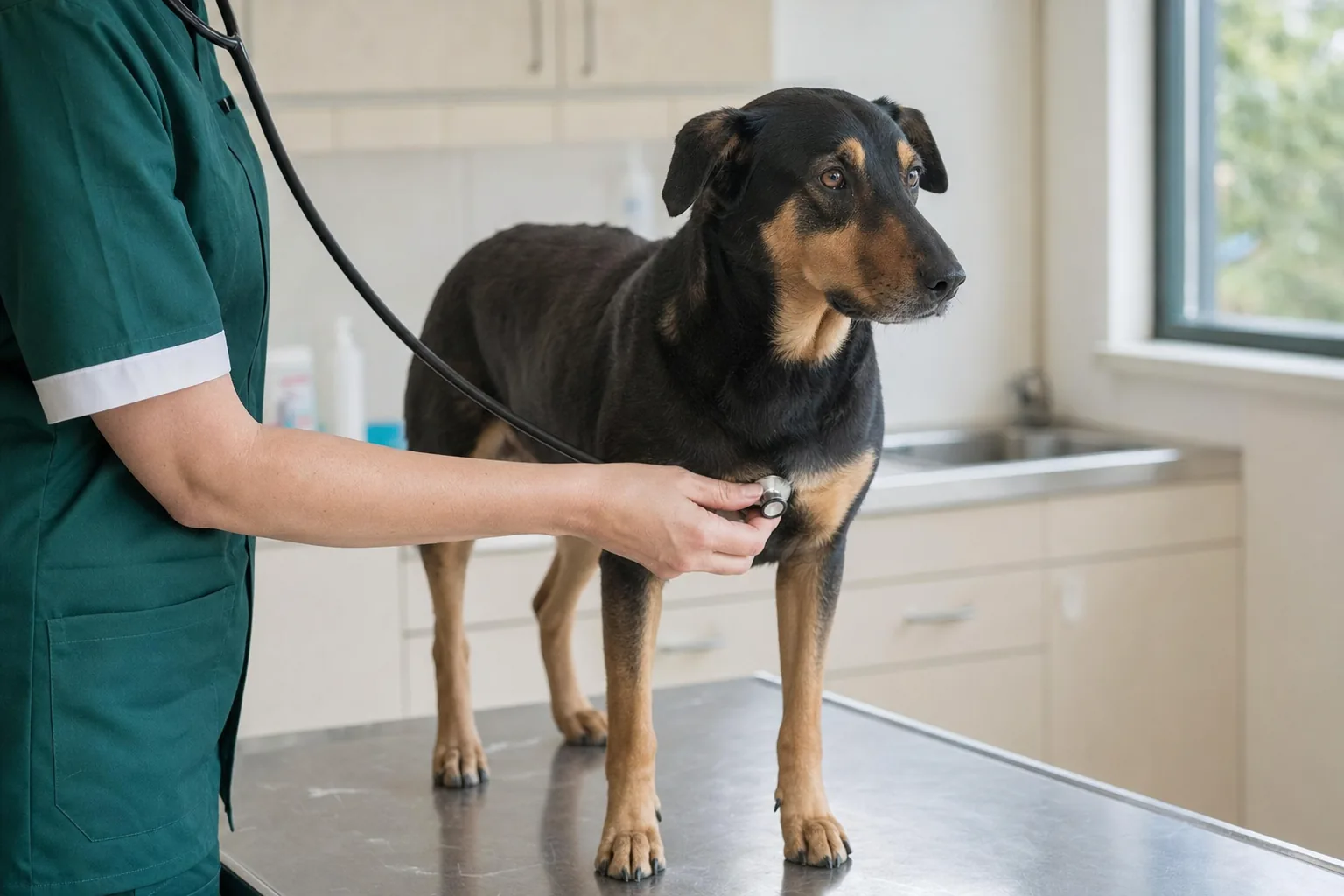
Caution. A dog who will not put the leg down, yelps when you touch his hip or elbow, cannot get up on his own, or a large-breed puppy who has been lame for several days: call your own vet the same day. A wobbly gait with dragging toes is an emergency.
Noticed something different about your dog? Go straight to their vet.
Do not look for the answer in a Facebook group, on TikTok or on a forum. Look for someone trained for this: your dog's own veterinarian, the only person who can examine, investigate and treat them.
- The same sign, dozens of causes. A dog that vomits may have eaten grass or may have an object stuck in the gut. From two lines you typed, nobody can tell which. The vet feels the abdomen, takes the temperature, runs tests.
- Nobody on the internet sees your dog. They see a photo and a story. A diagnosis comes from an examination and investigations, not from a resemblance to someone else's dog.
- In groups you hear from the people whose dog "got better on its own". Those for whom it ended badly rarely post again. What you read there is a selection, not a statistic.
- Doses are calculated by weight and species. Human medicines that look harmless, paracetamol or ibuprofen, are toxic to dogs. "I gave mine half a tablet" is the most dangerous advice you can get.
- Hours matter. With a twisted stomach, a poisoning or a urinary blockage, the time spent asking online is exactly the time that decides the outcome.
- The vet is accountable for what they say. They have your dog's record, history, vaccinations, past treatments. An anonymous account has none of that and answers for nothing.
Use this page to know what to observe, what to note and what to ask at the appointment, not to treat at home. If you still have doubts after a consultation, ask another vet or a specialist (dermatologist, internist) for a second opinion, not a group. And if you do not have a regular vet yet, find one now, while your dog is healthy: how to choose a veterinary clinic.
Your seven-month-old German Shepherd chases the ball with his back legs tucked together, hopping like a rabbit. Or your year-old Labrador is slow to get up after a nap, sits with one leg sticking out to the side and has stopped jumping into the car. Or someone in the park has told you your adult dog "has bad hips, you can see it in the way he walks". Hip and elbow dysplasia are the most common inherited orthopaedic conditions in large dogs. They do not go away on their own. Even so, a dysplastic dog can have a long, active life if you catch it early and work with your own vet. This page covers the signs to watch for, what to write down and what happens at the surgery.
When should you ring the vet today?
Dysplasia develops slowly, over months and years. A few situations still need a call the same day:
- he will not put the leg down at all, or yelps when you touch his hip or elbow;
- he cannot get up on his own, or his back legs suddenly give way;
- a large-breed puppy has been lame for more than two or three days, however cheerful he seems otherwise;
- the lameness comes with a temperature, a hot swollen joint, or he has gone off his food;
- weak back legs, a drunken wobble, toes scuffing along the ground, leaking urine. That looks more like a spinal problem and is an emergency.
One more thing. In a dog already known to be dysplastic, pain that appears out of nowhere can have another cause: a torn ligament, a sprain, the spine. Do not blame the hips by reflex.
What can you watch for at home?
The vet makes the diagnosis from X-rays. You, though, see him every day on the tiles, on the stairs and at play, and what you notice matters at the appointment.
Hips
- runs with both back legs together, "bunny hopping";
- is slow to get up, especially in the morning or after a busy day;
- sits crookedly with one leg out to the side instead of tucked under;
- hesitates at the stairs, at jumping into the car or onto the sofa;
- sways his hips as he walks, with short steps behind;
- has thin thighs, while his shoulders look much stronger than his back end;
- gives up on play sooner than other dogs his age.
Elbows
- limps on a front leg, usually between 5 and 12 months, worse after rest or a long walk;
- holds the elbow slightly out with the paw turned;
- does not like you stretching that front leg;
- sometimes the limp moves from one front leg to the other, because both elbows are affected.
Get your phone out and film him. From behind as he walks away from you, from the side at a trot, and as he gets up after a sleep. A minute of video tells your vet more than any description you could give.
What else to write down
| What to note |
Why |
| Breed, parents, and whether they had hip/elbow scores |
Dysplasia is inherited |
| His weight, once a month |
Extra kilos speed up arthritis |
| When it is worst: mornings, after play, in the cold |
It shows how much is inflammation and how much is tiredness |
| What he loves doing and what he has started to avoid |
Pain shows in what he gives up |
| What floors he lives and runs on |
Tiles and slippery wooden floors load the joints |
If your puppy came from a breeder, ask whether the parents were officially X-rayed and what their results were. Good results in the parents guarantee nothing, but they shorten the odds.
What will the vet check?
- History. Age, breed, when you first noticed, how things are now, your videos.
- Orthopaedic exam. The vet watches him walk and trot, then feels each joint, checks how far it bends and straightens, looks for the sore spot and compares the muscles left and right.
- Laxity tests. In puppies the vet may check how loosely the hip sits in its socket. This is usually done under sedation, because an awake dog tenses his muscles and hides the looseness.
- X-rays. Hips and elbows are X-rayed in precise positions, nearly always under sedation or anaesthetic, otherwise the pictures are not accurate. They show the shape of the joint, how well the head of the thigh bone sits in the socket and whether arthritis has started, meaning wear of the cartilage with new bone growing round the edges.
- Further tests for elbows. Sometimes a CT scan or arthroscopy (a small camera put into the joint) is needed, because some elbow lesions do not show up well on X-rays.
- Official scores. Breeding dogs can have X-rays officially graded: for hips, A (normal) to E (severe dysplasia) under FCI rules, from at least a year old; for elbows, grades 0 to 3. If you want to breed from your dog, ask about them.
- The plan. It depends on his age, how bad it is and how much it hurts:
- keeping his weight down, the most powerful thing you can do at home; lean dogs get arthritis later and more mildly;
- controlled exercise: regular on-lead walks on soft ground instead of long runs and jumping;
- physiotherapy and hydrotherapy (underwater treadmill, swimming), to build the muscles that hold the joint;
- pain relief, chosen by the vet, in courses or long term;
- surgery, for some dogs. In very young puppies there are procedures that change how the pelvis grows, in young dogs without arthritis procedures that reorient the pelvis, and in adults in a lot of pain a total hip replacement or removal of the head of the thigh bone. For elbows, arthroscopy takes out the bone fragments. What suits your dog is for a vet with orthopaedic experience to decide, often after a second opinion.
Ask what he can still do, too: which sports, what sort of walks. Plenty of owners stop everything out of fear, and the dog loses exactly the muscle that keeps him on his feet.
What should you not do at home?
- Never give him human painkillers. Many are toxic to dogs and cause ulcers or kidney damage even in small amounts. Pain relief is the vet's call.
- Do not shut him away for months "to rest". Without exercise the muscle melts away and the joint loses its support. Regular gentle exercise is part of the treatment.
- Do not let him get fat. Every extra kilo presses on joints that are already working at the wrong angle. In a dysplastic dog you should feel his ribs easily under your palm.
- No running beside the bike and no repeated jumping for frisbees or balls thrown a long way, especially while he is a puppy. Sprinting, slamming on the brakes and landing are the hardest moments for hips and elbows.
- Do not leave bare tiles on his routes round the house. A puppy who slips dozens of times a day is loading his joints at exactly the age they are forming. Put rugs down.
- Do not buy "joint" supplements at random instead of seeing the vet. Some have weak evidence behind them; if you want to try one, ask your vet which and when.
- Do not breed from a dysplastic dog. It is inherited and turns up in the puppies even when the parent "isn't lame".
Exercise that does him good
Long walks at a steady pace on grass or earth, gentle slopes, swimming and nose games are kind to the joints. In our mantrailing sessions we see dogs with operated or well-managed dysplasia working a trail with real enthusiasm. They go at their own pace with their nose down, no sprints and no jumps, and at the end their head is tired while their hips have barely noticed. Before taking up a new sport, ask your vet what pace and how long suit him.
With puppies, the best prevention is in how they grow. Keep him lean, feed a large-breed food in the right amount with no added calcium on top of a complete diet, and let him move freely on varied ground rather than taking him on long forced walks. Inherited dysplasia cannot be prevented completely, but it can end up a lot milder.
Frequently asked questions
What dog owners search for most often on the internet about this problem, with the short answer. The answers are a guide only: the decision belongs to your dog's own vet, after an examination.
How can I tell if my dog has hip dysplasia?
He runs with both back legs together like a rabbit, is slow to get up in the morning, sits with one leg out to the side, hesitates at stairs and at jumping into the car, and sways his hips. His thighs look thin next to his shoulders. Signs can start at a few months old, but only X-rays under sedation confirm it.
At what age does hip dysplasia show?
The first signs often appear between 4 and 12 months, while the dog is growing and the hip sits loosely in its socket. Some dogs show nothing for years and only go lame as adults, once arthritis sets in. The official breeding score is done from at least a year old, under FCI rules.
What is elbow dysplasia in dogs?
The bones of the elbow develop wrongly, with fragments of bone or cartilage that do not fuse properly. It shows up mostly in large breeds between 5 and 12 months, as lameness on a front leg that is worse after rest. It shows on X-rays, sometimes only on CT or arthroscopy, and is often treated by arthroscopic surgery.
Can a dog with dysplasia still exercise?
Yes, and he needs to, because strong muscles hold the joint together. Regular walks at a steady pace on soft ground, swimming, gentle slopes and nose games all suit him. Avoid sprints with sudden stops, leaping for balls and running beside a bike. Agree the pace and length of exercise with your own vet.
Can hip dysplasia in dogs be prevented?
Not completely, because it is inherited. You lower the risk by choosing a puppy from parents with good official scores, keeping him lean while he grows on a large-breed food in the right amount with no added calcium, and avoiding slippery floors and forced exercise. In a dog already affected, staying light delays arthritis.
The information on this page is educational and does not replace an examination. For full details and a diagnosis, consult your dog's own veterinarian.