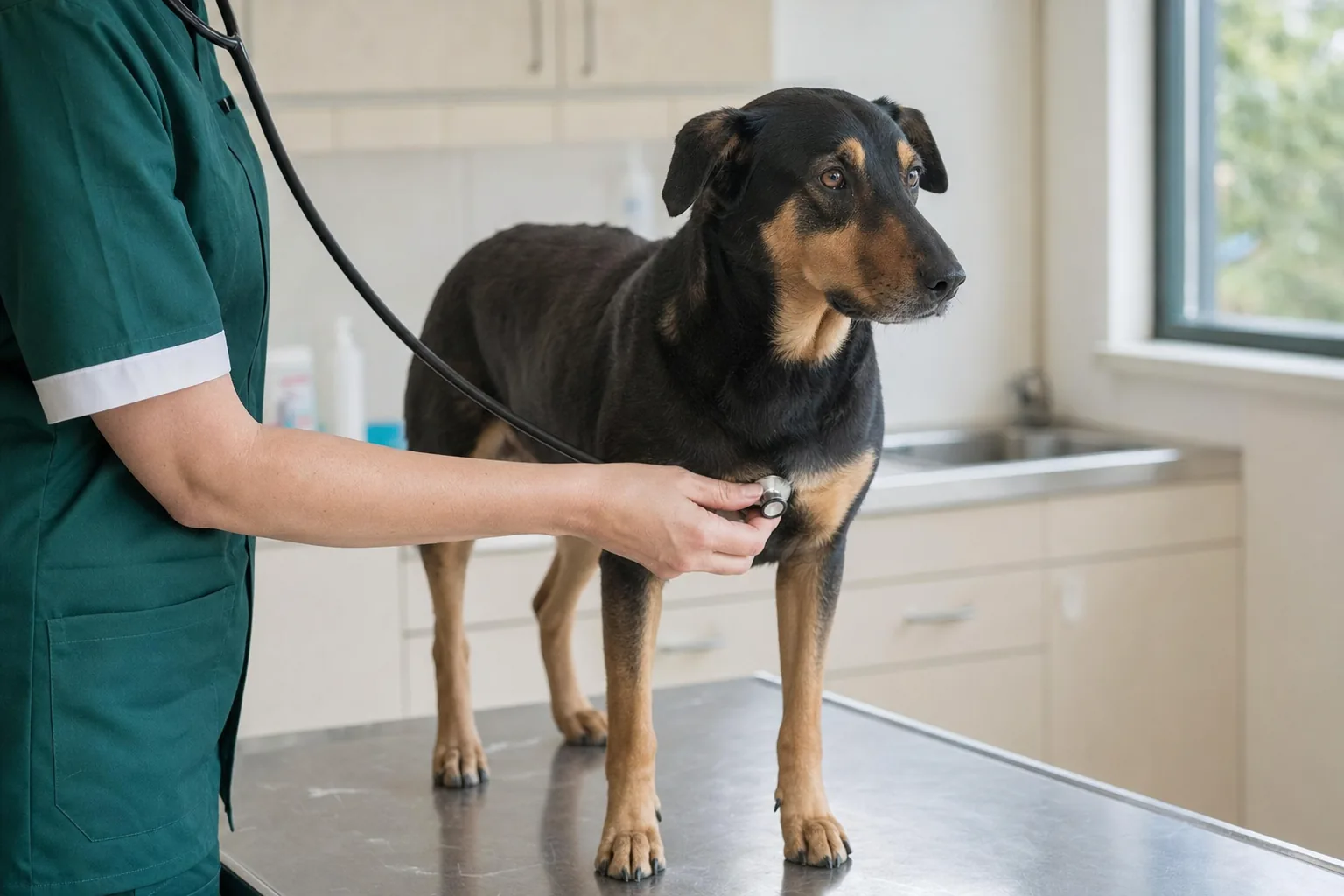
An eight-year-old Labrador gets out of his bed in the morning in two stages: front end, pause, back end, with a sigh. Five minutes down the road he is last year's dog again. A seven-month-old German Shepherd puppy runs with his back legs together, like a rabbit, and sits crooked with one leg stuck out to the side. A dog of any age has started refusing the stairs and no longer jumps onto the back seat of the car. Three dogs, three different diseases, one thing underneath: a joint that hurts. What you do at home is much the same in all three cases, and that is what this page is about: what to watch, what to film, what to write down and what to expect from your vet. What to give him for the pain is not here. The choice and the dose belong to the vet, based on weight, age and blood results, and that is how it should stay.
Warning signs: when to call today
Osteoarthritis builds over months and is managed over years. It is rarely an emergency. A few situations are, and they do not wait until Monday:
- the dog will not put a leg down at all, holds it up, or went lame suddenly after a jump, a slip on a wooden floor or rough play with another dog;
- a joint that is hot, swollen and painful when you touch it;
- lameness in several legs at once with fever, listlessness and no interest in food (immune-mediated polyarthritis and several tick-borne diseases look like this);
- a large-breed puppy who yelps when you touch his hips or can no longer get up;
- back legs that drag, slip or cross, or a dog who has lost control of his bladder or bowels: that is the spine, not the joint, and hours matter;
- pain that keeps him awake, panting at night, postures you have never seen him in;
- any lameness that lasts more than two or three days or comes back every few weeks.
On the phone, be specific: which leg, since when, what happened beforehand, whether he has eaten. If you have filmed anything, say so.
What you can observe and note at home
An orthopaedic vet sees your dog for ten minutes, on a tiled floor, in a room that smells of other frightened dogs. A tense dog hides a limp very well for ten minutes. You see him every morning. What you note at home is often the difference between a diagnosis at the first visit and three appointments of "let's see how he goes".
Three videos
On tarmac, not grass; a hard, flat surface shows up an uneven stride. First: at a walk, from behind and from the side, 20 to 30 seconds. Second: at a trot, the same. Third: getting up after sleep, and climbing the stairs. A mild limp shows best at the trot. The head drops when the sound front leg lands and lifts on the sore one; at the back, the hip "rises" on the painful side. Film once in the morning and once in the evening of the same day. The two clips tell the vet more than any description.
What to write down
When it hurts. Stiff after rest, then loosening up within a few minutes of walking: that is the pattern of osteoarthritis. Lameness that appears after exercise and settles with rest: more likely a ligament or a strain. Lameness that shifts from one leg to another in a growing large-breed puppy: panosteitis, an inflammation of the long bones during growth. Write down which leg and what time of day.
What he has stopped doing. Dogs do not whimper with chronic pain. They stop doing things. He refuses the stairs or takes them diagonally, no longer jumps into the car or onto the sofa, stops halfway through the walk and looks at you, no longer does his morning "bow" stretch, struggles to turn over in bed, always lies on the same side. The dog who has "gone lazy" or "got old overnight" is, more often than not, a dog in pain.
How he sits and how he runs. Puppies and young dogs with hip dysplasia sit "like a frog", one leg out to the side, or get up on their front legs first and drag the back end after them. At a run they keep the back legs together and bunny-hop. Some sway at the hips when walking.
The muscles. Put your palms on both thighs and compare. The leg he is sparing loses muscle within weeks and becomes visibly thinner. Measure each thigh with a tailor's tape at the same height and write the numbers down once a fortnight.
What he licks. A dog who licks one joint persistently, the wrist or the knee, is showing you where it hurts. The coat goes reddish there from the saliva.
His temper. Grumpy when touched on the back, growling at the child who comes near his bed, no longer wanting to be brushed. Pain changes behaviour before it changes the gait.
Weight, weather, floors. Weigh him. Note whether he is worse in cold, damp weather. Watch whether he slips on wooden or tiled floors: every slip is a small sprain.
What you may be dealing with, in brief
| Problem |
Who, usually |
What you see |
| Osteoarthritis |
Adult and senior dogs; earlier in heavy dogs or those with dysplasia |
Stiff after sleep, "warms out of it" on the move, worse in cold weather, refuses jumps |
| Hip dysplasia |
Puppies and young dogs of large and giant breeds, 5 to 12 months; then again in adulthood, as arthritis |
Swaying gait, bunny-hopping, struggles to rise at the back, sits crooked |
| Elbow dysplasia |
Young large-breed dogs, front legs |
Front-leg lameness, worse after rest, elbows held out |
| Cruciate ligament rupture |
Adults of any size, often heavy dogs |
Sudden hind-leg lameness, toe-touching only, sits with the leg stuck out |
| Luxating patella |
Small breeds |
Skips a few steps on three legs, then walks normally as if nothing happened |
| Panosteitis |
Large-breed puppies, 5 to 18 months |
Lameness that moves from leg to leg, sometimes a mild fever |
| Polyarthritis (immune-mediated or tick-borne) |
Any age |
Several swollen joints, fever, listlessness, "walking on eggshells" |
The table gives you the vocabulary for the conversation with the vet, nothing more. The same hind-leg lameness can be ligament, hip or spine, and each one is treated completely differently.
What the vet will check
- The questions. Since when, which leg, when it is worst, what has changed in the last few months: weight, a home with stairs, a new wooden floor, a new sport. What breed the parents are and whether their hips were scored. This is where your notes and videos come in.
- The gait. You walk him up and down the corridor, at a walk and at a trot, while the vet watches the head, the hips and how each foot lands.
- The orthopaedic exam. Each joint is felt, bent and straightened to its limit. The vet looks for swelling, heat, crackling, how far the joint moves and where the dog reacts, and compares the thigh muscles. For the hips there are manoeuvres that show whether the joint is loose; in puppies these are sometimes done under sedation, because they need the dog completely relaxed. For the knee there is the "drawer" test, which shows whether the cruciate ligament still holds.
- A short neurological exam: the reflexes in the legs, and whether he knows where his paw is when it is turned over onto its top. This separates a joint problem from a spinal one.
- X-rays. Almost always. Hip X-rays are taken under sedation, with the dog on his back and the legs stretched out exactly parallel; without sedation the position is wrong and the film lies. The film shows the shape of the joint and the changes of arthritis. Pain does not show on it: there are dogs with ugly hips on X-ray who walk well, and the reverse.
- Tests, when several joints are involved or the dog has a fever: blood, sometimes fluid from a joint (drawn with a needle under sedation and sent to the lab), tests for tick-borne diseases.
- Advanced imaging (CT, MRI) or referral to an orthopaedic specialist: for the elbow, for the spine or before surgery.
- The plan. Osteoarthritis is worked on from several directions at once. Weight brought down to normal, the best-proven measure of all: a loss of a few per cent of body weight shows in the gait. Controlled daily exercise, on the lead, on soft ground, instead of ball-throwing at the weekend. Pain medication chosen and monitored by the vet with periodic blood tests. Physiotherapy, swimming or an underwater treadmill. A home adapted to him. For dysplasia in a young dog and for a torn cruciate, the vet will also talk you through the operations; there are several, and the choice depends on age, weight and what you can afford. Ask for each one in turn, with what it gains and what it risks.
- The recheck. Chronic pain is followed up: 4 to 6 weeks after the plan starts, then every few months. Bring the diary and new videos.
If you have a large-breed puppy and want to know early: most countries run an official hip scoring scheme (letters A to E under the FCI system in much of Europe, the BVA/KC scheme in the UK, OFA in North America). Under the FCI rules it is done after 12 months of age, in some breeds after 18, under sedation, and the results of breeding dogs are public. When you buy a puppy, ask for both parents' scores. "They're healthy, they run all day" is not a score.
What not to do at home
- Do not give him painkillers from your own bathroom cabinet. Human anti-inflammatories are toxic to dogs at small doses: stomach ulcers, kidney damage. Even the ones some vets do use in dogs come in completely different doses and need blood tests first. Not even "a quarter of a tablet".
- Do not make him run "to loosen up". Movement helps when it is controlled: on the lead, at a walk, every day. A ball thrown fifty times on tarmac, sharp braking and leaping for a frisbee are exactly what makes a sore joint worse.
- Do not stop all exercise either. Complete rest wastes the muscle that holds the joint together. The exception is when the vet orders strict rest, after surgery or with a fresh rupture; then ask exactly how much and for how long.
- Do not let a large-breed puppy run beside a bicycle, jump off the sofa or race up and down stairs until he is well past a year old. The skeleton is not finished. Walks at his own pace, as long as he wants, on soft ground.
- Do not let him grow fat. An overweight large-breed puppy grows too fast for his joints. Keep him lean, with ribs easy to feel, and do not add mineral supplements on top of a complete large-breed puppy food. The imbalance does more harm than the lack.
- Do not replace the consultation with a joint supplement from the pet shop. Some help a little, some not at all. None makes a diagnosis and none takes away acute pain. Ask the vet which are worth it.
- Do not let him slip. Rugs on wooden and tiled floors, at least along his routes: bed to bowl, bowl to door. Nails kept short, the hair between the pads trimmed.
- Do not wait for a week-old limp "to pass on its own". A half-torn ligament tears all the way, and a small operation becomes a big one.
The home of a dog with bad joints
Non-slip rugs. A ramp for the car, or you lift him, one arm under the chest and one under the belly. A thick, firm bed instead of a soft cushion he sinks into and struggles out of. The bowl at chest height if his neck or elbows hurt. Shorter, more frequent walks instead of one long one at the weekend. In winter, a coat over the back and hips for short-coated dogs. The scales once a month.
Osteoarthritis does not go away, but a dog can live well with it for years if you take it seriously from the first sign. The dogs with known dysplasia we see at training, kept lean and exercised every day, work a trail at walking pace to a good age. If you do not yet have a vet you trust, our related services page helps you choose one.
The information on this page is educational and does not replace an examination. For full details and a diagnosis, consult your dog's own veterinarian.