Your Labrador is six, neutered, and weighed 38 kilos at his last booster. The vet said "he could lose a bit" and moved on. Or your Bichon has somehow turned rectangular and pants after three flights of stairs. Or you posted a photo online and somebody wrote "he's a bit chunky" underneath. Fat creeps onto a dog a few hundred grams a month, so anyone who lives with him does not see it happen, and it is the most common nutritional problem in pet dogs. Here you will find how to check with your hands, in two minutes, whether he is overweight and by how much, what to write down and what to come away with from your own vet. You will not find gram amounts: your vet works those out from your dog's target weight, and the internet diet for "a 30 kilo dog" was written for somebody else's dog.
When to ring the vet today
Extra kilos are not an emergency. They went on over months and they come off over months. Some things that look like "he's put on weight" are something else, though, and those do not wait:
- the belly has grown over days or a few weeks rather than months, especially if the rest of him has stayed the same or got thinner: it could be fluid in the abdomen, an enlarged organ, a mass, or in an unspayed bitch a pregnancy or a womb full of fluid;
- the belly is swollen and tight, he is retching and nothing comes up, he is restless: that is an emergency right now (gastric torsion, or bloat);
- he has gained weight without eating more, is listless, seeks out warm spots, his coat has thinned evenly on both flanks and on the tail, his skin has darkened or he keeps getting skin infections: that is what an underactive thyroid looks like;
- a pot belly, drinking a lot, weeing a lot, panting even at night, thin skin, muscle melting away: that is what too much cortisol looks like;
- a fat dog, flat-faced or not, who on a warm day pants noisily, has a bluish tongue and does not settle in the shade: he is overheating, and that is an emergency;
- a fat dog who has suddenly gone lame or cannot get up: a joint or a ligament, see the vet today;
- an unspayed bitch who has "put on weight" a few weeks after her season and is drinking a lot.
For everything else, book an appointment with your vet this week.
What to check and write down at home
The scales on their own tell you little, because you do not know your dog's ideal weight; the figure in the breed standard is an average. What does tell you something is the body condition score. You do it with your hands and eyes, in two minutes, once a month.
The ribs. Put your palms flat on the sides of his chest, fingers pointing to the tail, and press gently, as if stroking him. In a dog at a good weight you feel each rib under a thin layer, much like the knuckles when you run your fingers over the back of your other hand. If you only feel them when you press, as if through the pad of your palm, he is overweight. If you cannot feel them at all, he is obese. Ribs you can see from across the room mean a thin dog.
The waist, from above. Stand over him and look down. Behind the ribs there should be a narrowing, a "waist", before the hips. Without one, his body is a rectangle or, worse, an oval. With a long coat you feel rather than look, because the coat hides it.
The belly, from the side. Crouch down and look at him side-on. The line of the belly should rise from the ribs towards the back legs. If it runs straight or sags, that is fat.
Tail base and back. On a fat dog, pads of fat build up at the base of the tail, over the hips and over the shoulders. You should feel the spine easily under your fingers without it sticking out.
The score. Vets use a scale from 1 to 9. 4 to 5 is ideal, 6 to 7 overweight, 8 to 9 obese. Each point above 5 means roughly 10% over ideal weight, so a dog scoring 7 is carrying about 20% more than he should. Write the score down monthly, next to his weight.
Photos. From above and side-on, standing, on the same floor, in the same light, once a month. A few hundred extra grams a month are invisible when you look at him every day. In two photos six months apart, they jump out at you.
A food diary for one week. Everything that goes into the dog, weighed on kitchen scales rather than measured with a cup: kibble, wet food, training treats, chews, table scraps, what the children give him, what the neighbour gives him, what he hoovers up off the pavement. Note who gave it, too. Nearly every home with a fat dog has at least two food sources that not everyone knows about.
Exercise. How long he walks each day, in minutes, and how: on the lead at a walk, or running free. How long he is left alone. Whether he pants after a small effort, stops during walks or refuses the stairs.
The body condition score at a glance
| Score |
Ribs |
From above |
Side-on |
| 1 to 3, thin |
Visible from a distance, no fat cover |
Very marked waist, hip bones showing |
Belly tucked well up |
| 4 to 5, ideal |
Easy to feel under a thin layer |
Visible waist behind the ribs |
Belly rises towards the back |
| 6 to 7, overweight |
Only felt when you press |
Waist barely there or missing |
Belly straight or sagging slightly |
| 8 to 9, obese |
Cannot be felt |
Broad back, oval body, fat pads at the tail |
Belly hangs, dog sways as he walks |
The score works the same for a Chihuahua and a Great Dane, which is why it is more useful than kilos.
At the practice: what your vet checks
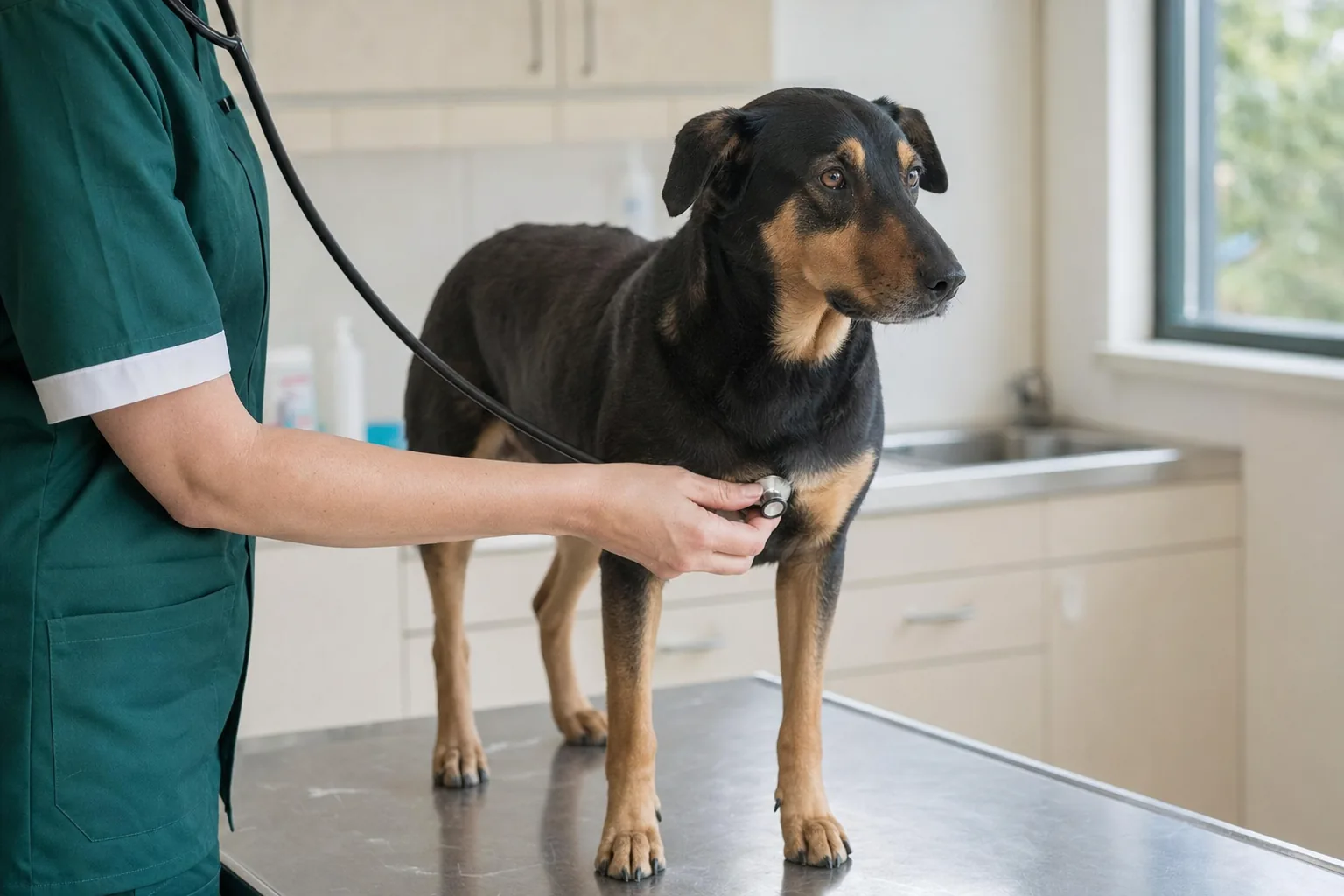
- Weighs him on calibrated scales and scores his body condition, then compares it with yours. Many vets also note a muscle score: a dog can be fat and short of muscle at the same time, especially an older one.
- Asks questions. What is in your food diary, who feeds him, how many meals, which treats, how much exercise, when he was neutered, whether he has started drinking more, whether he is on any medication.
- Examines him, paying attention to what extra weight makes worse: joints, breathing, heart, the skin in the folds, anal glands.
- Runs bloods if a hormonal cause is suspected (thyroid, cortisol) or if the dog is older, before a long weight-loss programme. In most overweight dogs the results come back normal, and that is useful too: the cause is in the bowl.
- Sets a target weight and a calorie figure. From the score the vet estimates his ideal weight and works out how many calories a day he needs to lose at a safe rate, around 1 to 2% of body weight a week. For a 30 kilo dog that is 300 to 600 grams a week. Any faster and he loses muscle and runs short of nutrients.
- Chooses the food. For a dog with a lot to lose, the vet usually recommends a weight-loss diet: fewer calories per gram, with protein, vitamins and minerals at normal levels. If you simply halve his usual portion, you halve the nutrients too, and he stays hungry. Treats count: no more than a tenth of the day's calories.
- Makes an exercise plan to suit his joints and age, built up gradually. You do not go from the sofa straight to running beside a bike.
- Books re-weighs every 2 to 4 weeks, usually without a full consultation, often with a nurse, and adjusts the ration to what the scales say. Plateaus are normal. A small tweak to the portion gets you past them, never hunger.
For anyone who likes numbers: in the only study that followed two groups of Labradors fed differently over their whole lives, the dogs kept lean lived almost two years longer on average and got arthritis later. Nothing else you can do at home has that big an effect on how long your dog lives.
What not to do at home
- Do not starve him or put him on a crash diet "to get it off quickly". He loses muscle before fat, runs short of nutrients and is back at his old weight the moment you give in. The safe rate is slow, 1 to 2% a week, and your vet sets it.
- Do not halve his usual food without asking. A maintenance diet is designed so that a normal portion covers his needs. Half of it no longer does. If he has a little to lose, the vet may trim the ration by a small percentage. If he has a lot, the food changes.
- Do not measure with a cup. Two "cups" scooped by two different people differ by tens of grams. Kitchen scales are cheap and they are the only tool that matters here.
- No table scraps, and nobody else in the house gives them either. If he really must get something "from the table", make it a carrot or a few pieces of his own kibble, kept separately in a jar.
- No human slimming products, teas, "fat burners" or supplements off the internet. Some are toxic to dogs, and none of them replaces getting the portion right.
- Do not suddenly take him running beside a bike or chasing a ball on tarmac. An obese dog's joints are already overloaded and he overheats quickly. Start with longer walks at a steady pace and build them up week by week.
- No grapes, raisins, onion, garlic, avocado or chocolate dressed up as "healthy fruit and veg". Raw carrot, cucumber, cooked courgette, green beans, a slice of apple with no pips: yes, instead of biscuits, if your vet agrees.
- The children only feed the dog from the ration you have already weighed out.
- Do not blame neutering and leave it there. After neutering, energy needs drop by about a fifth, sometimes more, and appetite goes up. If the portion stays the same, he puts on weight. Neutering explains how it started. The unchanged portion explains why it carries on.
- Do not wait for him "to slim down by himself in summer". He will not.
What a good day looks like
In the morning you weigh out the day's ration into a jar. Both meals and every treat you reward him with during the day come out of it. Praise, play and a good fuss have no calories, so be as generous with those as you like. At one meal at least, the kibble skips the bowl: hide it around the house, in stuffed toys or rolled up in a towel. Ten minutes of searching tires him more than ten minutes of walking, and a five-minute meal lasts half an hour. The morning walk is ten minutes longer than last week. In the evening, a search game indoors. Once a fortnight, the bathroom scales, same time of day, before a meal. At our training sessions the overweight dogs are the first to tire on the trail and the last to get their breath back, and their handlers notice the difference within the first months of a plan.
A lean dog lives longer, moves better and sees the vet less often, and all of it depends on whoever is in charge of the kitchen scales. If you do not have a regular vet to work out a target weight with you, our related services page helps you choose a practice.
The information on this page is educational and does not replace an examination. For full details and a diagnosis, consult your dog's own veterinarian.