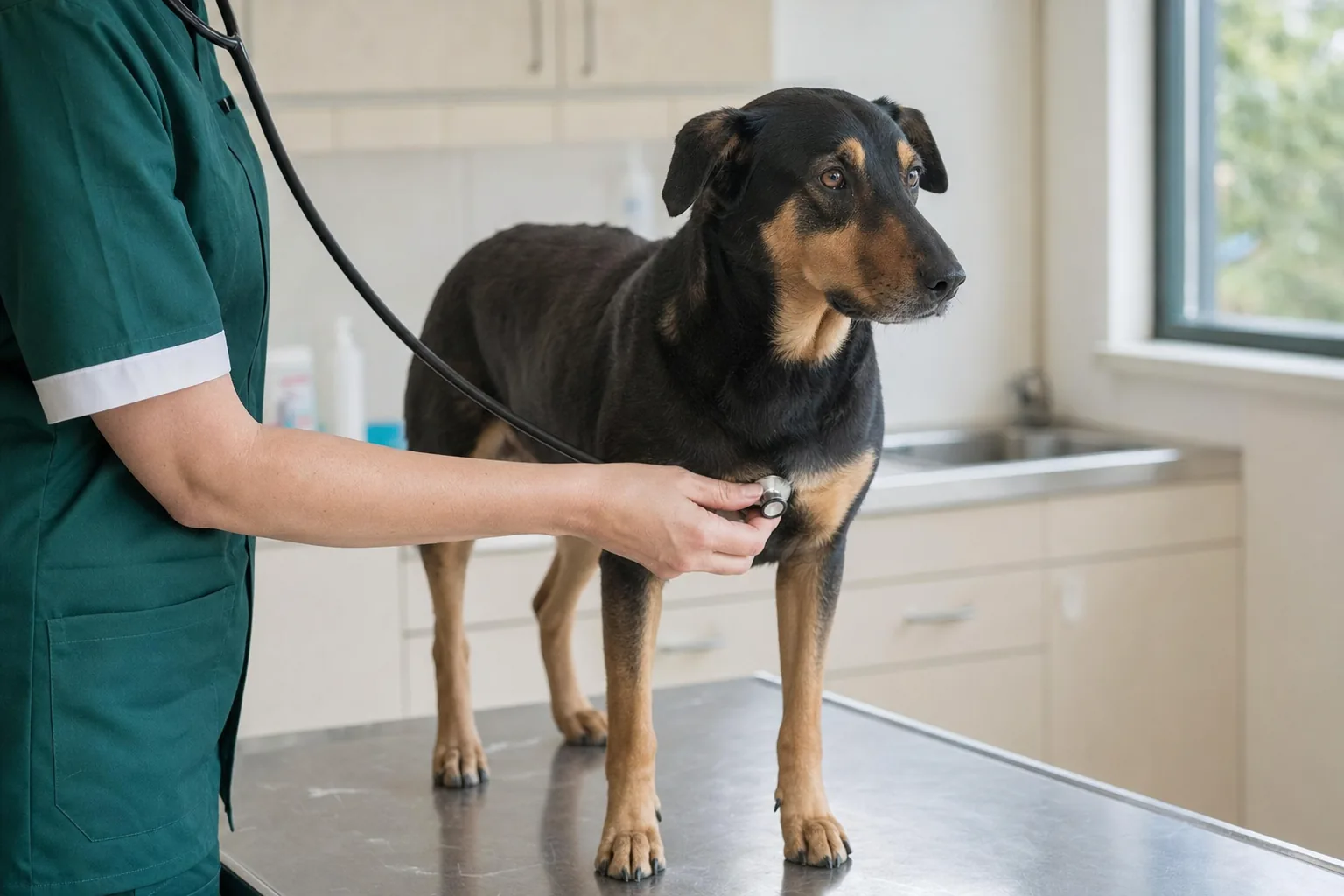
It is eleven at night and the dog is scratching next to the bed. Again. That rhythm of claws on belly has kept you awake for a week, and in the morning his front paws are wet and red from licking. Your picture may be different: a two-year-old who chews his paws and gets an ear infection every year from April to October and is perfectly well in winter. Or a dog who scratches his ears and his rear end whatever the month, and has loose stools on top. People file all three under one word, "allergy". To your vet they are three different diseases with signs that look alike and plans that do not: fleas, an allergy to something in the environment and a reaction to food. This page tells you what you can observe at home, when the itching cannot wait until tomorrow, what the road to a diagnosis looks like and what not to try on your own. The road is long. That is exactly why it is worth starting properly, once.
When the itching cannot wait until tomorrow
Ordinary itching is a problem measured in weeks and you deal with it with an appointment. The situations below are different: with any of them, you ring your own vet the same day.
- a red, wet, sticky patch that spreads from one hour to the next, usually on the cheek, the neck or the base of the tail, under thick coat. That is acute moist dermatitis, a hot spot: it hurts, it gets infected and it grows while you watch;
- a muzzle or eyelids that swell up out of nowhere, or button-sized lumps under the coat within minutes of a sting, a medicine or a new food. If on top of that he is breathing hard, vomiting or wobbly, you have an emergency measured in minutes, and you leave;
- scratching until he bleeds, not sleeping, not eating, not stopping even when you call him;
- round hairless patches with red edges and crusts that multiply week on week, especially in a puppy or a dog fresh from a rescue. If someone in the house has spots on their skin too, all the more so: some skin diseases pass to people;
- violent itching at the edges of the ears, the elbows and the hocks. Rub the edge of his ear between your fingers: if a hind leg starts kicking frantically, think mange until proven otherwise, and mange is contagious;
- a heavy smell, greasy skin, red moist folds, yellow crusts. That is an infection that has settled on top of the itch, and the infection is treated before you get to the cause;
- itching together with listlessness, fever, swollen lymph nodes or weight loss;
- any itching in a puppy under four months, and any worsening in a dog already on treatment for his skin.
What you can observe and note at home
For skin there is no blood test that says "allergic to X", job done, off you go. The diagnosis is made by ruling things out: parasites first, then infections, then food, and what is left at the end is environmental allergy. Each step takes weeks. A skipped step costs months, and it usually gets skipped because nobody wrote anything down. Your diary is what stops the vet skipping any of them.
How much he scratches. Every evening, a number from 0 (not at all) to 10 (almost constantly, waking from sleep to scratch). It is subjective and that does not matter: what matters is the same person, evening after evening, with the same scale in their head. After two weeks you have a trend, and the vet can see whether a treatment is changing anything or only seems to be.
Where. Paws (licking, chewing, digging between the toes), face (rubbing his muzzle on the carpet), ears, armpits, belly, groin, base of the tail and back, around the anus. Draw a dog on a sheet of paper and put an X wherever he scratches. That map says a lot. Base of the tail and lower back point to fleas. Paws, face, ears, armpits, belly point to environmental allergy. Ears plus the area under the tail, all year, with soft stools, point to food. Ear edges and elbows, to mange.
When. Does it start in spring and end in autumn, or run all year? Is it worse after a walk through grass, after a bath, in the evening in bed, after a particular meal? How old was he when it started: around one, or past seven? Is it worse in the carpeted flat and better in the countryside?
Fleas. Stand the dog on a white towel and run a fine-toothed comb through the coat, especially along the back towards the tail. Whatever falls out black goes onto wet paper. If it turns reddish-brown, it is digested blood, in other words flea dirt, and the dog has fleas even though you have never seen one. A dog allergic to flea saliva itches horribly from one bite a week, and he licks the flea itself off before you get a look at it. Note which parasite protection he is on, since when, and whether every animal in the house has had it.
Food. Everything that goes in his mouth, no exceptions: the food, the training treats, the leftovers, the toothpaste, the flavoured medicines, what the children and the grandparents slip him under the table. Without this list the elimination diet later on cannot be done properly. With it, it can.
The skin. Photos once a week, in the same light, of the same areas. Redness, crusts, spots, hairless patches, skin thickened and darkened where the itch is old, smell, rust-coloured staining from saliva on white paws.
The house and the others. New detergent, new carpet, building work, a room fragrance, a new plant, another animal, a house move. And whether anyone else is scratching: the other dog, the cat, the people.
At our summer training sessions we see the same picture again and again. The dog licks his paws in the car after a trail through tall grass, and the person at the other end of the line is convinced he cut himself on something. Only at the third session in a row, with the same licked paws, does the penny drop that it is something else. Most of the time it is a pollen allergy.
The main causes, side by side
| Cause |
Where he usually scratches |
When |
Other clue |
| Fleas (allergy to their saliva) |
Base of the tail, back towards the tail, thighs |
Worse in summer and autumn; in a heated home, all year |
Flea dirt on wet paper; other animals in the house scratching too |
| Mange (mites burrowing into the skin) |
Ear edges, elbows, hocks, belly |
Any time; sudden start |
Violent itch; people in the house with red spots |
| Environmental allergy (atopy) |
Paws, face, ears, armpits, belly, groin |
Seasonal at first, then all year; starts between 6 months and 3 years |
Ear infections that keep returning; worse after grass |
| Adverse food reaction |
Ears, area around the anus, paws; sometimes everywhere |
All year, whatever the season |
Soft stools, wind, several stools a day; can start at any age |
| Infection on top (bacteria, yeast) |
Folds, between the toes, belly, neck |
On top of any allergy |
Smell, greasy skin, crusts, intense redness |
| Contact dermatitis |
Belly, paws, muzzle: thinly haired areas that touch something |
After a carpet, a detergent, a plant |
Rare; disappears with the contact |
| Hairless patches with no itch, in a puppy |
Face, paws |
Any time |
A normal skin mite that has multiplied; not an allergy |
What the vet does, step by step
- Asks. Age at onset, season, areas, the itch score, the list of everything he eats, parasite protection, the others in the house, what you have tried so far and with what result. With the diary in hand this part takes five minutes and is the most useful bit of the whole appointment.
- Looks at the skin, centimetre by centimetre: where the lesions are and what kind they are (some are made by the disease, some by the scratching), the ears with the otoscope, between the toes, under the tail, the ear-edge test for mange.
- Runs tests on the spot. Skin scrapings (a blade drawn across the skin until a drop of blood appears, then under the microscope, looking for mites); sticky tape or a slide pressed onto the skin, for yeast and bacteria; combing for fleas; a special lamp and a culture for ringworm when there are round patches; sometimes a few plucked hairs, also under the microscope. All of them take minutes and tell you more about skin than any blood test.
- Rules out parasites, always first. Strict parasite control, for every animal in the house, for as long as the vet says, before anyone mentions allergy. Do not take it as an accusation: flea saliva allergy is common, one flea a week is enough, and the dog licks it off before you see it.
- Treats the infections on top, when the cytology shows them. Only once they have cleared can anyone see how much itch is left to explain.
- Proposes the elimination diet. Eight weeks on a single protein source the dog has never eaten before, or on a prescribed special diet, and absolutely nothing else: no treats, no leftovers, no flavoured medicines. At the end, back to the old food. If the itch returns within one or two weeks, the diagnosis is made. Blood, saliva or hair tests for "food allergy" are not reliable; the diet is the only valid test, which is exactly why it has to be done once, properly.
- Is left with environmental allergy when everything else has been excluded. Allergy tests (in the skin or from blood) come only afterwards, and they serve to choose the allergens for desensitisation (the body is gradually accustomed to what irritates it), if the vet proposes that route. They do not make the diagnosis of allergy.
- Makes the long-term plan. Control of the itch with what the vet prescribes, of the infections, of the fleas, skin care (baths with what they recommend, at the interval they set), food, and check-ups every few months. Environmental allergy is not cured. It is kept under control for years, and a well-managed dog has good seasons and a few flare-ups a year.
Before you leave, ask two things: what the next step is if the plan does not work, and when the two of you will decide that.
What not to do at home
- Do not give human medicines for allergy or itching and do not rub your own creams on him. The dog licks the cream off, and some of them are toxic to him.
- Do not change the food at random to something "sensitive" or "grain-free". Grain allergy is rare; most reactions are to animal proteins the dog has eaten for years. Food changed before the appointment spoils the elimination diet the vet would have wanted to run afterwards.
- Do not do the elimination diet "more or less". One treat a day cancels it. If you cannot keep the whole household on the same rule for eight weeks, tell the vet from the start; better to postpone it than to do it by halves.
- Do not stop flea protection because you cannot see any fleas. In a dog allergic to them, exactly when you cannot see them is when it counts.
- Do not bath him daily with human or baby shampoo. It dries the skin and inflames it. Baths help, but with what and how often the vet says.
- Do not put essential oils, vinegar, garlic or tinctures on his skin. Some are toxic, all of them delay the appointment.
- Do not take the cone off "because you feel sorry for him", if the vet gave him one. Two nights of unsupervised chewing undo what healed in a week.
- Do not clip a hot spot at home with scissors. It hurts, the dog moves, and you cut the skin. At the practice it is clipped under control, cleaned and treated in the same visit.
- Do not buy allergy tests online, from hair or saliva. They have no diagnostic value, and the list of "forbidden" foods you get back is simply made up.
- Do not put it off "until the summer is over". Every week of scratching thickens the skin and adds an infection that needs treatment of its own.
What you can do, in fact, until the diagnosis
The diary and the photos. The fine comb, once a week, on the white towel. Parasite protection up to date, for every animal in the house. Paws rinsed with clean water and dried after a walk through grass, especially in pollen season. Bedding washed hot. And nothing else without the vet.
A well-managed allergic dog has good seasons and a few flare-ups a year, and that is all. One treated from the kitchen cupboard has, by five, thick black skin on his belly and a file with ten ear infections in it. You travel the long road once; if you do not yet have a regular vet to travel it with you, our related services page explains how to choose a practice.
The information on this page is educational and does not replace an examination. For full details and a diagnosis, consult your dog's own veterinarian.