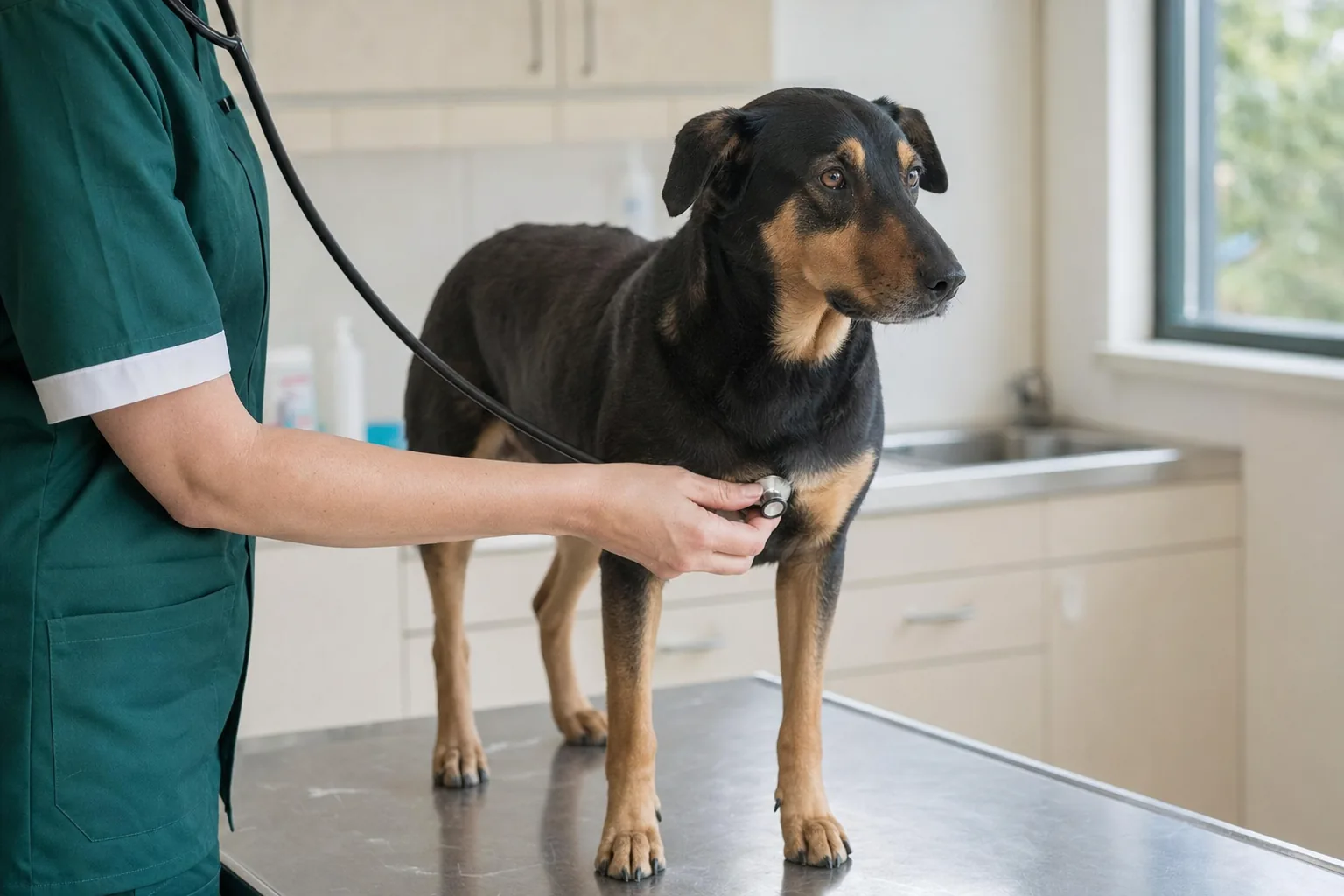
Three dogs, three different stories. The labrador leaves tufts all over the sofa from March to May, and this year it feels worse than ever. The three-year-old crossbreed has a round bald patch the size of a thumbnail on one front leg, and another on his head. The eight-year-old has gone bald on both flanks, a mirror image left and right, never scratches, and has lately been drinking more. The first one is almost certainly fine. The other two need to see a vet. Below is how to tell them apart, what to write down and what your own vet will be looking for when you bring in a dog who is losing hair.
When to ring the vet today
Losing hair is not an emergency on its own. What comes with it can be:
- red, wet skin that weeps or bleeds, sometimes spreading visibly from one hour to the next (that is a "hot spot", and in 12 hours it can be the size of your palm);
- a strong, heavy smell coming off the skin, with yellowish crusts or pus;
- itching so bad the dog cannot sleep, will not eat or bites himself until he bleeds;
- hair loss alongside lethargy, a big thirst, a swollen belly, or weight going up or down for no reason: that is how a hormonal disease shows itself, and it wants seeing soon;
- bald patches on the dog and, at the same time, small round red spots on the arms or neck of someone at home, particularly children (some fungi and some mites pass to people);
- lumps under the skin where the hair has gone;
- a puppy under six months whose patches multiply from week to week.
If nothing on that list fits, you have time to watch for a few days and go in with decent notes.
What to watch and write down at home
Before any test, your vet will want three things: where the hair is coming out, whether he is itchy and what the skin underneath looks like. You can gather all three yourself.
The map. On a sheet of paper, sketch the dog from the left, from the right and from above, and shade in the bald or thin areas. Is it the same on both sides of the body or the flanks? Round patches scattered about? Only the head and legs? Only where his mouth can reach, or only round the tail? Date the sheet and draw it again in two weeks.
The itch. Score it from nought to ten: nought is a dog who never touches himself, ten is the one who stops mid-walk to scratch. A dog losing hair without itching falls into one group. A dog who scratches first and loses hair afterwards falls into a completely different one, with different tests.
The skin. Part the coat in good light. It might be normal (pale pink or evenly pigmented, smooth), or red, with spots or little bumps, with rings that peel at the edge, thickened and dark like elephant hide, dry, flaky, greasy to the touch, crusty. Take close-ups of each area with the flash on.
The hair. Is it coming out root and all, or snapped off short as if clipped? Tug gently on a tuft at the edge of a patch. If it comes away whole with no effort, write that down. With an ordinary moult the hair comes evenly from everywhere, the skin looks healthy and nothing is left bare.
The history. His last flea and tick treatment (product and date; a photo of the box does the job). His food and any change in recent months. Whether he has been ill, had surgery or an anaesthetic in the last three months, whether she has had a litter, whether he was clipped short recently or you changed shampoo, whether he is neutered. Whether there are other animals at home, and whether anyone in the family is itchy.
Behaviour. Does he keep licking one spot, usually on a front leg, when he is left alone or bored? The shiny bald patch you get there often comes from pain or boredom, and the skin itself was never the problem.
The pattern you see and what usually sits behind it
| What it looks like |
Itchy? |
Common causes |
| Thinning all over, even, healthy skin, in spring or autumn |
No |
Normal moult, heavier in breeds with a dense undercoat and in dogs living in centrally heated homes |
| Symmetrical on flanks and body, thin or darkened skin, a "tired" dog |
No |
Underactive thyroid, too much cortisol, sex hormone imbalance |
| Round patches with peeling edges; sometimes on people at home too |
Little or none |
Ringworm (a fungus), sometimes a bacterial infection of the follicles |
| Patches on the head, round the eyes, on the legs, in a puppy or young dog |
None or a little |
Demodex mites, which live in the follicles |
| Ear edges, elbows, hocks, belly, ferocious itching |
Severe |
Sarcoptic mange, highly contagious, can pass to people |
| Base of the tail and the back, small crusts, chewed areas |
Marked |
Flea bite allergy |
| Paws, face, ears, armpits, itch that comes back each season or lasts all year |
Marked |
Environmental or food allergy, often with infections on top |
| Hair dropping out in tufts 1 to 3 months after an illness, a litter or an anaesthetic |
No |
The follicles "reset"; the coat grows back by itself |
| A patch still bald long after clipping, in Nordic breeds or Pomeranians |
No |
Hair growth stalls after clipping, a problem specific to these breeds |
| One shiny patch on a front leg, licked constantly |
Licking, not scratching |
Pain in the joint underneath, or a habit grown out of boredom and stress |
No table replaces the scrape and the microscope. Plenty of causes look alike, and one dog can have two at once, for example an allergy with a bacterial infection settled on top.
At the practice: what your vet checks
- Listens and looks at your map. Where the hair has gone and whether he itches splits the causes in two. Your photos show how it has developed.
- Examines the skin and the whole dog. Lamp, magnifier, hands: skin thickness, temperature, lymph nodes, the coat everywhere. Weight, pulse and gum colour too, because some causes are not in the skin at all.
- Runs a flea comb over a sheet of white paper, looking for fleas or the black "grit" they leave.
- Takes skin scrapes. The vet scrapes the skin with a blade in a few places until it just starts to bleed, and checks for mites under the microscope. With sarcoptic mange the scrape often comes back negative even when the mite is there; if suspicion is strong, your vet may decide on a trial treatment.
- Presses tape or a glass slide onto the skin, stains it and looks under the microscope: bacteria, yeast, inflammatory cells. This is where the add-on infection that keeps the itch going shows up.
- Plucks a few hairs and examines them. The root shows whether the hair is growing or resting, whether it has been snapped by scratching and whether it carries fungal spores.
- Uses a Wood's lamp and sets up a fungal culture (or runs a PCR test) when the patches are round and scaly. The culture takes one to three weeks.
- Runs bloods when the loss is symmetrical and not itchy: thyroid, cortisol, sometimes sex hormones, plus basic biochemistry.
- Takes a skin biopsy under local anaesthetic when nothing so far adds up. Two or three pieces of skin about the size of a pea go off to the lab.
- Suggests a food trial if food allergy is suspected: one single new food for eight weeks and nothing else. It sounds easy. In dermatology it is the hardest test to see through.
- Makes a plan and books a recheck. The treatment targets the cause found, not "the hair". The recheck at three to four weeks is part of the diagnosis, because some causes are only confirmed by how the dog responds.
What not to do at home
- Do not shave him down to the skin to "stop the shedding". The undercoat protects him from cold and sun. In some breeds a shaved coat does not grow back the same for months or years, and the bare skin burns.
- Do not wash him in human shampoo, anti-dandruff included, or in washing-up liquid. Dog skin has a different pH, and every wrong bath makes the itch worse.
- No oils, butter, vinegar, garlic or essential oils on the skin. Some are toxic when licked, others irritate, and all of them hide exactly what the vet needed to see under the microscope.
- Do not give him your own allergy tablets or rub in cortisone cream from the bathroom cabinet. They can hide an infection or a parasite and make the scrape useless.
- Do not use a parasite product made for another species or a different weight band.
- Do not change his food every week. A food trial that hops between three brands tells you nothing.
- Do not put a cone on him "so he stops licking" before you know why he licks. The licking has a cause, and the cone only covers it up.
- Children leave the patches alone until you know whether it is ringworm or mange. And you wash your hands after touching him.
- Do not wait for a growing patch "to clear up in summer". Patches that are spreading do not stop on their own.
What helps, day to day
Brushing that suits his coat. In the moulting season that means every day, with a metal-toothed undercoat rake; a blade that cuts the hair is the wrong tool. Flea protection all year round, because one flea is enough for an allergic dog. A complete food with good fats, not swapped on a whim. Baths only when he really needs one, with a dog shampoo, rinsed well and dried right down to the skin. Once a month, while you are brushing him anyway, have a look underneath the coat. A patch the size of a button is a routine appointment. One the size of your palm means you have already lost a month.
If the hair comes out evenly, the skin is healthy and the dog is happy, it is most likely just the time of year. Patches, changed skin, or a dog whose behaviour has changed as well mean the notes above and a trip to the practice. If you do not have a regular vet yet, our related services page explains how to choose one.
The information on this page is educational and does not replace an examination. For full details and a diagnosis, consult your dog's own veterinarian.