It is evening after a walk through the woods and along the edge of a meadow. You stroke his neck and find a bead the size of a lentil, hard, stuck to the skin, with legs. Or he has been chewing at the base of his tail for a week, the coat there is thinning, and on the white sheet over the sofa you find black specks that turn red when wet. Or you have seen nothing at all, but the puppy you brought home a fortnight ago has pale gums and sleeps more than he should. Fleas and ticks you can sometimes see with the naked eye. The illnesses they bring you cannot: anaemia in puppies, an allergy that drags on for months, babesiosis. We work trails through long grass and along woodland edges from March to November, and the check after every session is part of the session.
When to call the vet today
- a few days to three weeks after a tick, or after a walk through tick country even if you never found one, he gets a fever, goes flat, refuses food, passes red-brown urine or urine as dark as stout, or his gums turn pale or yellowish. Babesiosis is an emergency and gets worse day by day;
- a small puppy covered in fleas, with pale gums, sleepy, weak: flea anaemia kills puppies;
- lameness that keeps moving from one leg to another, swollen joints and fever, a few weeks after ticks;
- the tick bite is swollen, hot, oozing pus, or a redness is spreading from one day to the next;
- after a parasite product he trembles, drools, vomits, has a fit or seems confused: that is poisoning, especially if the product was for another species or another weight;
- the cat at home has rubbed against the freshly treated dog and is now trembling or drooling: an emergency for the cat;
- unexplained bleeding, red-purple spots on the gums or belly, weeks after ticks;
- the hind legs are getting weak, the weakness is creeping upwards, and you find a tick on him. It is rare here, but it happens.
What to check and do at home
The check after a walk
First with your hand, against the lie of the coat, then with your eyes, in the places ticks like best: inside and around the edge of the ears, around the eyes and lips, under the chin, the neck under the collar, the armpits, between the toes, the groin, under the tail. A freshly attached tick is the size of a poppy seed and flat. Two days later it is the size of a lentil, then of a bean, and blue-grey. On a dog with a thick coat, feel for them, because your eyes will not find them.
How to remove a tick
You need a tick hook, from any vet or pet pharmacy, or fine-pointed tweezers. Grip the tick as close to the skin as you can without squashing its body. Slide the hook under the tick and twist until it comes away, usually after two or three turns. With tweezers, pull straight out, slowly, without jerking or twisting. If the "head" stays in the skin (in fact the mouthparts), do not dig for it. It works its way out within days, like a splinter. Clean the spot, take a photo, and put the date and location in your phone calendar. For three weeks, watch for fever, lethargy and dark urine.
Do not put oil, butter, alcohol, nail varnish, a lit match or anything else on the tick "to make it let go". A smothered or burnt tick empties its contents into the wound and raises the risk of passing on disease. Do not squeeze it between your fingers either.
The fleas you cannot see
Stand him on a white towel and run a fine comb along his back towards the tail. Put the black specks that fall onto damp paper. If they dissolve into red-brown smears, they are flea droppings, which is digested blood. A dog allergic to flea saliva chews the base of his tail, his thighs and his belly from a single bite a week. He licks the fleas off himself before you ever get to see one.
What is on the dog is a small part of the problem. Eggs, larvae and pupae sit in the carpet, the bedding, the gaps between floorboards and the car, and from there they reinfest him for months. In winter, in a heated house, the cycle carries on regardless.
White segments like grains of rice near his bottom or in his bed are tapeworm, which he picks up by swallowing a flea. Worming is part of the flea plan.
What to bring to the vet
Which product you used last, when and for what weight (photograph the box). Which animals in the house were treated and which were not, the cat included. Whether he swam or was bathed after it went on. Where you walk: woods, meadows, parks with long grass, sheep pasture. Any travel. The ticks you found and when.
What you see and what the vet thinks of first
| What you see |
First suspicions |
When to see the vet |
| Chewing the base of the tail, thin coat there, black specks that go red on damp paper |
Fleas, probably with flea allergy |
In the next few days; nothing from the cupboard in the meantime |
| Puppy with lots of fleas, pale gums, sleepy |
Flea anaemia |
Today |
| Fever, lethargy, dark urine days or weeks after ticks |
Babesiosis |
Today, now |
| Lameness shifting from leg to leg, swollen joints, weeks after ticks |
Tick-borne disease (borreliosis, anaplasmosis) |
Today |
| Small red lump at the bite site for a few days |
Normal local reaction |
If it spreads, gets infected or the dog is subdued |
| Rice-like segments near the bottom |
Tapeworm, from fleas |
Book an appointment; the plan includes worming |
| Trembling, drooling, vomiting after a parasite product |
Poisoning by the product |
Now, with the packaging |
What the vet will do
- Ask what happened and look at the product packaging.
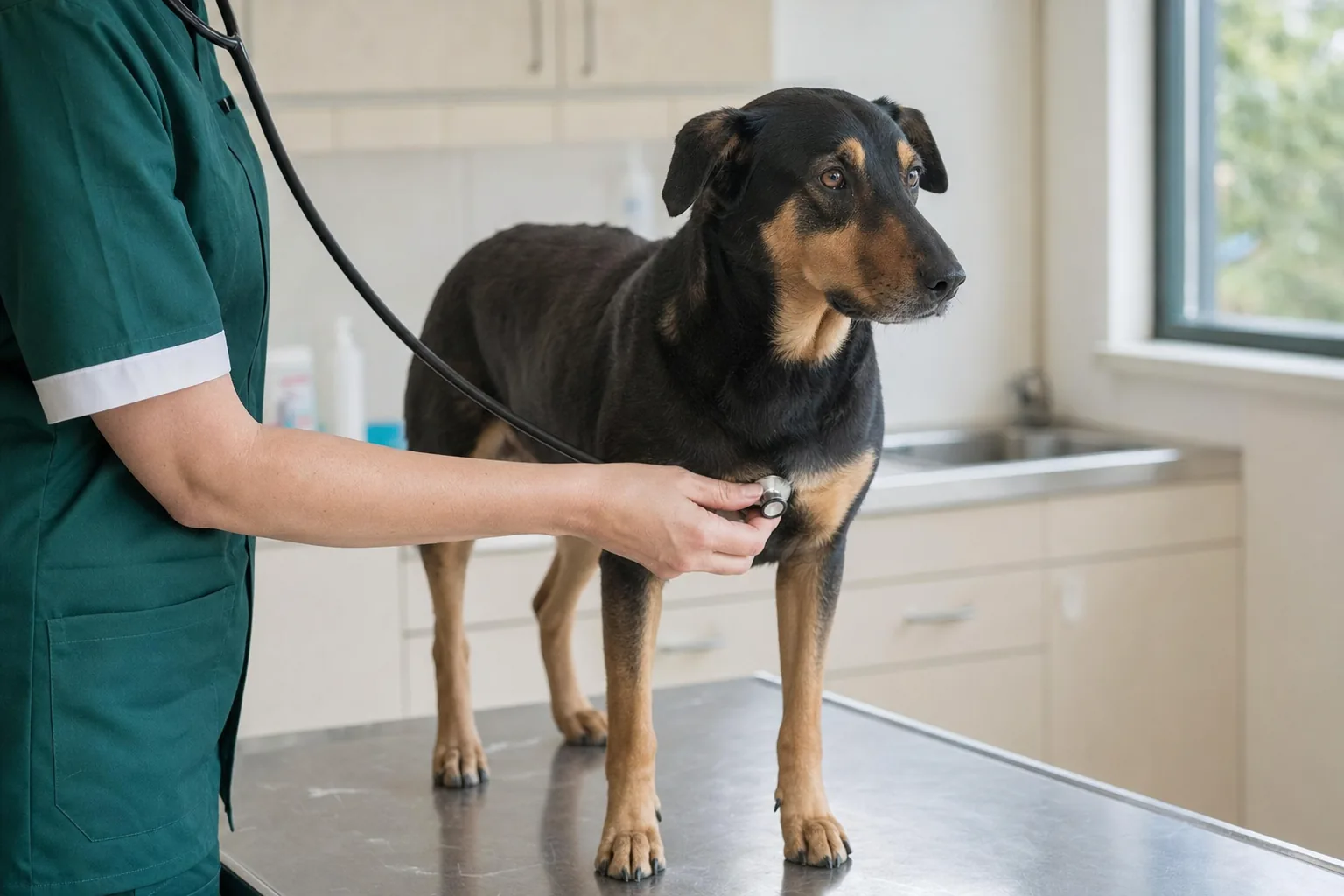
- Examine him. Comb through him, look at the skin at the base of the tail and on the belly, search for ticks hiding in the ears and between the toes, check the gums and temperature, and feel the lymph nodes, the spleen, the joints. If you can bring a urine sample, its colour tells a lot.
- Skin tests if there are lesions: skin scrapes and cytology, to tell flea allergy apart from other causes of itching and to spot infections that have set in on top of the scratching.
- Blood tests if he has had ticks and is ill, or has a history of ticks and is starting a new plan. A full blood count shows anaemia and low platelets. On a smear under the microscope, the parasites inside red cells can sometimes be seen directly. Rapid tests look for tick-borne diseases, PCR is used when needed, and biochemistry checks the kidneys and liver. Some diseases only show up in tests weeks after the bite, so your vet may suggest repeating them.
- The parasite plan. The product, whether spot-on, tablet or collar, is chosen on his weight measured on the day, his age and his lifestyle: woods, swimming, small children at home, other animals. What it covers and how long it lasts matter too. Put the schedule in your phone with an alarm. Dogs that work outdoors, like ours, are protected all year round with the product renewed on time, not just "from Easter to Christmas". If you have a cat, the vet picks a product that is also safe for her or tells you how to keep them apart after application.
- The house, when there are fleas. Vacuum every day and put the bag straight in the outside bin, wash the bedding and blankets at 60 degrees, and do the car and anywhere he sleeps. Sometimes the vet adds a household product. It takes two to three months for every stage to go. If they "come back" after three weeks, that is normal: it is the pupae hatching out of the carpet. That is exactly why you keep going.
- Worming for tapeworm, alongside the flea plan.
- Every animal in the house is treated on the same day, each with its own product.
Before you leave, ask what to do if he swims or is bathed after application, when the next dose is due, and which signs to watch for in the three weeks after a tick.
What not to do at home
- Do not use a cat product on a dog, or the other way round. Some dog products kill a cat who licks them or rubs against a freshly treated dog. If you have a cat, tell your vet before choosing anything.
- Do not split a product meant for a 30 kg dog to give "half" to an 8 kg dog, or vice versa. The dose goes by his real weight, measured at the time.
- Do not buy unlabelled products from markets or no-name websites, and do not rely on garlic, brewer's yeast or essential oil recipes. Nothing shows they protect, and some are toxic to dogs.
- Do not remove a tick with oil, fire, alcohol or your fingers.
- Do not stop in winter because "they're gone". Ticks get active above a few degrees, on mild February days, and for fleas in a heated house there is no winter.
- Do not treat only the dog who is scratching. Every animal, on the same day, plus the house.
- Do not give up after three weeks when they "come back". Those are the pupae from the carpet and the treatment is doing its job. Stop now and you are back to square one.
- Do not wash him with human or children's flea shampoo, and do not use household insecticides on the dog or his bed.
- Do not wait for a fever after ticks to pass. Babesiosis responds well when treated early and badly when treated late.
- Do not give human fever medicines. Some are toxic to dogs, and all of them hide the very sign you needed to call about.
What is in your hands
Five minutes of checking after every walk through grass. The fine comb once a week over the white towel. The doses in your phone calendar. Bedding washed often, the vacuum run regularly. A product chosen with your vet, all year round, for every animal in the house.
A tick found in the evening and removed properly costs you thirty seconds. The same tick left for three days can mean a week in hospital. For us the check after a trail is part of training, the same as water for the dog. If you do not have a regular vet yet, our page on related services will help you choose a practice.
The information on this page is educational and does not replace an examination. For full details and a diagnosis, consult your dog's own veterinarian.