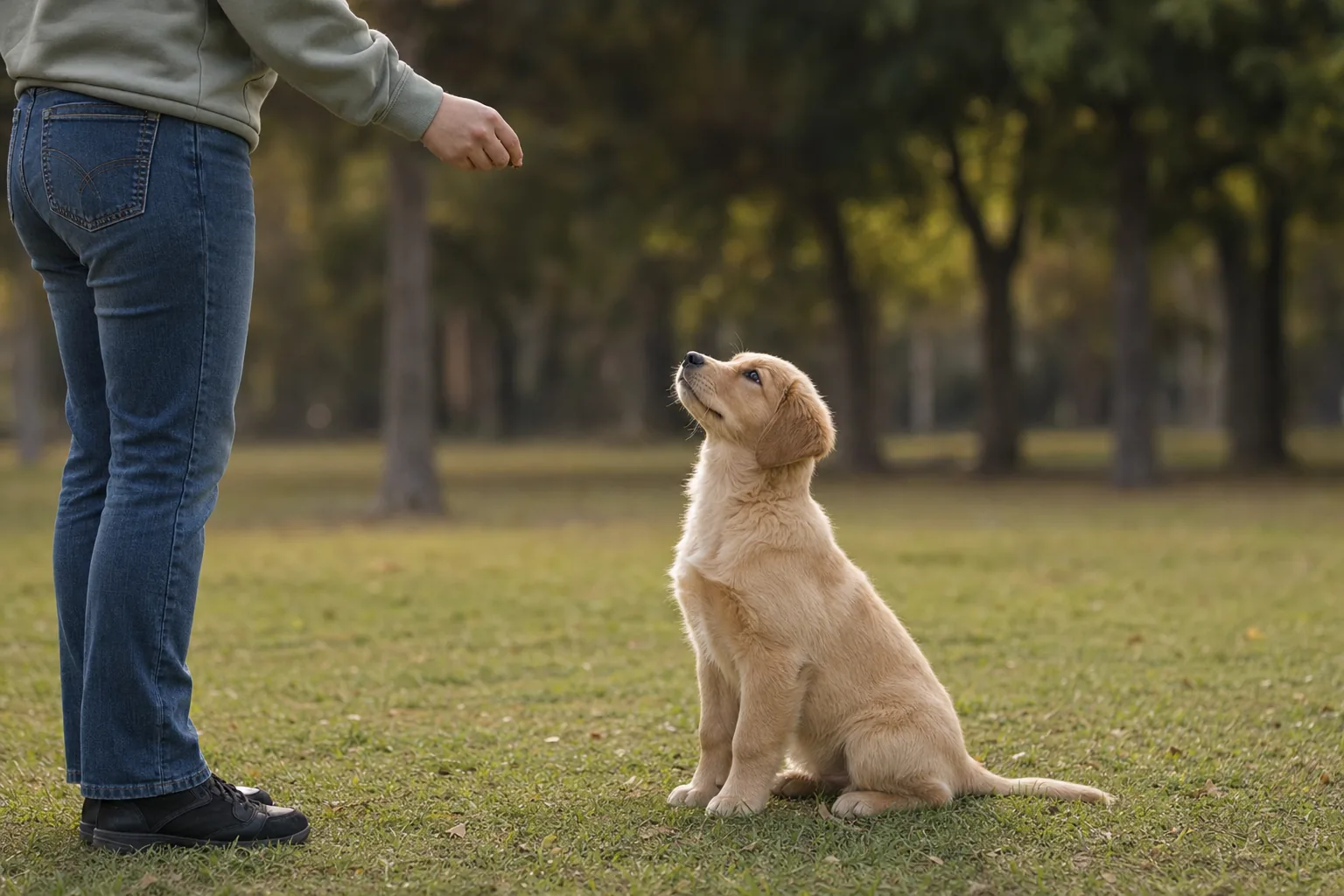
You brought an eight-week-old puppy home on Saturday, it is now Wednesday and you have had about ten hours' sleep in total. Every night he has howled in the kitchen from eleven until two, and the neighbour has started banging on the wall. Or your four-month-old slept happily in the bedroom until you moved him onto the landing, and now he cries for an hour at bedtime. Or you have adopted an adult dog who wanders round the house all night, claws clicking on the floor. The first two are really the same story: a puppy who has suddenly lost everything that made him feel safe. The third is different, and you will find it further down under ages. Here is the first week, night by night, and how to teach the crate so that he feels it belongs to him.
How do you teach a puppy to sleep through the night, step by step?
Until a few days ago your puppy slept pressed against his mother and four or five littermates in a warm, breathing heap. On his first night with you he sleeps alone, in the dark, somewhere that smells of strangers, in a house full of new noises. Crying is the oldest signal a young mammal has when it is left alone. Manipulation has nothing to do with it. What you do in the first three or four nights decides whether the crying lasts a week or three months.
1. Where he sleeps for the first few weeks
Next to your bed, in a crate or a bed with sides, at about the height where he can feel your hand. Fingers through the bars and that is all. The kitchen, the landing or a closed door between you can come later, if at all. Puppies who sleep close to people in the first weeks cry less and settle faster, and they do not turn into "spoilt" dogs because of it. They learn that night-time is safe. If you want him to sleep somewhere else in the long run, move the crate gradually once he is sleeping well (step 5).
2. The bedtime routine
- Last meal three hours before bed. Water stays available, but the last big drink is an hour or two before.
- Twenty to thirty minutes of calm before bed: food scattered on the floor to sniff out, something to chew, slow strokes. A wild game with the children at ten at night winds him up, and a wound-up puppy does not drop off, he cries.
- Last wee right before lights out, on the lead, nothing exciting. When he has finished, praise him in a happy voice and give him something tasty.
- In the crate he gets something to chew, such as a toy stuffed with soft food, and a blanket that smells of the litter (ask the breeder for one when you collect him) or of you (a T-shirt you have worn for two days).
- Lights off and a steady background noise, a fan or a quiet radio, to cover the neighbours' doors and the lift.
- The same bedtime every night, weekends included, and the same word as he goes into the crate.
3. At night, when he cries
There are two kinds of crying and you tell them apart by the clock. Protest comes in the first five to fifteen minutes after you have put him to bed, with you right there: whining, short barks, scratching at the door. Need comes after two to four hours of sleep, when he wakes up restless and keeps turning in circles, whining. For protest, put your hand to the bars, say something calm, breathe beside him and leave him in. For need, take him out to wee with the lights low, no chat and no play, give him a treat in silence, and have him back in the crate within five minutes.
A puppy of 8 to 10 weeks needs one or two trips out a night; by 14 to 16 weeks most need none. Set an alarm for a quarter of an hour before he usually wakes and take him out yourself, before he cries. That way he does not learn that crying opens the door, and you sleep better than if you lie there waiting.
4. Teach the crate during the day
If he only ever sees the crate at night with the door shut, it is a prison to him. During the day the door stays open and good things happen inside: that is where his meals arrive, where tasty bits appear "out of nowhere" when he is not looking, and the only place he gets a chew. When he goes in by himself, close the door for thirty seconds and open it before he whines. Then two minutes, then ten with you in the room, then with you in another room. Never use it as a punishment.
Size: he should be able to stand, turn round and lie stretched out on his side, with a little room to spare. In a crate that is too big he makes himself a toilet corner. Cover three sides with a blanket so it feels like a den, and keep it away from radiators and draughts.
5. Moving the crate, if you want to
After two or three weeks of quiet nights beside the bed, move the crate half a metre a night towards where it will end up, until it is on the other side of the door. On the first night beyond the door, leave the door open. If the crying comes back at any stage, go back half a metre and stay there for two nights.
The first week
| Night |
What you do |
| 1–2 |
Crate beside the bed, hand at the bars, blanket that smells of the litter. Alarm at three hours for a wee. Note how many minutes he cried at bedtime. |
| 1–7 |
By day: meals in the crate with the door open; chews in the crate; door closed for 30 seconds, then gradually longer. |
| 3–4 |
Alarm moves to four hours. Same bedtime routine, same time, same order. |
| 5–7 |
If bedtime crying is down to under five minutes, change nothing. If not, go through the list of mistakes. |
| 7 |
Compare the minutes of crying and the number of wake-ups on night 1 with night 7. That tells you when to start moving the crate. |
What changes with age?
8 to 12 weeks. Everything above. A puppy sleeps 18 to 20 hours out of 24, and if he has not slept during the day (children keeping him awake, visitors, the park), he is restless at night from overtiredness. Plan his daytime naps, in the crate with the door open, after every play session.
3 to 6 months. The night-time wee disappears. Teething arrives instead: he chews at night and whimpers with sore gums, and a chew toy kept in the freezer helps. This is a good age to move the crate if you want to, or to let him choose his own spot if you would rather not use a crate at all.
The adolescent, 6 to 18 months. He wakes at five in the morning with the light and the birds and decides it is daytime. Thick curtains, a covered crate, and breakfast half an hour after he wakes. A dog fed the moment he opens his eyes starts waking up for food, earlier and earlier.
The adopted adult. For him, the first week in a new home is like a puppy's first week. His bed goes beside yours, the bedtime routine stays the same and the bedroom door is shut so he does not roam the house. Many do not cry, but they do not sleep either: up, down again, a big sigh. Keep the routine and it passes in a week or two.
The senior. An old dog who wanders at night, cries or stands in the middle of the room has not forgotten his manners. He is in pain, needs to go out more often or is starting to mix up day and night, which is common as the brain ages (vets call it cognitive decline). See your own vet first. Then a nightlight, a soft warm bed and one late trip out just before you go to bed.
Which mistakes keep a puppy awake?
- "Leave him to cry, he'll get used to it", in another room with the door shut. Some puppies go quiet after three nights because they have given up asking. Others howl for hours, night after night, and come to believe that night means being alone. The first can grow into dogs who never ask for anything and suffer in silence, the second into dogs with separation problems. Neither outcome is worth those three nights.
- Only answering once the whine turns into a howl. The whine got nothing, the howl brought your hand to the bars. He learns to go straight to howling.
- Taking him into bed at three in the morning after an hour of crying, then leaving him in the crate the next night. After an hour of crying he got the best thing possible, and the next night the rule has changed. Decide in advance. The bed is as good a choice as the crate, as long as it is your choice and not you caving in.
- Talking and playing on the night-time trip out. Three minutes of play at three in the morning and he will wake at three every night, ready to play.
- A crate that is too big, uncovered, beside the radiator. Wee in the corner, light from the street, too hot. You want a den, not a birdcage.
- Last meal at ten at night. A puppy who goes to bed with a full tummy needs to go out at one.
- The crate as a daytime punishment. "In your crate!" after some mischief, then you send him to the same place to sleep.
- A day without sleep. Visitors, children, three hours at the park, and in the evening he is too wired to settle and you cannot understand why, when he "must be exhausted".
How long until he sleeps through?
With most puppies, if the crate is beside the bed and the routine holds, bedtime crying drops below five minutes within three to seven nights. Six or seven unbroken hours come within one to three weeks, and the night-time wee goes at around 14 to 16 weeks. If you moved him to another room too early, the count starts again from zero on the day you bring him back beside the bed.
Keep a tally every morning: how many minutes he cried at bedtime (say forty on the first night, ten on the fourth, two on the seventh), how many times he woke and what time he woke for good. Next, he goes into the crate on his own at his word in the evening and lies down. And the clearest sign of all is the morning you find him awake, calm and waiting for you, without having made a sound.
Setbacks come with moving the crate, teething, the first night at the in-laws' or in kennels, or after an illness. Two or three nights with the crate back beside the bed get him back on track.
When should you call an instructor?
- he cries for hours every night and has done for more than three weeks, even though he sleeps beside the bed and the routine is kept;
- he panics in the crate: drooling, bending the bars, tearing his claws, weeing from fear. Stop using the crate that day, switch to a pen or a safe room and call a behaviour professional, because forcing it makes things worse;
- the crying spreads into the day, he cannot be left for five minutes without howling and follows you from room to room. That is the start of a separation problem, and you work on it early, while he is young;
- an adult dog has not slept for several nights, wanders, pants, gets up and lies down again. Your own vet first, then any change of routine.
In our puppy class, one of the first things we ask is "how are you all sleeping?". And quite often someone finds out there that the right answer, the crate beside the bed, is exactly what their gran told them and what they dismissed because "that's not how you do it".