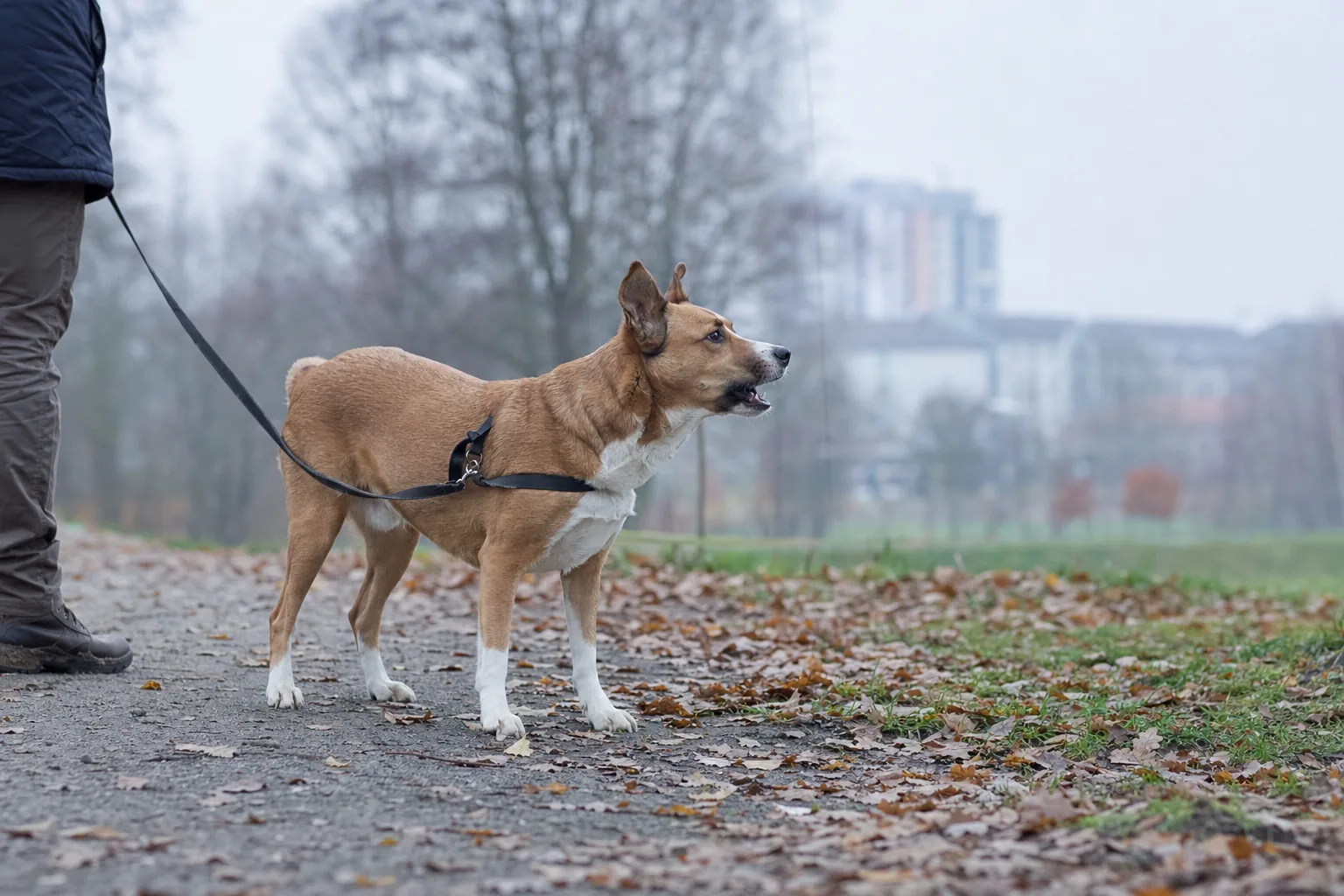
An ambulance goes down the main road and your dog lifts his nose and howls after it, long and low, until the siren fades. Or the neighbours tell you they hear him howling ten minutes after you leave, and it goes on for an hour. Or you have a dog who whines at the door, at the table, in the car, when you sit on the sofa, when you get up. A thin, endless sound that by seven in the evening has worn your patience to nothing. Howling and whining have different causes. They share a page because people search for them together, and because the plan starts from the same question in both cases: what is he trying to tell you?
Why does my dog howl, and why does he whine all the time?
Both are him talking, about different things. Let's take them one at a time.
Howling
The howl comes from the wolf. In wolves it keeps the pack connected over long distances: "I'm here, where are you?" In dogs the message has survived, in a few versions.
Sirens, music, other dogs. A siren has frequencies and a rise and fall that sound like a howl. The dog answers it as he would another dog, then the dog in the next block joins in, then a third. People assume it hurts his ears. If it did, he'd hide; instead he points his nose at the sound. When the siren stops, so does he. Some dogs howl at certain instruments, a harmonica or children singing, for the same reason.
Loneliness. Left alone, a dog howls to call his group back. When the howling starts in the first few minutes after you leave, goes on for a long time and comes with whining, pacing, drooling or damage at the door, you're looking at panic about being left. That's a different problem from noise. Set your phone recording when you go out and watch the first 20 minutes.
Breed. Huskies, malamutes, beagles, scenthounds and bassets howl more because they were bred to: hounds give tongue on a trail so the hunter knows where they are. A beagle baying in the garden when he smells a rabbit has a job and nowhere to do it.
Joy. Some dogs give a short howl when you come home, when visitors arrive, when you take the lead off the hook. It's part of the greeting and over in seconds.
Age. An old dog who starts howling at night, staring into space, wandering empty rooms, may be disoriented: poorer hearing, poorer sight, cognitive decline. The first step there is the vet, so you'll find it again in the health section.
And yes, there's an old superstition that a howling dog foretells a death. He howls at a siren, out of loneliness or at a dog far away. He knows nothing about the future.
Whining
It's the sound a puppy uses to call his mother. It stays, for life, the sound a dog uses to ask for something or to tell you he doesn't feel right.
Asking. He wants out, wants food, wants to get out of the car, wants you to play. He looks at you or at the thing he wants, whines and waits. If you've answered a few times, he has learnt that this is how you get things. It's the most common kind and the easiest to fix. It's also the easiest to keep going without meaning to, because every time he gets what he asked for, he learns it's worth trying again.
Excitement and frustration. He whines in the car on the way to the park, when he sees another dog he can't reach, when you're waiting at the lights with the ball in your hand. The sound is high-pitched, his body can't keep still, sometimes he spins. There's too much going on inside him and nowhere for it to go.
Appeasement. He whines and makes himself small when you tell him off, when a bigger dog approaches, when you raise your voice at someone else at home. The sound is short, with ears flat and a flick of the tongue over the lips. He's telling you he wants no trouble.
Fear. Whining at noises, in new places, at the vet's, when left alone. His body pulls back, tail low, eyes looking for a way out.
Pain. Whining when he gets up, when he lies down, when you touch a particular spot, on the stairs, at night in his sleep. Or constant whining with no target in a dog who never used to. There's nothing to train here. Go to the vet.
A puppy's first nights. He cries because it's the first time he's been alone, without his littermates, somewhere strange. That's normal. How you respond in the first week decides whether it lasts three nights or three months.
What doesn't work, even when it seems to
Shouting. To a dog, a person raising their voice while he howls is a person howling along with him. With whining, shouting is still attention, and the dog who wanted attention has just got it.
Giving in on the tenth whine. You ignored him nine times and on the tenth you opened the door. What he learnt is that he has to keep it up for ten minutes. An answer that comes only now and then makes him persist harder than anything else, and that habit is the hardest to undo.
Anti-bark collars. They stop the sound through discomfort and leave untouched the reason he makes it. For a dog howling out of loneliness, they add pain on top of panic. We don't use them and we don't recommend them.
Leaving the puppy to cry all night "so he learns". Some puppies tire and go quiet. Many learn that nobody comes. That's resignation, and it comes back later as anxiety. In the first week a puppy needs to sleep near you, with the crate or bed by your bed and your hand on the mesh when he whines.
Ignoring whining "on principle" without asking why. Ignoring works for demands. For pain, for needing to go out and for fear it's a mistake: the dog is telling you something true, and you're looking the other way.
Battling the siren howl. It can be done, but it takes weeks to get rid of ten seconds of howling a day. If you live near a hospital, move his bed to a room at the back. If he howls briefly and stops by himself, leave him be.
The plan, step by step
1. Three days of diary
For every episode, note the time, what happened just before, what his body was doing (how he stood, where he looked), what you did and how long it lasted. After three days a pattern shows. The dog who whines every morning at 6:40 wants to go out. The one who whines when you get up from the sofa wants you to come back. The one who whines when he gets up himself may have a joint problem.
2. Meet the real need before he asks
Half of demand whining disappears once the need is met before it turns into a demand.
- Toilet trips at the same times, a little before the time he usually starts whining.
- Meals at fixed times, from stuffed toys, so they last longer.
- Exercise and nose work early in the day: a 30-minute walk on a long line where he chooses the way and sniffs as much as he likes. A dog with a tired nose whines less in the evening.
- A place of his own, a bed or blanket, where good things turn up and where he can go when he's wound up.
3. For demand whining, quiet brings the good stuff
The need is met and he still whines to get something out of you:
- Whining brings nothing. No look, no word, no "no". Look at your phone, turn your back.
- In the first second of quiet, turn to him, praise him warmly and give him what he wanted if it's reasonable (attention, going out, a game). If it isn't, food off the table for instance, he gets your attention and something else good instead.
- Stretch the quiet slowly: one second today, three in a week, ten in two weeks.
- Everyone at home does the same. If one person gives in, you all start again.
The first three or four days are noisier, because he tries harder at what used to work. That is exactly how you know the plan has started to bite.
4. For excited whining, turn the volume down
In the car to the park, at the door before a walk, at the sight of another dog. Here you don't ignore. You work:
- The car only moves when he's quiet. If he whines, pull over, wait for 30 seconds of silence, then drive on. Within two weeks he links quiet with moving.
- The lead comes off the hook, and if he whines and jumps, it goes back and you sit down. Start again when all four paws are on the floor. On day one this takes five minutes, a week later ten seconds.
- With other dogs, work from the distance at which he can see them but can still look at you and still eat. There, every glance at you earns praise and a good treat. The distance comes down over a few weeks.
5. Howling out of loneliness needs its own plan
If the footage shows howling from the first minutes, with pacing and damage at the door, the steps above won't be enough. It's worked on with very short absences built up gradually, no departure ritual, camera running. It takes months. Get help from a behaviour specialist in the first few weeks and talk to your own vet; for some dogs, treatment from the vet is what makes the plan workable. We have a separate page on separation anxiety.
6. A puppy's first nights
For the first 7 to 10 nights the crate or bed sits next to your bed, as close to you as you can get it. When he whines, put your hand on the mesh, without talking. If he wakes after 3 or 4 hours' sleep, take him out in silence, then straight back to bed, no play. After two weeks move the bed half a metre a night towards where it will stay.
The first week
| Day |
What you do |
| 1–3 |
Keep the diary. Film the first hour after you leave home. |
| 2 |
First sniffing walk, 30 minutes, in the morning. Meals come from toys. |
| 3 |
Sort the diary episodes: demand, excitement, fear, possible pain, loneliness. |
| 4–7 |
For demand whining, only quiet brings good things, for everyone at home. Practise the lead and the car for excited whining. |
| 7 |
Reread the diary. If you ticked "possible pain" even once, book the vet; if you ticked "loneliness", the specialist. |
When it might be a health problem
- he whines when getting up, lying down, climbing stairs, jumping into the car, or when you touch a particular spot;
- he whines at night, in his sleep or on waking, when he never used to;
- constant aimless whining with restlessness, panting, odd postures (hunched back, the "prayer position" with chest down and bottom up): this can be belly pain, and with a swollen belly and retching it's an emergency;
- an old dog howling or whining at night, staring into space, getting stuck in corners, no longer answering to his name;
- a bitch whining 6 to 8 weeks after her season, gathering toys and making a nest: possibly a false pregnancy;
- the noise started after a new medication or a change of food.
Tell your own vet exactly what you noted: the time, the movement after which he whines, how long it lasts. Film an episode, because on the consulting table dogs go quiet.
When to call a specialist
- the footage shows howling and panic in the first minutes after you leave;
- the whining comes with growling, a stiff body or biting when you touch him or take something away;
- the noise goes on for hours with no visible reason, and your vet has ruled out pain;
- he has hurt himself (claws, teeth, muzzle) trying to get out of a room while howling;
- you've kept to the quiet rule for three weeks without slipping and the demand whining hasn't dropped at all;
- the howling has led to trouble with the neighbours and you need a plan with deadlines.
An assessment session with us starts from the diary and the footage. With this problem, what we find most often is a dog whining for three different reasons in the same day, and a person answering all three the same way.
A behaviour that appears suddenly or changes for no apparent reason can have a medical cause. For full details, consult your dog's own veterinarian.