It was evening and your dog was asleep on the rug. All of a sudden he went rigid, fell onto his side and started paddling his legs as if he were running, his mouth full of saliva and his eyes open but not seeing you. It felt like forever. By the clock it was probably a minute and a half. Then he got up, staggering, walked into the table, drank half a bowl of water and looked at you like a stranger.
He is fine now. You are not. Below is what that was, what to do next time, what to write down and what the trip to your own vet looks like. Whether he needs treatment, and which, is the vet's call, made on the results of the tests.
When is a seizure an emergency?
A single seizure lasting a minute or two, with the dog back to himself within half an hour, does not mean a dash out at midnight. It means seeing the vet the same day or first thing next morning, with the video on your phone. The situations below are different. Set off for the practice now and ring from the car so they are ready when you arrive.
- The seizure lasts more than five minutes, timed on a clock. Memory is no good here: during a seizure, one minute feels like five.
- A second seizure starts before he has fully come round from the first.
- He has two or more seizures in the same day, even short ones.
- After the seizure he does not get up, does not know you and cannot swallow even after 30 to 60 minutes.
- He is a puppy under six months, a very small dog, or a diabetic dog on insulin. In these dogs seizures often come from low blood sugar.
- She is a nursing bitch, because a drop in calcium causes trembling and seizures.
- You suspect he has eaten something: the sweetener in chewing gum or "sugar-free" baking, slug or rat poison, human medicines, a lot of chocolate.
- He feels very hot to the touch after a long seizure. Muscles working that hard produce heat, and the dog can overheat.
In the car, lay him on a blanket, on the floor or the back seat, with someone beside him and away from the doors. At the practice, tell them what time it started, how long it lasted, how many there were and what you saw.
What to write down at home after a seizure
The vet will almost never see a seizure. You do, and what you bring to the appointment is most of what the vet has to go on.
Film it and time it
It feels wrong to reach for your phone at that moment, but it is the single most useful thing you can do. From 30 seconds of footage the vet can tell whether it was a generalised seizure (the whole body), a focal one (only part of the body) or something that just looks similar: a faint from the heart, a balance episode coming from the inner ear, a lively dream. Hold the phone sideways and get the whole dog in the frame.
Start the timer when he goes down and stop it when the thrashing ends. Separately, note how long it took before he was walking normally again.
Before, during and after
Write down what he was doing beforehand: asleep, playing, just eaten or not eaten for a while, hot, wound up, someone at the door. Some dogs have a spell, minutes or hours ahead, when they are clingy, restless, hiding or looking for a corner. If you learn to spot it, you have time to get him somewhere safe.
Then the seizure itself. Maybe he fell on his side, went stiff, paddled, drooled, weed or pooed, chattered his teeth. Maybe it was only twitching in the face or one leg, or standing up snapping at the air. And this matters a lot, so note whether he was aware. Did he respond to his name, did he look at you?
Last, what he was like afterwards: disorientated, as if blind, bumping into furniture, drinking a lot, wolfing his food, sleeping for two hours, snappy for a few minutes. And how long it all lasted.
The diary and the history
One line per seizure: date, time, length, what came before, what he did, how long recovery took, whether you filmed it. Some seizures come during sleep or on waking, others on stressful days or after a skipped meal. A pattern shows up after a few episodes and carries weight when the vet decides on treatment.
Add his breed (epilepsy is inherited in some breeds), his age, any older episodes you may have put down to dreaming, a knock to the head, a fever or a recent illness, any medication he takes and everything he could get at in the house and garden.
What can cause seizures, by age and signs
| Cause |
When it usually shows |
What makes the vet think of it |
| Idiopathic epilepsy (no lesion, often inherited) |
First seizure between 6 months and 6 years |
Normal between seizures, normal neurological exam, a predisposed breed |
| Low blood sugar |
Small-breed puppies, diabetic dogs on insulin, dogs who ate sweetener |
Seizure a few hours after a meal or after insulin, and it repeats |
| Toxins (slug or rodent bait, human medicines, some plants) |
Any age, out of the blue |
Continuous tremors before the seizure, drooling, vomiting, access to the substance |
| Liver disease (a shunt from birth or damage that came later) |
Puppies who fail to grow; adults with abnormal bloods |
Seizures after meals, dullness, weight loss, sometimes odd urine |
| Tumour or other process in the brain |
Mostly over 6 to 7 years |
Seizures starting in old age, behaviour changes between seizures, circling |
| Inflammation of the brain (encephalitis) |
Young and middle-aged dogs, some small breeds |
Fever, neck pain, fast changes from one day to the next |
| Low calcium |
A nursing bitch, in the first weeks |
Trembling, fast breathing, then a seizure |
The first thing the vet looks at is his age at the first seizure. A three-year-old with a normal neurological exam between seizures most likely has idiopathic epilepsy. A nine-year-old having the first seizure of his life needs different tests.
What the vet will check after a seizure
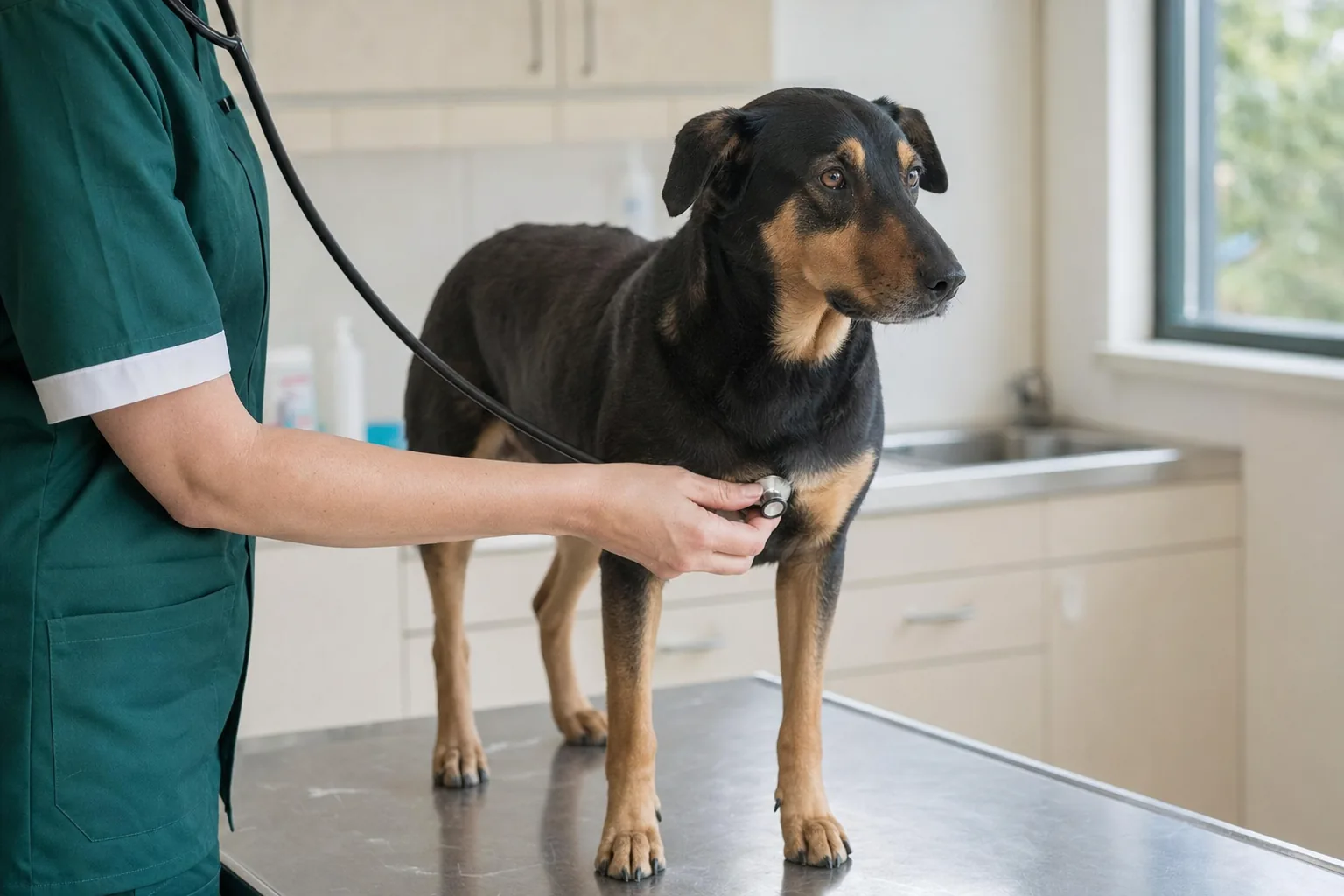
- Asks for your video and diary before anything else. With them, some causes can be ruled out straight away.
- Does a general and a neurological exam: gait, head position, reflexes in each leg, pupil response, whether he blinks when a hand comes towards his eye, feeling in his face. Between seizures, a dog with idiopathic epilepsy has a normal exam. An asymmetry or a missing reflex sends the vet down a different road.
- Takes blood: glucose, liver function (often with a special test, bile acids, before and after a meal), kidneys, electrolytes, calcium, a full blood count. This looks for causes outside the brain, which are treated differently and sometimes go away once the cause is dealt with.
- Depending on his age and the bloods, checks a urine sample and blood pressure as well.
- Listens carefully to the heart if the video leaves room for a faint rather than a seizure, sometimes with an ECG or a heart scan.
- Refers you to a specialist centre for an MRI and a sample of the fluid around the brain and spinal cord (cerebrospinal fluid) if the first seizure came before six months or after six years, if the neurological exam is not normal, if seizures come in clusters or do not respond to treatment. Both are done under general anaesthetic. Not every dog needs them, and the vet will tell you whether yours does.
- Decides whether to start treatment. International guidelines generally recommend long-term treatment after two or more seizures in six months, after cluster or prolonged seizures, or after a very rough recovery. After a single short seizure with normal bloods, the usual approach is to wait and keep the diary up to date. Treatment aims for fewer, milder seizures, often none at all. Nobody can promise you he will never have another.
- Sets the follow-up. Once treatment starts, there are blood tests at intervals the vet decides, to check drug levels and the liver. Treatment is given every day, at fixed times, for years, and is never stopped suddenly.
Before you leave, ask three things: which sign means coming straight back, when the next check is, and whether you can have a written plan for a long seizure at home, in case one happens before then.
What not to do during and after a seizure
- Do not put your hand in his mouth. Dogs do not swallow their tongues, and that myth has cost a lot of fingers. The jaws clamp shut with no control and no intent.
- Do not hold him, hug him or pick him up while it is happening. It does nothing for him and you can get hurt. Move the chairs away and, if he is near the stairs or a radiator, pull him clear by the blanket under him. That is all.
- Do not give him water or food until he is walking straight and swallowing normally. A dog who is still disorientated can choke.
- Do not try to bring him out of it with cold water, shouting or shaking. A seizure cannot be stopped from the outside.
- Do not give him anything from your own medicine cabinet, no human sedatives, nothing left over from another dog. If the vet decides you need something for a long seizure at home, the vet will supply the right product and show you how to use it.
- Do not skip doses or stop treatment because "he hasn't had one in three months". Stopping suddenly is one of the most common causes of cluster seizures in treated dogs. Any change happens with the vet, gradually.
- If he has had seizures, do not let him swim alone or leave him unsupervised on the sofa or bed. A seizure in water or a fall from a height does more harm than the seizure itself.
- Do not swap the vet's follow-up for diets and oils you found online. Some "natural" products make seizures more likely. If you want to change his food, tell the vet first.
- Do not tell him off for weeing, pooing or snapping during a seizure. He was not conscious at the time.
A house that is ready for the next one
A quiet corner with a mattress on the floor, where you can take him if you catch the warning spell. During the seizure, dim lights and the TV off. Afterwards, the door shut so he cannot wander onto the stairs while he is still confused. Your phone has the practice number saved, plus an out-of-hours clinic nearby. The diary lives somewhere anyone in the house can find it.
Everyone who looks after the dog, older children included, knows the three rules: the clock, the phone, hands away from his mouth.
Most dogs with idiopathic epilepsy live for years with rare seizures and an almost normal life, training included, as long as your own vet knows what they are doing and when. Your share is the diary and the fixed times. If you do not have a practice yet, our related services page will help you choose one.
The information on this page is educational and does not replace an examination. For full details and a diagnosis, consult your dog's own veterinarian.