It is New Year's Eve, fireworks are going off outside and your dog is standing in the middle of the room shaking from nose to tail, ears flat. In another house, a twelve-year-old dog's back legs tremble while he stands, and stop as soon as he lies down. In a third, a three-month-old toy puppy has been shivering and has not eaten since breakfast; he lies in your arms like a rag. And in a fourth, the dog is trembling and drooling, and now he has been sick too, an hour after you found a chewed chocolate wrapper on the floor.
Four situations, four different answers. The first passes when the fireworks stop. The second needs a check-up, but not tonight. For the third and fourth you ring your vet now, not after you have waited to see. Below: how to tell them apart, what to film, what to write down, what the vet will check and what not to do at home.
When is shaking an emergency?
Ring your vet or head to the clinic now if:
- he is trembling and drooling, vomiting, restless or disorientated, especially if he could have got at chocolate, sugar-free gum or sweets, mouldy food or compost, slug or rat poison, insecticide or your own medicines. That is what poisoning looks like; take the packaging with you;
- the trembling turns into a seizure: he falls on his side, does not respond, paddles his legs, drools, wets himself. Do not put your hand in his mouth. Move things away from him and check the clock. Film it. Ring when it ends, or during it if it goes on for more than a few minutes or comes back;
- a toy-breed puppy under six months is shivering, floppy, wobbly, glassy-eyed or has not eaten for a few hours. Low blood sugar can kill him within hours;
- a nursing bitch, one to four weeks after whelping, becomes restless and pants, trembles and goes stiff. Eclampsia is an emergency measured in hours;
- he is shaking and cannot stand, staggers, falls over, tilts his head or his eyes flick from side to side on their own;
- he is shaking and has a fever (above 39.2 on a rectal thermometer), or feels cold to the touch and is flat after cold weather or a bath;
- he is shaking and whimpering, standing hunched, will not let you touch a particular spot, cannot settle. That is pain, and severe pain is an emergency;
- he has been shaking for more than an hour and you cannot see why: the house is warm, no fireworks, no visitors;
- he is an unvaccinated puppy, or his course is not finished, who has had a cough or discharge from his eyes and nose and now has rhythmic twitching in one muscle. Distemper causes twitching that carries on even in sleep.
What to watch and write down at home
The most useful thing you can do is take a thirty-second video. Shaking never performs on cue at the surgery. Your vet wants to see whether it is the whole body or one leg, fine or coarse, whether it stops when the dog moves or lies down, and whether he can see you and respond to you during it.
Tremor or seizure?
During a tremor the dog is aware: he follows you with his eyes, comes when called, takes a treat from your hand. During a seizure he does not respond and usually falls. That one difference decides whether you are booking a check-up or driving to the clinic.
Where and how
The whole body, only the back legs, only the head (a fine "yes-yes" nod in an otherwise normal dog), a single leg, the jaw. Fine like a shiver, or coarse. While standing, at rest, asleep. Twitching paws and lips in sleep are dreams, and that is normal.
When and in what context
Write down the time. What was going on in the house: noise, visitors, you leaving. What it was like outside: cold, rain, or he had just had a bath. Before or after food, after exercise. Some dogs shake before something they love. Ours tremble with excitement while we put the trailing harness on and stop the second they set off. Note how long it lasted and how it stopped.
The rest of the dog
Appetite, thirst (especially if he has been drinking more lately), vomiting, diarrhoea, weight, how he walks, how he gets up in the morning. His rectal temperature, if you can take it.
Age and history
For small puppies, when the last meal was. For older dogs, how long it has been going on and whether it is getting worse. For bitches, the last season and whether she is feeding a litter. Vaccinations. Any medication he is on, because some cause tremors.
What he could have got into
Go through the house like a detective, even if it feels silly: the bin, your handbag, the gym bag with gum in the pocket, the cupboard under the sink, the garage, the garden with slug pellets, the compost heap, the mouldy walnuts under the tree.
Common situations, as a rough guide
| Situation |
What it looks like |
What you do |
| Cold: wet coat, small dog or no undercoat |
Shivering that stops as he warms up |
Towel, warm spot; if it has not stopped within half an hour, ring |
| Fear (fireworks, thunder, the vet's) or excitement (before a walk) |
Whole body, ears back or fidgety; passes when the cause goes |
Quiet, distance, no telling off; for noise fear, a plan with a professional |
| Pain |
Trembling with a hunched back, panting, not wanting to move, crying out when touched |
Vet today |
| Nausea |
Trembling with lip licking, drooling, gulping, eating grass |
Vet if it keeps happening; see also the page on vomiting |
| Older dog, back legs while standing |
Fine tremor that stops when he lies down; otherwise well |
Booked appointment: checks for joint pain and muscle weakness |
| Small puppy who has not eaten or has been sick |
Shivering, floppy, wobbly, glassy-eyed |
Now |
| Young dog, often a small breed, fine tremor all over, nothing else to explain it |
Whole body, worse with excitement and exercise; dog fully aware |
Vet: there is a generalised tremor syndrome that responds to treatment prescribed by the vet |
| Poisoning |
Trembling with drooling, vomiting, agitation, big pupils, disorientation |
Now, with the packaging |
| Seizure |
Falls, unresponsive, paddling, drooling, loses bladder control |
Film it, keep him from hurting himself, ring |
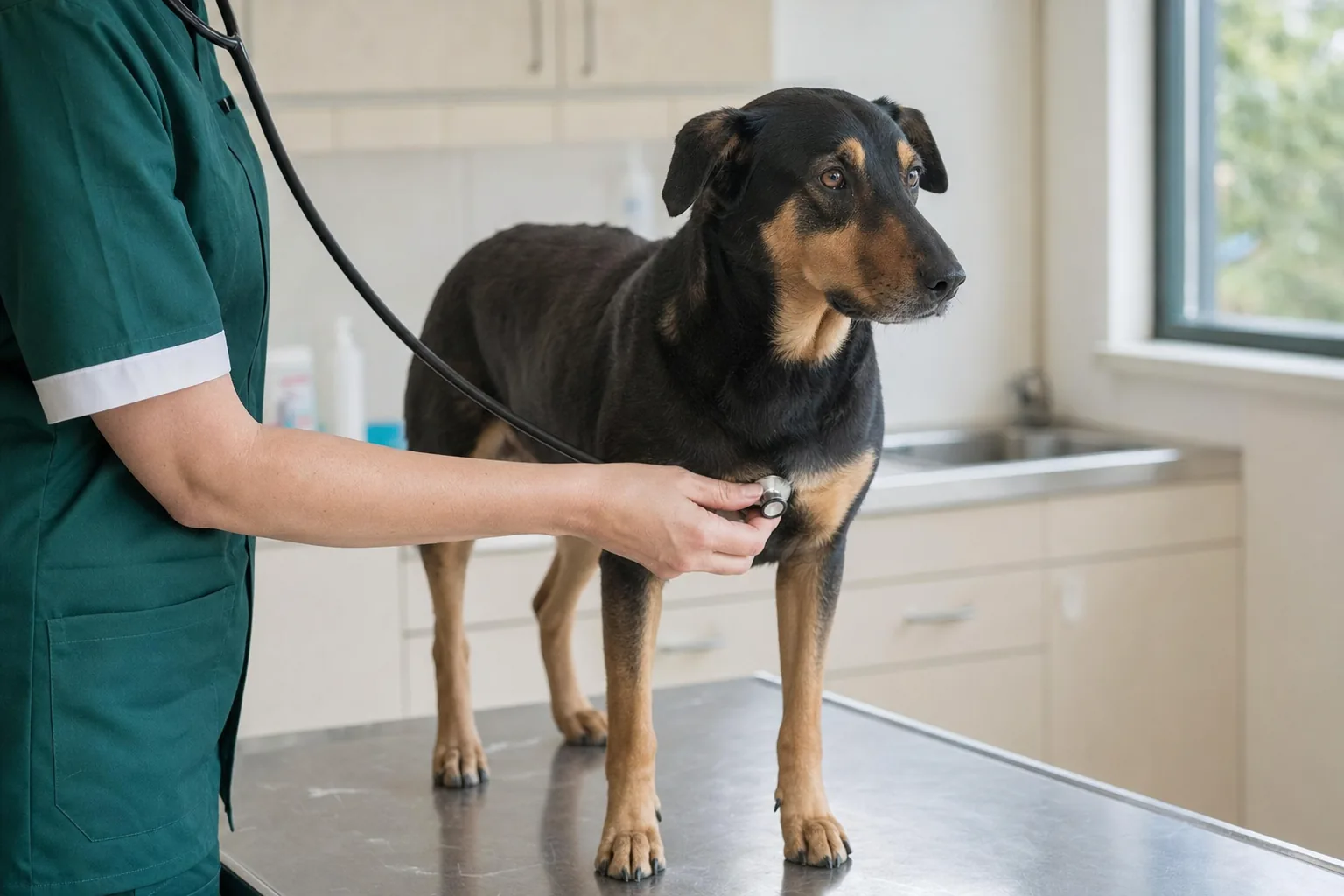
What will the vet check?
- Your account and the video. The video is by far the most valuable thing you bring.
- A physical exam: temperature, gums, hydration, heart, abdomen. Then a neurological exam (reflexes, gait, head position, eye movements) and an orthopaedic one (every joint, the spine). Pain is one of the most often missed causes of trembling.
- Blood tests. Blood sugar straight away in puppies and weak dogs. Electrolytes, including calcium, in nursing bitches. Kidney and liver values. A full blood count (how many blood cells there are and what they look like). Sometimes thyroid and adrenal hormones, in dogs with vague signs that have lasted for weeks.
- A urine sample shows how the kidneys are working and how dehydrated he is.
- If poisoning is suspected, supportive treatment starts at once, based on what you tell them, sometimes with targeted tests. The packaging you bring cuts all of this short.
- Imaging. X-rays of the spine or joints when pain is the question. For unexplained tremors, sometimes referral to a neurologist for an MRI and a spinal fluid test.
- A plan to suit the cause. Noise fear gets a behaviour plan and sometimes prescribed medication for the worst nights. Pain gets treated, along with whatever is causing it. The older dog's tremor is usually monitored, and any arthritis treated. Generalised tremor syndrome gets treatment from the vet and usually responds well. Poisoning means a stay in the clinic. Low blood sugar is corrected at the clinic and the puppy goes home with a feeding schedule.
Before you leave, ask which signs mean you should come back the same day, and whether to film any further episodes.
What not to do at home
- Do not give him your own medicines "to calm him down" or "for the pain". Some are toxic to dogs, and all of them mask exactly what the vet needs to see.
- Do not warm him with anything hot directly against his skin: a hot water bottle, a hairdryer, pushing him up against a radiator. A floppy or chilled dog cannot move away and will get burned. Use a dry towel or a blanket, a warm room, your own body next to him.
- Do not force food or water into a dog who is wobbly or struggling to swallow; he can breathe it in. If you suspect low blood sugar in a small puppy, ring the clinic first and ask what to do on the way.
- Do not try to make him sick after a suspected poisoning. Some substances do more damage coming back up, and a trembling dog can inhale the vomit. Go to the clinic.
- Do not tell him off for being scared, drag him towards what frightens him "so he gets used to it" or shut him away alone during fireworks. You can sit with him, stroke him and talk to him softly. Comforting him does not make the fear worse.
- Do not put your hand in his mouth during a seizure. He will not swallow his tongue, but he may bite you without meaning to or knowing he has.
- Do not wait until morning with a puppy who is shaking and floppy, a nursing bitch who has gone stiff, or a dog who has eaten chocolate.
- Do not put new trembling in an older dog down to age without a check-up. "He's old" is not a diagnosis, and arthritis can be treated in ways that change his days.
If he shakes at fireworks and thunder
It is not a whim and he will not grow out of it. It usually gets worse. Until you have a plan with a professional, set up an inside room with the blinds down and steady background noise, and get his favourite bed ready in advance. Stay nearby, calm, and do not haul him out of his hiding place. Do the evening walk before the bangs start.
Talk to your own vet in good time as well. There is prescribed help for New Year's Eve, but it needs discussing weeks ahead, not at eleven o'clock on the 31st. If you do not have a regular vet yet, our page on related services explains how to choose a practice.
The information on this page is educational and does not replace an examination. For full details and a diagnosis, consult your dog's own veterinarian.