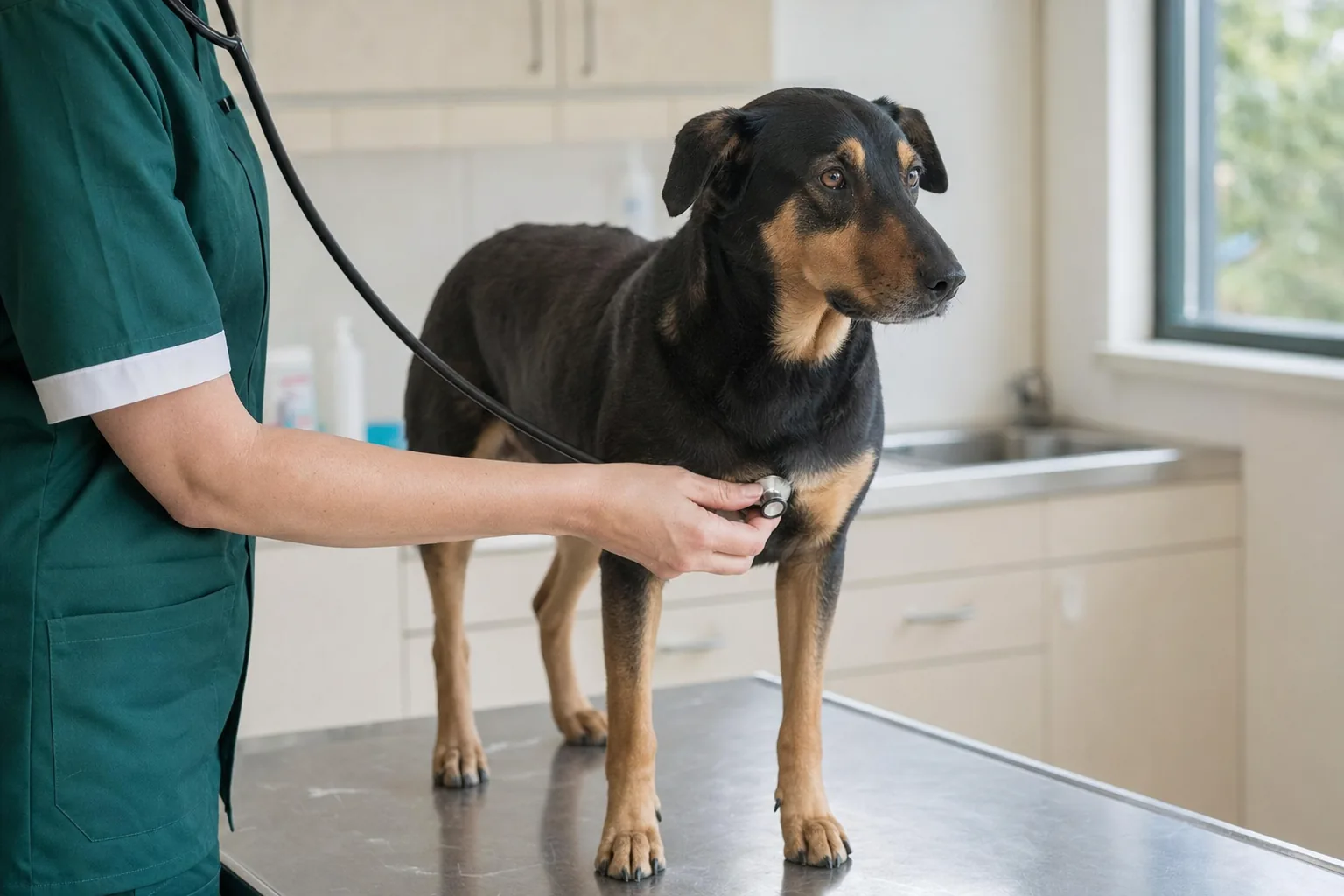
You've just got in from a walk and your dog, a Bichon or a six-kilo crossbreed, suddenly sits down on the rug and hauls himself forward with his front legs, bottom pressed to the floor. Third time this week. Or you have an old Labrador who licks under his tail until the fur is soaked and stops mid-walk to sit down on the grass. Videos of scooting dogs get a lot of laughs. For the dog it's an itch or a pain in a spot he can't reach any other way. Below is what you can check yourself before the appointment, what each sign tends to mean and what you leave to your own vet.
When to ring the vet today
One scoot across the rug after a soft stool means nothing. Ring the same day if you see any of these:
- a red or purplish swelling beside the anus, on one side, the size of a hazelnut or bigger, sometimes warm to the touch;
- blood or pus on the fur under the tail, on the carpet or where he has been lying. An anal gland abscess can burst on its own and leave a small hole next to the anus that leaks;
- he yelps when he sits down, keeps his tail clamped down and won't let you look;
- he strains to pass a stool and nothing comes out, or the stool comes out thin, like a ribbon;
- he licks under his tail almost non-stop, with the fur wet and the skin red and raw;
- he feels hot, is flat and off his food, signs that an infection has spread beyond the gland;
- in a dog over eight, a firm lump next to the anus that doesn't hurt and doesn't go away. It needs to be seen soon, because that is how anal gland tumours start.
On the phone, say what you see, since when, whether he has had soft stools in the last few days and how much he weighs. Until you get there, don't put anything on the area.
What you can watch for and write down at home
A dog scoots to rub the area under his tail, because it itches, hurts or feels full. Over two or three days you can gather the details your vet needs to get to the cause.
First, when he does it. Straight after a poo, indoors after a walk, at night, any time? Full anal glands usually cause scooting after a bowel movement and then again a few hours later. Itchy skin causes scooting at random, especially when the dog is lying still and has time to notice it.
Then how often. Log every episode on your phone with the time. Three in a week is a completely different picture from ten in a day.
His stools tell you a lot. Note how firm they are and what colour, whether they were soft in the days before, and whether you see anything small and white moving in a fresh stool or on the fur near his tail. Tapeworm segments look like grains of rice and dry out within a few hours, by which point they look more like sesame seeds.
The smell is a clue too. Anal gland secretion smells of rotten fish with a metallic edge. If you notice it on the sofa or his blanket after he has sat down in a fright, the glands have emptied themselves and were most likely full.
Wearing gloves, in good light, lift his tail and look at the area. You are looking for redness, one side more swollen than the other, scabs, fur stuck together with bits of poo, scratches from his teeth. In long-coated dogs, check there isn't a clump of dirty fur pulling on the skin. Take photos, even if it feels odd: your vet uses them as a reference a week later.
Check the rest of his skin as well. Is he scratching elsewhere, licking his paws, are his ears red, has he got patches on his belly? An itchy bottom is often just one end of a bigger allergy.
Finally, his history: his last worming treatment and the product (a photo of the box), his last flea treatment, any recent change of food, and whether anyone has emptied his glands before and when.
The causes and how they usually show
| Cause |
What you usually see |
What tends to go with it |
| Full (impacted) anal glands |
Scooting after a poo, licking under the tail, fishy smell |
Soft stools in the days before, a small or overweight dog |
| Inflamed or abscessed anal gland |
Swelling beside the anus, pain when sitting, sometimes blood or pus |
Fever, lethargy, tail held low |
| Intestinal worms (tapeworm) |
White, rice-like segments on the fur or in the stool |
Fleas in recent months, scavenging |
| Allergy (to food or something in the environment) |
Itching elsewhere too: paws, ears, belly |
Comes with the seasons or after a new food |
| Poo residue or dirty fur |
Matted fur, smell, red skin underneath |
Recent diarrhoea, a long-coated dog |
| Perianal fistulas |
Deep sores around the anus, severe pain when passing stools |
Mostly German Shepherds, middle-aged dogs |
| Anal gland tumour |
A firm, painless lump that grows slowly |
An older dog, sometimes drinking and weeing more |
The table helps you describe what you see. The decision is made at the appointment. And two causes can sit on top of each other: an allergic dog has soft stools, soft stools don't empty the glands, and full glands add their own itch on top of the allergy.
What your vet will do
- Ask since when, how often, what his stools have been like, what he eats, when he was last wormed and whether his glands have been emptied before. With your three-day log, this takes two minutes.
- Look at the area: the skin, whether both sides match, redness, wounds, worm segments, matted fur.
- Do a rectal exam. With a gloved, lubricated finger, the vet feels the anal glands from the inside. If you picture the anus as a clock face, the glands sit at four o'clock and eight o'clock. The vet can feel whether they are full, how firm they are, whether they hurt and whether there is a mass in the wall. It takes under a minute, and no photo can replace this step.
- Empty the glands if they are full, also from the inside, because that is the only way to get everything out. The vet looks at what comes out. Brownish fluid, watery or a bit thicker, means healthy glands that were simply full. A thick grey paste means blocked glands, and yellow or bloody material means inflammation or infection. Sometimes a little goes on a slide for the microscope.
- If there is an abscess or infection, flush the gland, perhaps take a sample for culture and decide on treatment. A burst abscess is cleaned and left to heal from the inside. You'll be told how long it takes and when to come back for a check.
- Ask for a stool test if worms are suspected, and look over all his skin if an allergy is suspected.
- In an older dog where a mass can be felt, run blood tests (calcium rises with some anal gland tumours) and imaging before any decision.
- Make a longer-term plan. For a dog who comes in month after month with full glands, you'll talk about weight, about fibre in the diet for a firmer stool, and about allergies. Surgical removal of the glands is the last resort, for repeated abscesses or tumours, because it carries its own risk of incontinence.
Before you leave, ask two more questions: how soon it is likely to come back, and which sign means you should come back sooner.
What not to do at home
- Don't empty his glands yourself after watching a video on your phone. Pressing from the outside without being able to feel the gland can push the contents into the surrounding tissue and cause exactly the inflammation you were trying to avoid. A healthy gland emptied as routine gets irritated and starts filling up faster. If your vet decides that regular emptying at home makes sense for your dog, they'll show you, on your dog, and you practise while they watch.
- Don't squeeze or lance a swelling. An abscess is opened at the practice, under local anaesthetic, and flushed.
- Don't put creams, ointments or disinfectants from the bathroom cabinet on it. Many irritate the skin and they all get licked off within five minutes anyway.
- Don't cut the matted fur next to the anus with scissors. The skin there is thin and cuts easily. Soften the fur with lukewarm water and tease it out with a comb, or leave it to a groomer.
- Don't give a wormer "just to see" before the appointment. If it wasn't worms, you've fixed nothing and lost a week.
- Don't change his food three times in a month to "test for allergy". A food trial uses a single diet for eight weeks, together with your vet.
- Don't tell him off for scooting. He is trying to get rid of an itch or a pain, and he has no other tool for it.
What helps day to day
The glands empty themselves when a firm stool passes, so a firm stool comes first: the right food, a healthy weight, as much water as he wants. Keep fleas under control all year, because fleas bring tapeworm. In long-coated breeds, have the groomer keep the fur under the tail short. And take a look under his tail once a week while you're brushing him anyway: a lump caught at hazelnut size means an appointment, one caught at walnut size means an operation.
A dog who scooted once and then nothing for two weeks needs nothing. One who does it every day, or shows any of the signs at the top of this page, needs a rectal exam from someone who knows what they are feeling for. If you don't have a regular vet yet, our related services page helps you choose a practice.
The information on this page is educational and does not replace an examination. For full details and a diagnosis, consult your dog's own veterinarian.