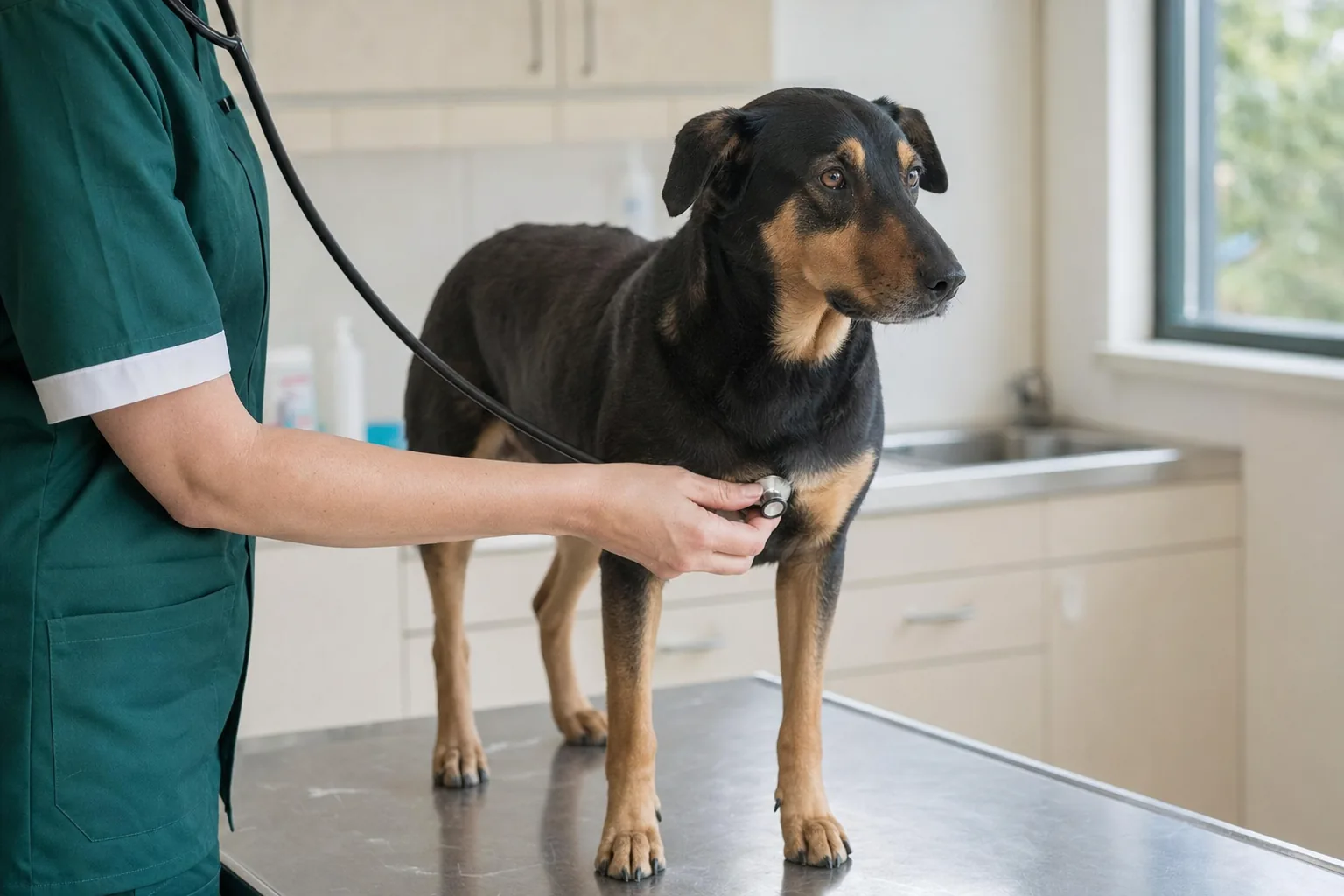
You have just brought home an eight-week-old puppy, and the person you got him from said "he's been wormed", with no date and no word on what with. Or your adult dog has had soft stools for a week, his coat has lost its shine and he wolfs down everything in the bowl yet keeps getting thinner. Or you have seen something white wriggling by his tail. Here you will find what to look for at home, what each sign means and when to ring your own vet. You will not find which medicine to give. That is your vet's decision, because the dose depends on the dog's weight and on the parasite the test turns up.
When worms cannot wait
Most worm infestations go unnoticed and get sorted at a routine check. A few situations will not wait:
- a puppy with a hard, swollen belly who is vomiting or has diarrhoea; in puppies a heavy burden can block the gut;
- stool with red blood in it, or black, shiny, tar-like stool;
- pale or whitish gums (press on the gum: in a healthy dog it is pink and the colour comes back in under two seconds);
- a flat dog who is not eating or drinking, or who has visibly lost weight in a week;
- a cough that will not clear in a young puppy (the larvae of some worms pass through the lungs before they reach the gut);
- worms in his vomit, especially in a puppy;
- any of the above in a dog under four months old or an elderly one.
Ring, say what you are seeing and since when, and ask whether to bring a stool sample. Do not give a wormer "to see what happens". In a dehydrated puppy, or one whose gut is packed with worms, both the timing and the product matter, and your vet should choose them.
What to watch at home, and how to bring a sample
The stool test makes the diagnosis. What you bring the vet is the pattern, so keep notes for a few days:
The stool. Its consistency (formed, soft, watery), its colour, any mucus or blood, how many times a day. A photo helps more than any description. Have a look with the naked eye as well. Roundworms look like whitish-yellow spaghetti, 5 to 15 cm long, and you see them mostly in puppies, sometimes after the first worming. Tapeworm segments look like grains of rice or cucumber seeds, move for the first few minutes after they come out and then dry onto the hair around the bottom.
The belly. In a puppy it is round and hard even on an empty stomach, while the rest of him is thin. In adults you rarely see anything.
Coat and weight. A harsh, dull coat that sheds more. A dog who eats normally, or even more, and still loses weight.
What he does with his rear end. Scooting along the floor, licking or nibbling under the tail. More often than not the anal glands are to blame rather than worms, but write it down anyway.
History. When he was last wormed and with what (next time, photograph the box). Whether he scavenges, has caught a mouse, drinks from puddles, has had fleas (fleas carry one kind of tapeworm). Whether there are small children or other animals at home.
The stool sample. When your vet asks for one, take a walnut-sized piece, fresh that day, put it in a clean bag or pot and keep it cool until you get there. Some tests need samples from three different days, because eggs are not passed in the same numbers every day.
Which parasites, and where they come from
| Parasite |
How the dog gets it |
What you usually see |
Risk to people |
| Roundworms (Toxocara) |
From the mother, before birth and through her milk; from contaminated soil |
Puppy with a pot belly, soft stool, spaghetti-like worms |
Yes, especially children, via soil and sand |
| Hookworms (Ancylostoma) |
Through the skin and from soil; from the mother |
Anaemia, pale gums, black stool |
Yes, through the skin, rarely |
| Whipworms (Trichuris) |
Eggs in soil, very hardy |
Diarrhoea with mucus, sometimes blood, weight loss |
Practically none |
| Tapeworm (Dipylidium) |
By swallowing fleas |
Rice-like segments by the tail, scooting |
Rare, children who swallow a flea |
| Echinococcus |
From raw offal from farm animals |
Nothing in the dog |
Yes, serious: cysts in the liver and lungs |
| Giardia (not a worm, a single-celled parasite) |
Contaminated water and soil, other dogs |
Soft, greasy, foul-smelling stool that comes and goes |
Possible, rare |
The same soft stool can come from several different parasites, and each one is treated differently. That is why the table cannot replace a test.
At the clinic: the test and the worming schedule
- Questions. Age, when he was last wormed and with what, how he lives (garden, town, hunting, scavenging), which dogs he meets, whether there are children at home. Your notes speed this up.
- Clinical exam. A feel of the belly, gum colour, weight compared with last time, the state of his coat, sometimes his temperature.
- The stool test. In a flotation test the eggs rise to the surface of a solution and are read under the microscope. A negative result does not mean he has no worms, because eggs are not shed all the time. That is why the test is sometimes repeated, or samples from several days are requested. There are rapid stool tests for Giardia.
- Blood tests, if the vet suspects anaemia or the dog is very run down.
- Treatment. The product is chosen for the parasite found or, in puppies, by the age-based schedule. The dose goes by his weight on the day, not his weight two months ago. Some treatments are repeated after 2 to 3 weeks, because they kill adult worms but not the eggs and larvae.
- The prevention schedule. For puppies, the European guidelines (ESCCAP) set worming from 2 weeks of age, then every 2 weeks until 2 weeks after weaning, then monthly until 6 months. For adults, at least 4 times a year, and monthly for high-risk dogs. The mother is treated at the same time as the pups. Your vet fits the schedule to your dog; one option is a stool test every 3 months, with treatment only when it comes back positive.
- Flea control, because fleas bring tapeworm. Treat the worms and forget the fleas, and the tapeworm is back within a few months.
Before you leave, ask when the dose is repeated and when the next worming is due. Put both in your phone calendar there and then.
What not to do at home
- Human wormers. The ingredients and doses are different, and some are toxic to dogs.
- Any old wormer for a puppy who is vomiting or has bad diarrhoea, before you have spoken to your vet. With a heavy burden, worms killed all at once can block the gut.
- A double dose "to be on the safe side", or a product for a 20 kg dog given to a 4 kg puppy. Weigh him first.
- Garlic, pumpkin seeds, cider vinegar and other home remedies instead of treatment. They do not clear worms, and garlic in quantity is toxic.
- Treating only one animal when you have several. They reinfect one another.
- Leaving poo in the garden or the park. Toxocara eggs survive in soil for years and end up exactly where dogs and children play. Pick it up straight away and it leaves with the bag.
- Raw meat and offal from farm animals that has not been frozen first. That is the route for Echinococcus.
- Putting it off because "he looks fine". Most infestations show nothing on the outside. That is exactly why the schedule exists.
Everyday hygiene
Wash your hands after playing with the puppy and before eating, children especially. Pick up poo straight away, in your own garden too. While he is on treatment, wash his bedding at 60 degrees. Keep fleas under control all year round, not just in summer. If you have small children and a new puppy, what protects you most is worming on time and a covered sandpit.
Intestinal worms are the easy part of looking after a dog. They show up on a test, are treated with a tablet and are prevented with a schedule; the hard part is remembering the schedule. If you do not have a regular vet yet, our page on related services will help you choose a practice.
The information on this page is educational and does not replace an examination. For full details and a diagnosis, consult your dog's own veterinarian.