Your dog gets up off the sofa and leaves behind a damp brown mark on the cushion and a smell of rotten fish. Or you have a cocker who smells "doggy" two days after a bath, whatever shampoo you try. Or a pug who drags his bottom across the living room carpet and keeps licking under his tail. A smell is telling you something, and on a dog it can come from about six places: the mouth, the ears, the skin, the paws, under the tail and the other end of the digestive system, as wind. Below is how to track down the source with your own nose, what anal glands are (the culprit everyone searches for) and what your own vet can do about each source. You will not find instructions for emptying the glands at home. Done at home, it usually does more harm than good.
When the smell is the tip of the problem
The smell itself is not an emergency. What lies behind it sometimes is. Ring today if:
- there is a red-purple swelling beside the anus, on one side, warm and painful; the dog yelps when he sits or will not sit at all. That is an infected anal gland about to burst;
- there is a hole beside the anus with blood or pus coming out. The abscess has burst; it will heal, but it needs veterinary care;
- he strains to pass faeces and cannot, groans, or what comes out is ribbon-thin;
- on top of the smell he is lethargic, off his food, running a temperature;
- there is a heavy smell of rotting meat from a wound or a damp patch of coat, especially in summer. Look for maggots: small white larvae that move. If you see them, go now;
- one ear smells strongly and the dog is holding his head tilted, walking in circles, losing his balance. The infection has reached the inner ear;
- an unspayed bitch has a foul-smelling discharge from the vulva a few weeks after her season and is drinking a lot. It may be an infected womb;
- the breath smells sweet in a dog who is drinking and weeing a lot, or of ammonia in a dog who is flat. It may be diabetes or kidney disease;
- the breath has turned rotten within a few days, he is drooling and refusing food. A broken tooth, an abscess, something wedged;
- a "fishy" smell becomes constant in an older dog who is drinking more and more. Anal glands can develop tumours, and some of them cause thirst.
For everything else, book an appointment this week, with the source already found.
What to look for and note at home
Find the place first. Sniff your dog section by section, the way a vet would: the mouth, each ear, the skin on the back and the belly, the folds (the face in flat-faced breeds, the base of the tail, around the vulva in overweight bitches), between the pads, under the tail. Note where it is strongest.
When it smells. All the time? Only after a fright or a lot of excitement (the anal glands empty by themselves when he is worked up)? After lying down, after a bath (the "wet dog" smell that will not leave), after a meal (wind)?
Marks. A yellow-brown oily mark on a cushion or the bed that smells of fish is anal gland secretion. A damp one without much smell is urine, usually an older spayed bitch leaking in her sleep.
What he does with his rear end. Scooting (how many times a day?), licking or nibbling under the tail, whipping round towards his tail as if something bit him, sitting down carefully.
Faeces. Soft for a few days, or always soft: a stool with no substance does not press on the glands on the way out, so they do not empty. Recent diarrhoea irritates the area and causes scooting too.
Ears. The smell (sweet and rancid, like old cheese, means yeast; like pus, bacteria), the colour of any discharge (dark brown like coffee grounds, yellow, black), whether he shakes his head, scratches, flinches when touched.
Skin and coat. Red, damp, hairless patches (a "hot spot" can appear within hours and smells bad), scabs, a greasy coat, dandruff, dark thickened skin in the folds. Where he scratches and how much.
Paws. A faint smell of corn snacks on the paws is normal; it comes from bacteria that live naturally between the pads. Red, damp paws that he licks constantly and that smell strongly are a different story.
Mouth. Lift the lip and look for tartar, red gums, a broken tooth. A fishy smell that seems to come from the mouth often comes from under the tail: he has been licking there.
What has changed. New food, scraps from the table, fewer walks, extra weight (overweight dogs have more trouble with both glands and skin folds), a new shampoo, more frequent baths, swimming in a lake.
Where the smell comes from, in short
| Smell |
Source |
What else you see |
| Rotten fish, metallic, sudden, after a fright or after lying down |
Anal glands |
Oily mark on the cushion, licking under the tail, scooting |
| Rotten fish all the time, pain when sitting |
Long-full anal gland, infected, abscess |
Swelling beside the anus, will not sit, yelps |
| Sweet and rancid, old cheese, yeasty |
Ears, folds, paws |
Brown discharge, head shaking, red greasy skin, itching |
| Pus |
Infected ear, wound, abscess, "hot spot" |
Yellow discharge, pain, moist redness |
| Wet dog that does not go once he is dry |
Skin: seborrhoea, infection, sometimes an underactive thyroid |
Greasy or dry coat, dandruff, smell back a day after a bath |
| Rotten, from the mouth |
Teeth and gums; occasionally something wedged |
Tartar, red gums, drooling, chewing on one side |
| Sweet or like pear drops, from the mouth |
Diabetes |
Drinking and weeing a lot, losing weight |
| Ammonia, urine |
Kidneys, or urine on the coat |
Drinking a lot, vomiting, flat; damp patch in the bed |
| Rotting meat, from a damp area |
Infected wound, maggots |
Larvae, matted coat, dog subdued |
| Wind |
Food, eating too fast, the gut |
Rumbling belly, soft stools |
Two pairs get mixed up all the time. Anal glands get mistaken for the mouth, because after a lick the smell moves. And bad skin gets passed off as "the breed smell". A breed does not smell. Unhealthy skin does.
What anal glands are and why they block
Two little sacs, anywhere from pea-sized to hazelnut-sized, one each side of the anus, at roughly four o'clock and eight o'clock if you picture it as a clock face. They make an oily, brownish, strong-smelling liquid that marks the faeces: the dog's calling card for other dogs. Normally they empty by themselves, a little at a time, when a firm stool passes and presses on them. If the stools are soft, if the glands sit deeper (common in small breeds) or if the dog is overweight, they stop emptying. They fill, the secretion thickens to a paste, they press and itch, and the dog scoots and licks. From there to infection and an abscess is not far. A healthy dog with normal stools never needs anyone to empty them.
What your vet will do
- Ask questions. Where you found the smell, since when, what the stools are like, what he eats, whether he scoots, whether he has had diarrhoea, whether he is wormed (tapeworm segments make dogs scoot too), which shampoo you use and how often.
- Examine him, including his weight and a body condition score: the vet feels the ribs and the waist. Excess fat plays a part in half the problems on this page.
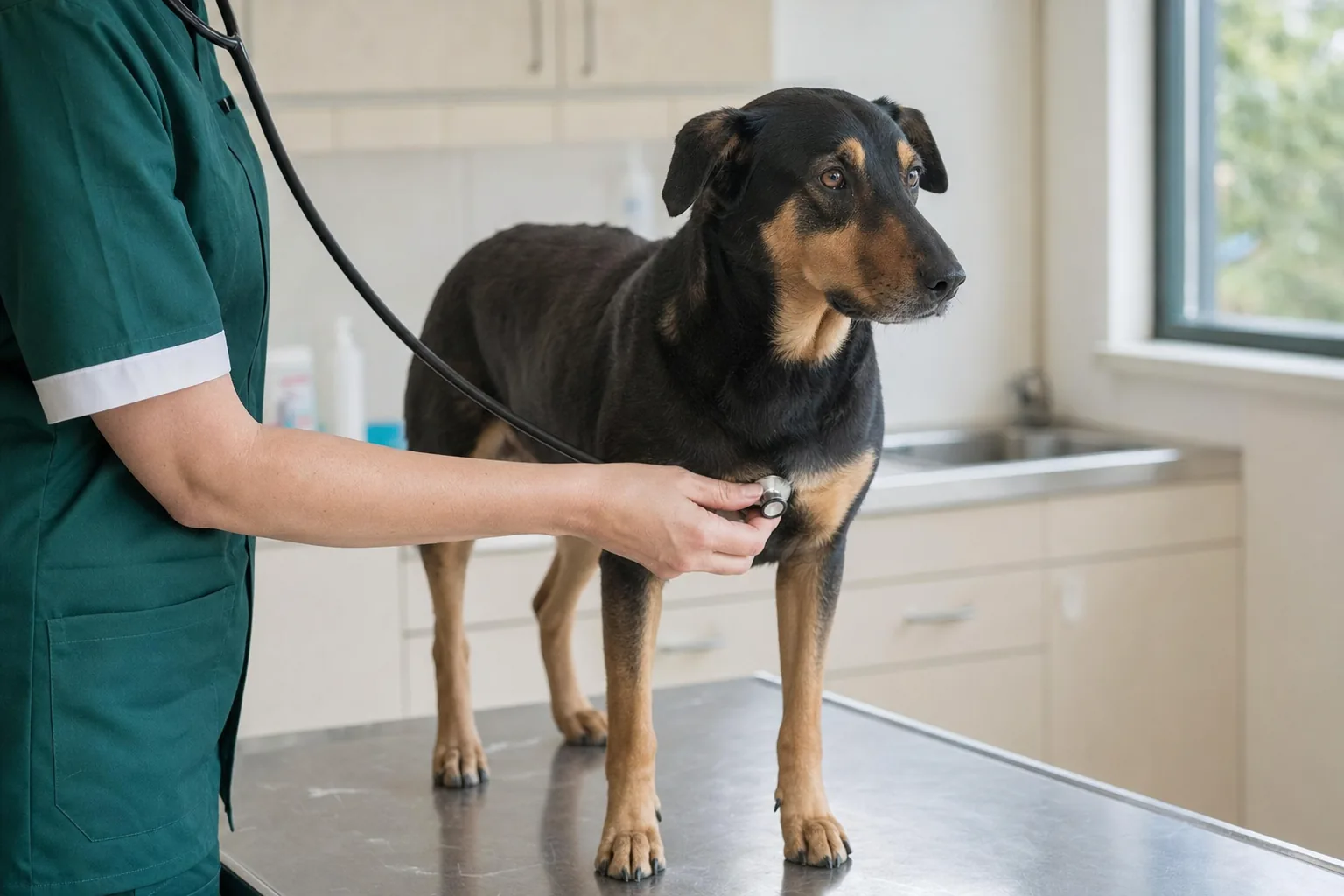
- Check the anal glands with a rectal exam, gloved: one finger inside, thumb outside. That is the only way to feel each gland, how full it is, whether it hurts, whether there is a lump, and the only way to empty it completely. The vet also looks at what comes out: normal brown fluid, thick paste, pus, blood. An infected gland gets flushed and the right treatment given. An abscess is opened and drained, usually with the dog sedated. When the problem keeps coming back every few weeks, you talk about the cause: the stools (more fibre), weight, allergies and, only as a last resort, surgical removal of the glands. In older dogs the vet feels carefully for tumours and, if anything seems off, asks for blood tests and a needle sample.
- Look in the ears with an otoscope (the light used to see down the ear canal) and take a sample of discharge on a slide for the microscope: yeast, bacteria, mites (in puppies, the coffee-ground discharge). The vet checks the eardrum is intact. Treatment is chosen on what they find, and ears that keep getting infected point towards allergy.
- Check the skin with sticky tape or a slide pressed on it, a light scrape for mites, sometimes a culture, and in dogs with a greasy coat and a smell that will not shift, a blood test for the thyroid. An allergy sits behind a lot of smelly skin.
- Mouth: a dental check and, if needed, a booking for a clean under anaesthetic.
- A plan for home, depending on the source: a medicated shampoo chosen by the vet, on a schedule; fibre in the food for firm stools; weight loss; fleas and parasites kept under control; ears cleaned with a dog ear cleaner as often as your vet says. Before you leave, ask whether and when you need to come back.
What not to do at home
- Do not empty the anal glands by following a video online. Squeezed from outside they only half empty, it hurts, an inflamed gland can burst, and done repeatedly it irritates them so they fill faster. A dog with no problems needs no emptying at all. A dog with problems needs a rectal exam at the vet.
- Do not ask the groomer to express them routinely at every trim. If he is not scooting or licking, the glands manage on their own. Squeezed from outside every six weeks, they start to stop managing.
- Do not bath him every day, whether with human shampoo or washing-up liquid. Dog skin has a different pH from ours, and frequent washing strips its protective layer. A week later he smells worse than before.
- Do not cover the smell up with perfume, "doggy" sprays or reed diffusers. You lose the signal and add an irritant to skin that is already unhappy.
- No cotton buds in the ear. You push the discharge down towards the eardrum and can rupture it. Ears are cleaned only by pouring in a solution and massaging the base, with the product and frequency your vet gives you.
- Do not pour vinegar, surgical spirit or household disinfectants into the ears or onto the skin. They sting, they dry, and on a ruptured eardrum they do damage.
- Do not put your own creams on red, damp skin. Many contain things he will lick off that are not meant for dogs.
- A swelling beside the anus is not to be pricked, squeezed or "drawn out". It is a gland about to burst or an abscess. The vet, today.
- Do not let scooting go on for weeks because "that's just what he does". Every week with a full gland is a week closer to an abscess.
- Do not blame the breed. A healthy cocker does not smell. One with yeasty ears and greasy skin does, and both can be treated.
If his glands keep causing trouble
Firm stools come before anything else; your vet may suggest more fibre or a more suitable food. Weight brought back to normal. Regular walks, because moving helps digestion. A diary of the days he scoots or licks, so you can see how long passes between episodes and whether the gap is getting longer. Go back to the vet when the gap drops below a few weeks. Surgery only comes up once everything else has been tried for a few months.
On a training day, a dog who empties his glands from excitement can be smelled from three metres away, and everyone grins. At home on the cushion, you grin rather less. A smell is easy to read if you go looking for it with your nose before covering it with perfume. If you do not have a regular vet yet, our page on related services will help you choose a practice.
The information on this page is educational and does not replace an examination. For full details and a diagnosis, consult your dog's own veterinarian.