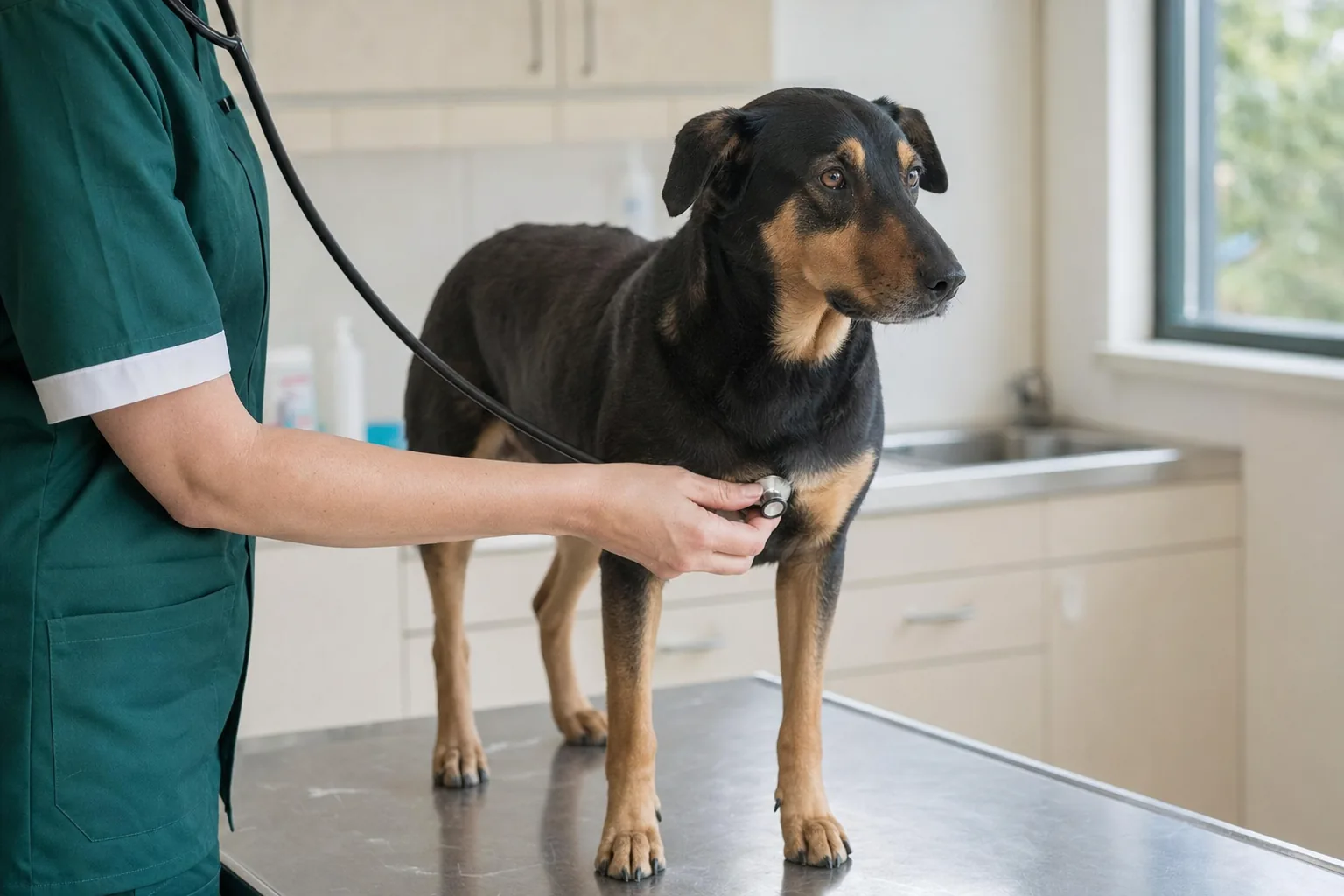
You are stroking his muzzle and your thumb slides over a smooth spot. A closer look shows a round bald patch about the size of a large button, its edge slightly flaky, as if someone had sprinkled dandruff on it. He isn't scratching. A week later there is another one on a front leg, and your child, who sleeps with the dog, shows you a red ring on their forearm that itches a bit. That is the classic start of ringworm, or dermatophytosis. It is treatable, but treatment runs for months, it spreads to people and other animals, and it needs proper tests. A cream grabbed off the chemist's shelf won't sort it.
When it can't wait for an appointment in two weeks
Ringworm isn't a midnight dash to the emergency clinic the way a poisoning is. A few situations still deserve a call to your own vet on the day you notice them:
- patches multiplying from one day to the next, or merging into large bald areas;
- skin that is moist, with pus, thick crusts, painful swellings or a bad smell;
- a dog who is flat, feverish or off his food;
- a very young puppy, an old dog, or one with a chronic illness or on treatment that dampens the immune system;
- a baby in the house, or someone with weakened immunity, for instance during cancer treatment or after a transplant;
- people at home who already have round, red, itchy patches. They should see their GP or a dermatologist the same week.
When you ring, describe the patches and ask how they want you to arrive. Some practices would rather you go straight into a consulting room than sit with an infectious dog among other animals in the waiting area.
What ringworm looks like and what to note at home
In everyday speech "fungus" covers two conditions with very little in common. Worth separating them straight away, because one spreads to people and the other doesn't.
Ringworm is the subject of this page. The fungi behind it live in the hair shaft and in the outermost layer of skin. Dogs pick them up from an infected animal (very often a cat), from soil if they dig, or from rodents if they hunt mice or poke about in burrows. The spores survive in the environment for a long time, up to around eighteen months, on brushes, blankets and furniture.
Malassezia is a yeast that lives on every healthy dog's skin. It only multiplies when the skin is already unwell, most often because of an allergy. Then you see greasy red skin, notice a rancid smell, the paws turn brown from licking and the ears get grubby quickly. The itch is intense. You can't catch it from the dog, and it is treated alongside whatever caused it.
Before the appointment, gather information. Your vet makes the diagnosis, but you are the one who has watched the patches change.
Photos. Photograph each patch with a ruler or a lighter beside it for scale, in the same light, every two or three days. Ringworm usually gives round or irregular bald patches with broken hairs at the edge, dandruff-like scale or small crusts. The skin may be its normal colour or slightly pink. The textbook ring, red at the edge and clear in the middle, is more common in people than in dogs.
Where. Muzzle, around the eyes, ears, paws and front legs. Those are the parts that touch the ground and other animals, so that is where patches tend to show up first.
Itch. Plenty of dogs with ringworm barely scratch at all. If yours is scratching himself raw, your vet will think of allergy, parasites or Malassezia first.
Contacts. A new cat in the house or garden, a recently arrived puppy, digging in the garden, mousing, a stay in kennels or a trip to the groomer. Then any other pets with patches, and any people at home with red marks on their skin.
What else it could be
| Cause |
What you see |
Spreads to people? |
| Ringworm |
Round bald patches, broken hairs, scale, little itch |
Yes |
| Malassezia |
Greasy red skin, rancid smell, brown paws, intense itch |
No |
| Demodicosis (a mite) |
Bald patches around the eyes and muzzle, mostly in puppies |
No |
| Sarcoptic mange |
Very intense itch, ear edges and elbows |
Yes, briefly |
| Bacterial infection of the hair follicles |
Spots, crusty rings, often on the belly |
No |
| Hot spot |
Moist, red, painful area that appears within hours |
No |
In a photo, half of those rows look much the same. That is why your vet won't diagnose from a glance.
How your vet confirms it and how long treatment runs
There are clear international guidelines for ringworm, and most practices follow them. Expect something like this:
- History and examination. Where the patches are, how long they have been there, which animals and people share the house. Your photos save a lot of time here.
- Wood's lamp. An ultraviolet lamp. In a darkened room, hairs infected with the most common of these fungi glow a yellow-green. Not every species glows, so a negative result doesn't rule ringworm out.
- Hairs under the microscope. Your vet plucks a few hairs from the edge of a patch and looks at them directly. Sometimes the fungus is visible there and then.
- Culture. The dog is brushed with a sterile toothbrush and the sample goes onto a special medium. Results take one to three weeks and name the exact fungus. This is the test the diagnosis rests on.
- PCR. A quicker lab test. It can come back positive from dead spores, so it is used for diagnosis rather than as proof the dog is clear.
- Treatment. Usually two parts: medicated antifungal baths or rinses twice a week, and in most cases a medicine given by mouth. Whether to clip a long coat is a decision for you and your vet; in some dogs it helps, in others it scatters spores round the house.
- The finish line. The hair grows back before the fungus is gone. Treatment normally stops after negative check-up cultures, often two in a row. That adds up to several weeks, often two to three months.
Ask about the cat as well. Cats can carry the fungus without a single patch, and then the dog keeps catching it back from them however carefully you treat him.
What not to do at home
- The antifungal cream from your own cupboard. Not without your vet's say-so. On a small patch it can hide the infection without curing it, the dog licks it off, and the culture may come back misleading.
- Internet remedies. Vinegar, garlic, iodine, bleach on the skin, tea tree oil. The last one is toxic to dogs.
- Stopping when the hair grows back. The fungus is still there. A few weeks later the patch returns, sometimes on your arm too.
- The dog in your bed or the children's room. Until your vet says he is no longer contagious, he sleeps in his own spot. Wash your hands after stroking him and after every treatment.
- Kennels, the groomer, group classes. All of them wait for negative cultures. At our training sessions a dog with active ringworm stays home until treatment is finished, so the fungus doesn't travel to the other dogs and the people in the group.
- Leaving the house to look after itself. A dog treated perfectly will reinfect himself from his own bed if the spores stay there.
The cleaning everything depends on
Spores are tiny and cling to dust, and disinfectant on its own doesn't reach them. You get them out by scrubbing and hoovering, again and again. Hoover twice a week and empty the bag or canister outside. Wash surfaces with detergent first, then go over them with the disinfectant your vet recommends. Blankets and beds go in the machine at the highest temperature the fabric will take, twice. Clean brushes and combs thoroughly or replace them. If you can, give the dog a room with a washable floor and no rugs during treatment; it is far easier to keep clean.
It is two months of work, maybe more. Ringworm treated all the way to the end stays finished. Half-treated, it can bounce between dog, cat and children for years.
The information on this page is educational and does not replace an examination. For full details and a diagnosis, consult your dog's own veterinarian.