His coat looked fine this morning. This evening, just under his ear, there is a red, wet, shiny patch the size of a jam-jar lid, with the hair stuck down around it, and when you reach for it he flinches or growls. By tomorrow it is the size of your palm. Maybe he is a retriever who swam in the lake on Sunday and was left to dry off on his own, or a shepherd with a dense undercoat in late August. This is a hot spot, a moist dermatitis that appears and spreads within hours, nearly always because something else set him off licking or scratching. Below: when to ring the vet today, what to note down, what the vet will do, and what you should never put on it.
When to ring the vet today
A hot spot will not kill him. It is an open wound, though, it hurts and it keeps getting bigger. Ring the same day if:
- the patch is growing by the hour, or new ones have turned up;
- it is on his face, near an eye, on his neck under the collar, or somewhere he can always get at with his teeth;
- he will not let you touch it, growls, hides away or cannot sleep for the itching;
- yellow-green fluid is coming from it, it smells, or you can feel hard lumps under the skin around it, which means the infection has gone deeper;
- he has a temperature, is flat, or is off his food;
- it is his third hot spot this year, so the cause needs finding.
Ring straight away, too, if he also shows signs of an ear infection: shaking his head, holding it on one side, an ear that is red and smells. A hot spot on the cheek very often starts at the ear.
What to look at and note down at home
A photo with a ruler next to it. Take one now and another six hours later, ruler beside the patch both times. The vet can tell from them how fast it is spreading.
Where it is. He cannot tell you what is itching, but where the patch sits often can:
| Where the patch is |
What may be behind it |
| Cheek, under the ear, neck |
An ear infection or an itchy ear; he scratches it with a back paw |
| Rump, above the tail, thighs |
Fleas (flea allergy), full anal glands |
| Near a joint (hip, knee) |
Pain: he licks the place that hurts |
| Anywhere, after a bath or a swim |
A thick coat that stayed wet against the skin for hours |
| Paws, belly, armpits |
Allergies, environmental or food |
Fleas. Stand him on a white towel and run a fine flea comb through the base of his tail. Black specks that go reddish on damp kitchen paper are flea dirt. In an allergic dog, one flea is enough.
What happened in the days before. A swim, a bath with no proper drying, a heatwave, a stay in kennels, a short clip, a new food, a missed parasite treatment. Write down when the scratching started and where.
The coat. In breeds with a dense undercoat, such as golden retrievers, Labradors, German shepherds, huskies and Newfoundlands, check whether dead undercoat has balled up against the skin. That is where the damp sits.
Until you get to the vet, if you have a protective collar at home (the cone from a previous visit), put it on him so he cannot reach the patch. That is as far as it goes. Nothing goes on the wound.
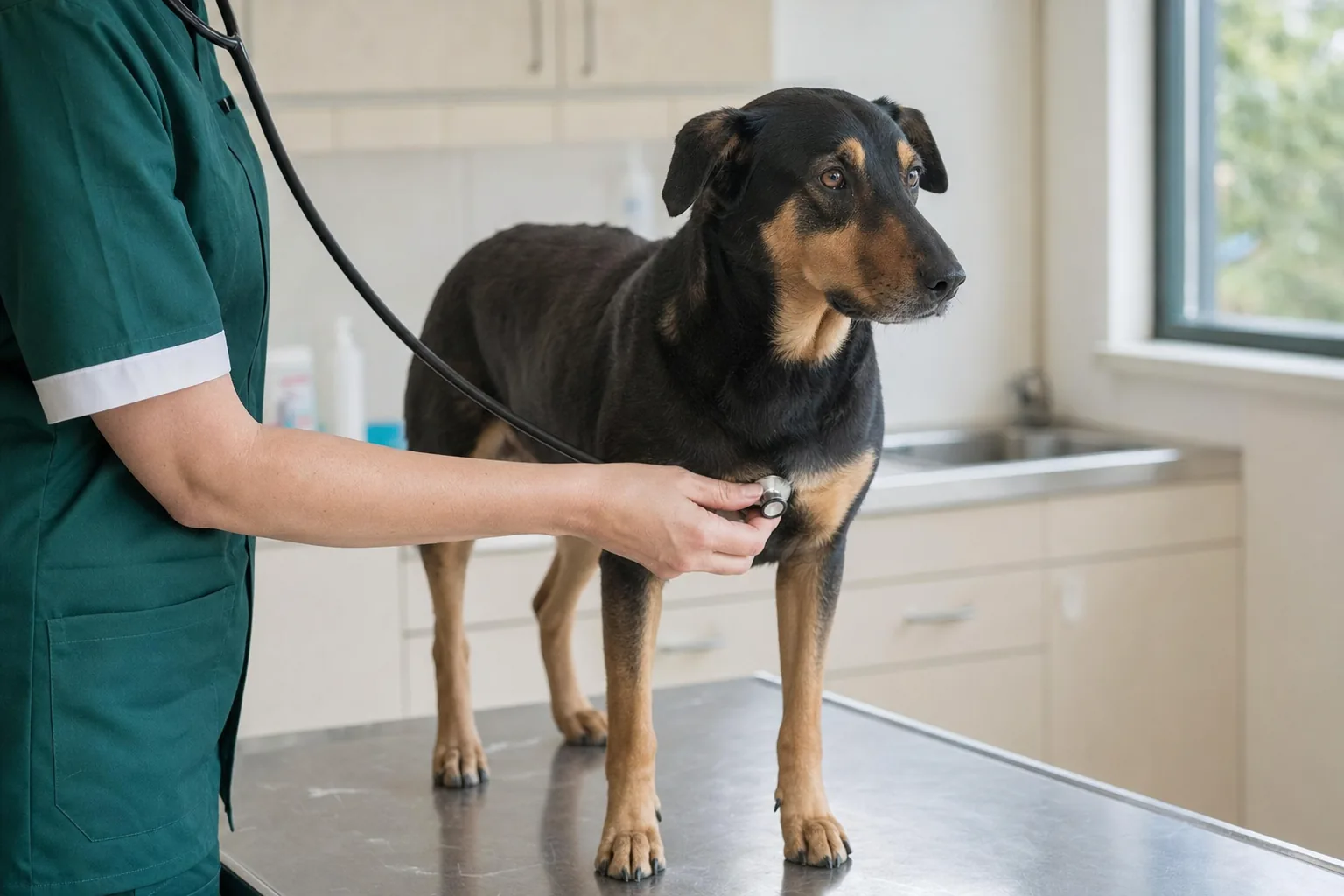
What the vet will do
- Look at the patch properly. The vet clips the hair over a wider area than the patch so all of it shows and the skin can breathe. It is often twice the size it looked under the coat. Because it hurts, some dogs are clipped and cleaned under light sedation.
- Check how deep it goes. A simple hot spot stays on the surface. Lumps, pustules or crusts around it point to a deeper skin infection, which needs different and longer treatment.
- Take a few cells from the wound. With sticky tape or a glass slide, to look at under the microscope: bacteria, yeast, and which defence cells are there.
- Hunt for the cause. Ears with an otoscope, the coat for fleas, the anal glands, the joints, and whatever you know about his allergies. Skip this part and the hot spot comes back.
- Decide on treatment. Cleaning the wound, something for the itch and the pain, sometimes treatment for infection, and separately whatever the cause needs (the ears, the fleas, the anal glands). The vet will show you what to apply at home and for how long.
- Fit a collar. He will almost certainly go home in a cone or a soft collar and wear it until the patch has healed. One minute of licking in the night can open the wound up again.
- Book a check-up, usually a few days later. Treated properly, the patch dries out, scabs over, and the hair starts growing back within two or three weeks.
If hot spots keep coming back, the vet will suggest an allergy plan. That might mean strict flea control all year, an elimination diet if a food allergy is suspected, or tests for environmental allergies.
What not to do at home
- Human creams and ointments. Especially whatever is left in the family first-aid box from something else. You do not know what is on the wound, he licks them off, and some seal the damp in.
- Surgical spirit, vinegar, essential oils (tea tree oil included) or internet recipes. They sting on an open wound, he licks even harder, and some oils are toxic to dogs.
- Trimming it with scissors. The skin around it is swollen and he will jerk away, and cutting a dog while trimming a hot spot is the commonest accident at home. If any clipping happens at home, it is with electric clippers and only on the vet's say-so.
- A tight bandage. The patch has to dry in the air. Under a bandage it stays damp and spreads.
- Letting him lick it "to keep it clean". His tongue is what keeps the wound open.
- A bath with ordinary shampoo over the wound. Wash it only if the vet says so, and the way the vet says.
- Waiting for it to clear up. A patch that grew overnight will not. Caught on day one, it heals far more easily.
The healing days
The collar stays on day and night, including when he seems to be sleeping peacefully. Take it off "just for an hour" and the next morning you will find the patch open again. Raise his food and water bowls on a step, or use wider ones, so the cone does not catch on the rim. Walks carry on. Swimming and pushing through undergrowth wait until the patch has closed. If it is on his neck, leave the collar off for a few days and use a harness that keeps clear of the spot.
Look at the patch twice a day without touching it. Good signs: it dries, goes matt, then scabs. Bad signs: it gets wet again, spreads, or yellow dots appear around it, and then you ring the vet without waiting for the check-up.
Heading off the next one
After every swim or bath, dry him right down to the skin, not just the top layer. On dogs with a thick undercoat, a towel followed by a dryer on a cool setting makes a big difference. Brush him often while he is moulting so dead undercoat cannot pack against the skin. Keep up flea protection all year, and look in his ears once a week. And when you see him scratching hard at the same place, look there first, before a patch has a chance to appear.
The information on this page is educational and does not replace an examination. For full details and a diagnosis, consult your dog's own veterinarian.