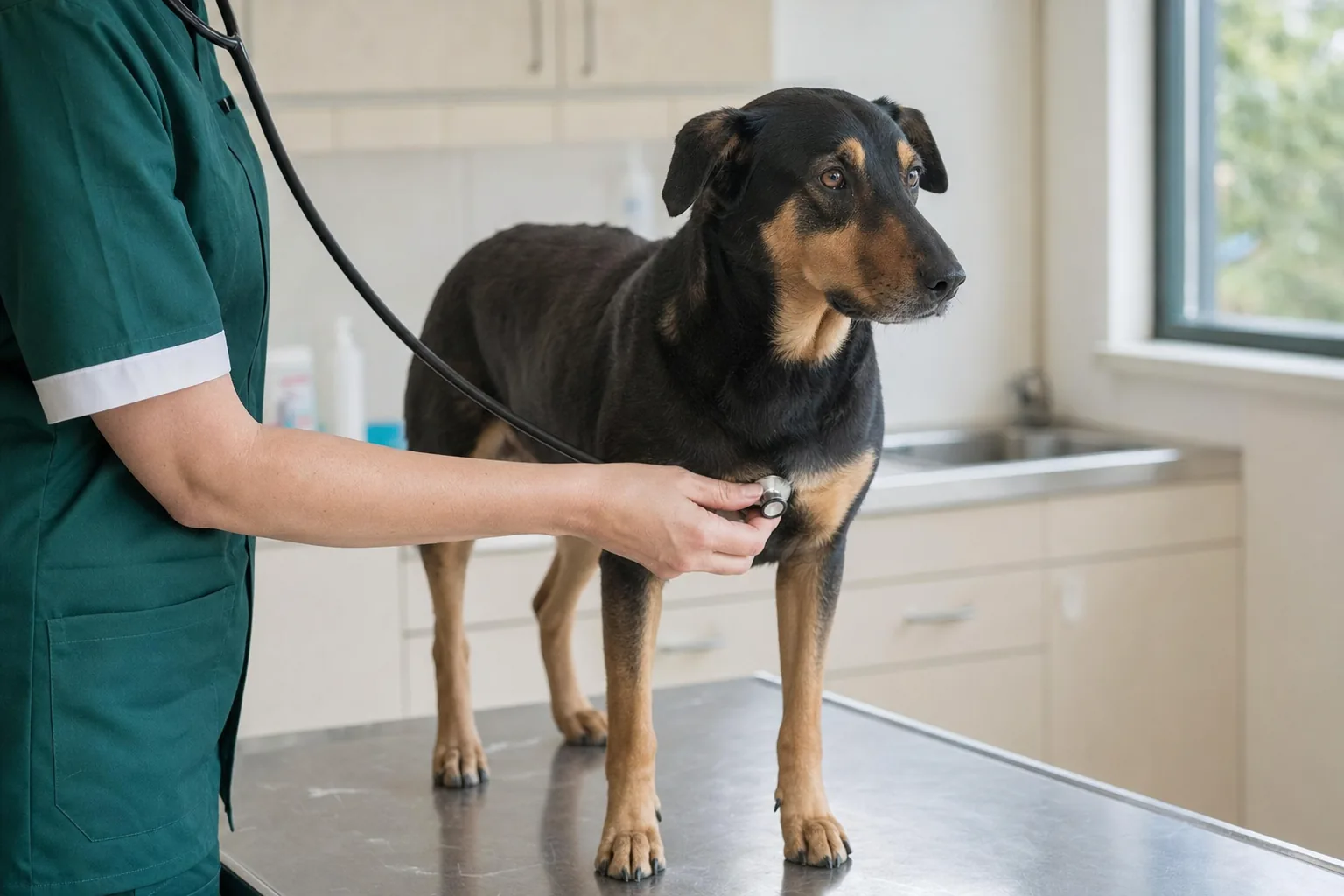
It's three in the morning and the noise has woken you again: the dog is scratching so hard his collar rattles. The edges of his ears have thickened and crusted, the skin on his elbows and hocks is red and bare, and for about a week your own forearms have been itching. Or you've taken on a puppy from a farm who has round bald patches around his eyes and doesn't seem bothered by any of it. People call both of these "mange". They are two different diseases, with different rules. Below is how to tell them apart and what to write down, so you get to your vet with the information that matters. The treatment is your vet's choice, once they've seen under the microscope which mite your dog has.
When mange can't wait
Mange isn't an emergency in the way a poisoning is. A few situations, though, shouldn't wait for next week's appointment:
- he's scratching so hard he can't sleep or eat in peace, and he has made wounds that bleed;
- there are moist patches with pus and a bad smell, or thick crusts that come away bleeding;
- he's listless, has a temperature, or the lymph nodes under his jaw and behind his knees feel swollen (when the skin is infected over a large area, the whole dog gets ill);
- a puppy under four months is losing weight, has stopped growing or has skin trouble all over;
- within a few days the hair loss has spread to several areas, especially in an adult dog who has never had skin problems;
- you or the children have itchy spots on your arms, belly or waistline that appeared after the dog started scratching.
In that last case, ring your own GP as well. Dog mange does pass to people, but the mite can't breed on human skin, so the itch usually goes once the dog has been treated. Your GP will tell you what to do in the meantime.
What to watch and write down at home
Mange is confirmed under the microscope, and sometimes not even that works first time. What you bring to the appointment shortens the road a lot.
Where it shows. Take close-up photos in daylight of every affected area: ear edges, elbows, hocks, belly, eyes, muzzle, paws. Keep them in a separate album and add one a week. Sarcoptic mange nearly always starts on the ear edges, the elbows and the hocks. Demodectic mange (demodicosis) starts on the face, mostly around the eyes, and on the paws.
How itchy he is. Count how many times he scratches on an ordinary evening and how many nights he's woken you. With sarcoptic mange the itch comes on suddenly and it's torment. With demodicosis he barely scratches at first. The itching only starts once the skin gets infected.
The ear test. Gently rub the edge of his ear between your fingers. If his back leg starts going straight away, as if scratching at thin air, note it down. Vets use this reaction as a clue, because it's common with sarcoptic mange.
Who else has it. Other dogs in the house, cats, people. Then any contact with foxes (a garden backing onto woodland, a working gundog), stray dogs, a boarding kennel, a rescue centre, a puppy who arrived recently. Foxes often carry sarcoptic mange and leave it behind wherever they go.
The history. When it started, what has already been put on his skin, which flea and tick protection he's on and when he last had it, any other illnesses, what he eats. If he's already been treated for "allergy" and it didn't work, say that first.
Two diseases, one name
|
Sarcoptic mange |
Demodicosis (demodectic mange) |
| What causes it |
A mite that burrows tunnels in the skin |
A mite that normally lives in every dog's hair follicles and multiplies too much |
| Caught from other animals? |
Yes, very easily: dogs, foxes, shared objects |
Practically never; puppies pick it up from their mother in the first days, like every dog |
| Caught by people? |
Yes, temporarily: itchy spots |
No |
| Where it starts |
Ear edges, elbows, hocks, belly |
Around the eyes, muzzle, paws |
| Itch |
Severe, from the start |
Mild or none, until the skin gets infected |
| Who gets it most |
Any age, after contact |
Puppies and adolescents; in adults, often a sign of another illness |
The table gives you the right questions. It isn't for choosing a treatment. Skin can itch for plenty of other reasons too, such as fleas, allergies, yeast and ear mites, and to an untrained eye they all look much the same.
What your vet will do
When mange is suspected the appointment takes longer than usual, because skin samples are taken and read there and then. So you know what to expect:
- Questions. When it started, how itchy he is, who else has it, where the dog came from, what's already been put on his skin. Your photo album answers half of them.
- A skin check all over. The vet looks at where the lesions are, what they look like and whether they're infected, and checks his lymph nodes, temperature and general condition.
- Skin scrapes. With a blunt blade the vet gently scrapes the skin in a few places and looks under the microscope. For demodicosis they scrape deeper, until there's a little blood, and the mite is easy to find. For sarcoptic mange they scrape several areas at the surface, and the result often comes back negative even when the mite is there: there are only a few and they hide.
- Other skin samples: plucked hairs looked at under the microscope, sticky tape pressed onto the skin, an impression for bacteria and yeast. Sometimes a blood test that looks for antibodies to the sarcoptic mite.
- A treatment trial. Because sarcoptic mange so often slips through the tests, many vets treat the dog when the signs fit, even with a negative scrape, and watch how he responds. Veterinary dermatology guidelines recommend exactly that.
- With demodicosis in an adult dog: blood tests for whatever illness has weakened the skin's defences (thyroid, adrenal glands, other long-term conditions). If that isn't sorted, the mange comes back.
- Rechecks. Treatment runs for weeks. With demodicosis, the vet repeats the scrapes until they're negative twice in a row, a month apart, and only then calls it done. Don't stop treatment just because his coat has grown back.
If you have other dogs at home, ask whether they need treating too. With sarcoptic mange the answer is usually yes, even if they aren't scratching yet.
What not to do at home
- Don't put used engine oil, diesel, paraffin, sulphur or lime on him. These old remedies still do the rounds in the countryside and online. They burn the skin, soak through it and get licked off, and some of them poison the dog. The chemical burn can end up worse than the mange you started with.
- Don't use parasite products meant for another animal or another weight, and don't combine two products "to be on the safe side". Some substances are dangerous for certain breeds, Collies and related breeds in particular. Your vet knows which.
- Don't use creams or lotions made for people, including the scabies treatments from the chemist. The strengths are different and the dog licks them off.
- Don't clip the whole dog down to the skin without asking your vet. On infected areas it can help. All over, in cold weather, it does him harm.
- Don't bath him every day in human shampoo. Your vet may recommend a medicated shampoo used at a set frequency. Anything else dries the skin and makes the itch worse.
- Don't give him "something for the itch" before there's a diagnosis. It calms him for a few days and hides the signs just when the vet needs to see them.
- Don't take him to the park, group training or kennels while sarcoptic mange is suspected. Let your trainer know, and come back when your vet says so.
The house, his bed and the people
Off the dog, the sarcoptic mite doesn't live long, a few days at room temperature. Wash his bed, blankets and harness at 60 degrees at the start of treatment and again a week later. Hoover the sofa and the car. Anything that can't be washed goes in a sealed bag for a few days. With demodicosis you need none of this, because the mite doesn't pass to other animals.
For you: wash your hands after handling him, keep him off the bed until the treatment is finished, and if you get itchy spots, see your GP.
A dog with mange looks and smells awful for a few weeks. He nearly always recovers, provided he gets to the vet early and nobody has "treated" him first with whatever was in the shed.
The information on this page is educational and does not replace an examination. For full details and a diagnosis, consult your dog's own veterinarian.