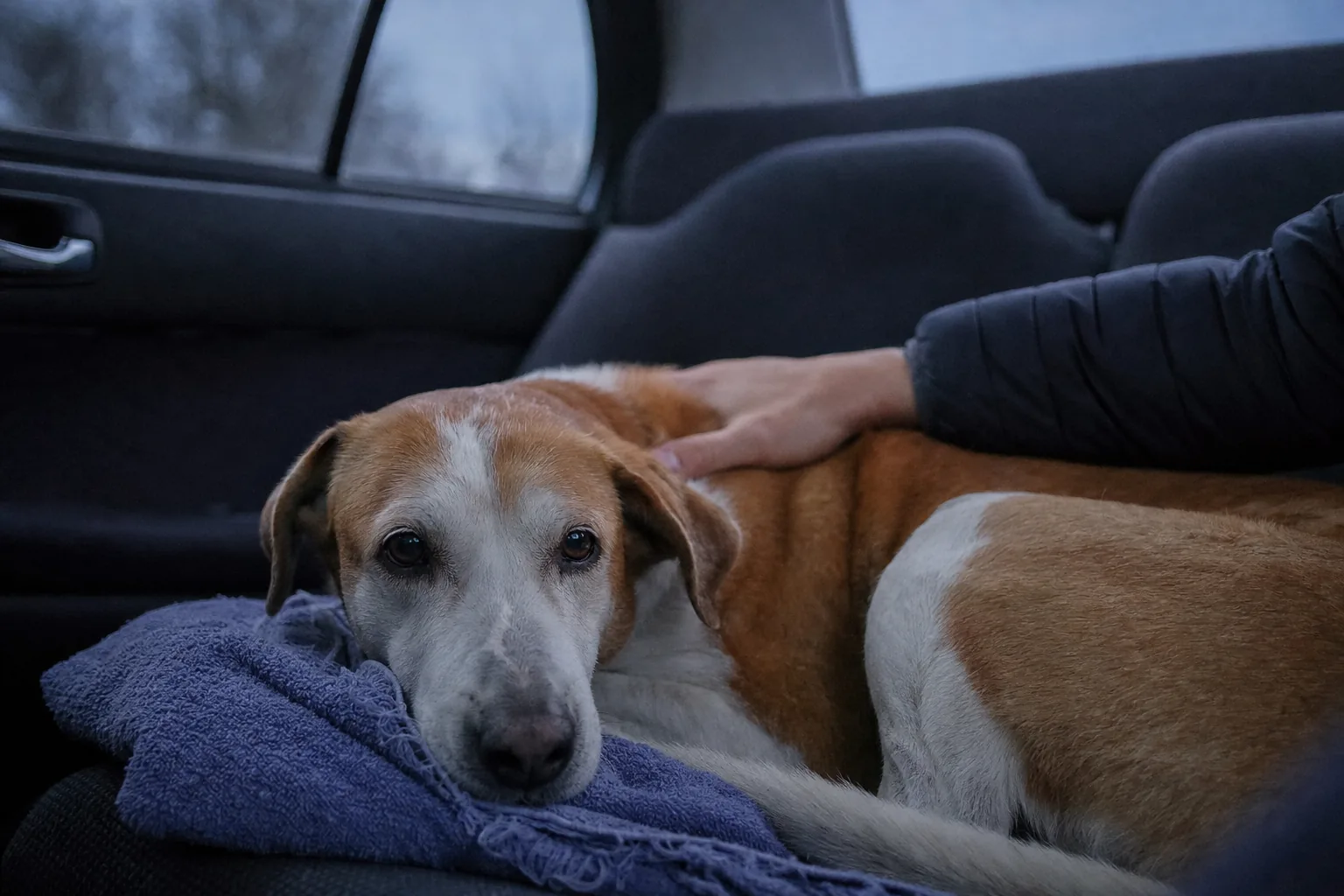
Emergency. An unspayed bitch who drinks a lot, vomits, is listless or has a swollen belly in the months after a season, with or without discharge: call your own vet or an emergency clinic now. Stop feeding her and do not give leftover antibiotics from the cupboard.
Noticed something different about your dog? Go straight to their vet.
Call your own vet or the nearest clinic with an emergency service now, and set off. Do not ask a group what to do: every answer you wait for there is time lost for the dog.
- The same sign, dozens of causes. A dog that vomits may have eaten grass or may have an object stuck in the gut. From two lines you typed, nobody can tell which. The vet feels the abdomen, takes the temperature, runs tests.
- Nobody on the internet sees your dog. They see a photo and a story. A diagnosis comes from an examination and investigations, not from a resemblance to someone else's dog.
- In groups you hear from the people whose dog "got better on its own". Those for whom it ended badly rarely post again. What you read there is a selection, not a statistic.
- Doses are calculated by weight and species. Human medicines that look harmless, paracetamol or ibuprofen, are toxic to dogs. "I gave mine half a tablet" is the most dangerous advice you can get.
- Hours matter. With a twisted stomach, a poisoning or a urinary blockage, the time spent asking online is exactly the time that decides the outcome.
- The vet is accountable for what they say. They have your dog's record, history, vaccinations, past treatments. An anonymous account has none of that and answers for nothing.
Use this page to know what to observe, what to note and what to ask at the appointment, not to treat at home. If you still have doubts after a consultation, ask another vet or a specialist (dermatologist, internist) for a second opinion, not a group. And if you do not have a regular vet yet, find one now, while your dog is healthy: how to choose a veterinary clinic.
Your bitch is eight, unspayed, and finished her season five weeks ago. For a few days she has been drinking enough for two dogs, waking you at night to go out, licking under her tail a lot, and on her blanket you found a yellowish stain with a foul smell. Perhaps in your case there's no discharge at all, just a belly that looks bigger, a full bowl left untouched and vomiting this morning. Both stories can be pyometra: the womb has become infected and filled with pus. It is an emergency. Untreated, she can develop blood poisoning, and the womb can rupture. Below: what to do now, what to tell your vet, and how to prevent it.
What to do in the next 10 minutes
- Check two things. Is she spayed or not, and when was her last season? Pyometra happens almost only in unspayed bitches, most often within two months of a season. If you don't know the exact date, think back to when you last saw blood or males hanging around her.
- Look at her carefully for two minutes:
- discharge from the vulva: yellow, greenish, brownish or bloody pus, often with a heavy smell;
- her belly: swollen, firm, sore when touched;
- her gums: pink, or dark red, pale, greyish;
- how present she is: following you with her eyes, or lying flat and listless, not getting up.
- Ring your own vet now, or an emergency clinic if it's night-time or the weekend. Don't wait for morning if she is listless, vomiting, has a swollen belly or her gums are no longer pink. The form without discharge is the most dangerous: the cervix is closed, the pus stays inside and you see nothing.
- Stop feeding her until you've spoken to the vet. If it is pyometra she'll most likely go to surgery, and an empty stomach matters for the anaesthetic. Ask about water on the phone.
- Photograph the discharge, on the blanket or a white tissue, and note how much she has drunk today if you can estimate it. Bring her vaccination card.
- Get ready to go: a blanket, a towel, someone to drive. Lift her carefully, one hand under her chest and one under her rump, without pressing on the belly.
Why it can't wait
A womb full of pus pours bacterial toxins into the bloodstream. The kidneys suffer first, hence the thirst and all the weeing, then the heart and liver. A bitch who is only drinking a lot today can be in shock in a day or two. When the cervix is closed, the womb can stretch until it ruptures, and then pus spills into the abdomen. Surgery becomes much harder and the odds drop.
The signs, in brief
| What you see |
Open form (cervix open) |
Closed form (cervix closed) |
| Discharge from the vulva |
Yes, pus or blood, foul smell |
No, or very little |
| Drinks and wees a lot |
Often |
Often |
| Licks under her tail |
Often |
Rarely |
| Swollen belly |
Sometimes |
Often, may be firm and painful |
| Vomiting, diarrhoea |
Sometimes |
Often |
| Listless, off food |
Gradually |
Quickly, within days |
| Fever |
May be absent |
May be absent; a bitch in shock can even have a low temperature |
| How fast it worsens |
Over days |
Over hours to days |
The table doesn't make a diagnosis. Heavy thirst has other causes, such as diabetes or kidney disease, and discharge can come from a milder vaginal infection. Your vet tells them apart with an ultrasound scan.
What to tell your vet, and what they'll do
On the phone
- her age and weight;
- whether she's spayed, and when her last season was;
- whether she has ever had injections or tablets to stop her seasons, or hormone treatment after an unwanted mating;
- what you see: discharge (colour, smell, since when), how much she drinks, vomiting, appetite, how active she is;
- whether she has had womb problems or false pregnancies before.
At the practice
- Examination. Temperature, pulse, gum colour, hydration, a careful feel of the belly. An enlarged womb can sometimes be felt straight away.
- Ultrasound. It shows an enlarged, fluid-filled womb and confirms pyometra within minutes. Sometimes an X-ray is added.
- Blood tests. White blood cells, the ones that fight infection, are usually well raised. Kidneys, liver and blood sugar are checked too, to see how much her body has suffered and how safe the anaesthetic is.
- Stabilising. A drip for fluids and blood pressure, and treatment against the infection. If she's very weak, she may spend a few hours on the drip before surgery.
- Surgery. The usual treatment is removing the womb and ovaries, like a spay but more delicate, because the womb is large, fragile and full of pus. It solves the problem for good. She usually stays in for one to three days.
- Without surgery. There is that option too, for carefully chosen cases: young breeding bitches with the open form and no signs of infection spreading through the body. It's done under strict veterinary supervision with repeated scans, and pyometra can come back at the next season. For a pet bitch, most vets recommend surgery.
- Afterwards. A cone, no jumping and no running for 10 to 14 days, a wound check, stitches out. Most bitches operated on in time recover quickly. Plenty of owners tell us that after a few days she seems "years younger".
When she's discharged, ask which signs mean coming straight back: a red, swollen or weeping wound, fever, a bitch who still isn't eating on day two.
How to prevent pyometra
Spaying. It's the only sure prevention: no womb, no pyometra. The timing (before or after the first season, at what age, by size and breed) is something to decide with your own vet. For large breeds the advice has changed in recent years and varies from case to case. If you don't want puppies from her, it's worth a proper conversation early on.
If you don't spay her for good reasons (a breeding or show bitch, a medical decision), watch her closely after every season:
- mark the start and end of every season on the calendar;
- for the 2 to 3 months afterwards, keep an eye on her drinking, on how her vulva looks, on her appetite;
- any discharge that appears after a season has finished means a call to the vet the same day;
- from 6 years on, at the annual check-up, ask for a womb scan if your vet thinks it useful.
No hormone treatments "to stop the seasons". Injections and tablets that postpone or suppress seasons raise the risk of pyometra and of mammary tumours. So do hormone treatments given without follow-up after an unwanted mating. If you want to avoid puppies, the safe answer is spaying; talk to your vet.
Age. The risk rises year on year, and most cases happen in middle-aged and older bitches. A three-year-old can get pyometra too, just less often.
If you have an unspayed bitch, unusual thirst in the months after a season is the sign to remember. Many people put it down to hot weather or age and lose days she needed.
Frequently asked questions
What dog owners search for most often on the internet about this problem, with the short answer. The answers are a guide only: the decision belongs to your dog's own vet, after an examination.
What is pyometra in dogs?
An infection of the womb, which fills with pus. It happens in unspayed bitches, usually a few weeks after a season, when hormones keep the womb ready for pregnancy and bacteria multiply easily. Toxins get into the blood and hit the kidneys, heart and liver. Untreated, it can lead to shock and a ruptured womb.
How do I know if my dog has a womb infection?
She drinks far more and wees often, licks under her tail, has discharge from the vulva (yellow, greenish or bloody pus with a foul smell), goes off her food, is listless, vomits. In the closed form there is no discharge and the belly swells. If she has had a season in the last two months and you see any of these signs, ring today.
Can pyometra be treated without surgery?
In carefully chosen cases, yes: young breeding bitches with the open form and no body-wide infection, under strict veterinary supervision with repeated scans. The risk of it returning at the next season remains. For a pet bitch, the usual treatment is surgery to remove the womb and ovaries, which solves the problem for good.
How long after a season does pyometra appear?
Most often within two months of the season ending, sometimes up to four. That is why it's worth marking every season on the calendar and watching her drinking, appetite and vulva in the months afterwards. Any discharge that appears after a season has finished is a reason to ring your vet.
How can I prevent pyometra?
By spaying, the only sure prevention. Decide the timing with your own vet according to size and breed. If you don't spay her, avoid injections and tablets that stop her seasons, because they raise the risk, and watch her closely after every season. The risk grows with age.
The information on this page is educational and does not replace an examination. For full details and a diagnosis, consult your dog's own veterinarian.