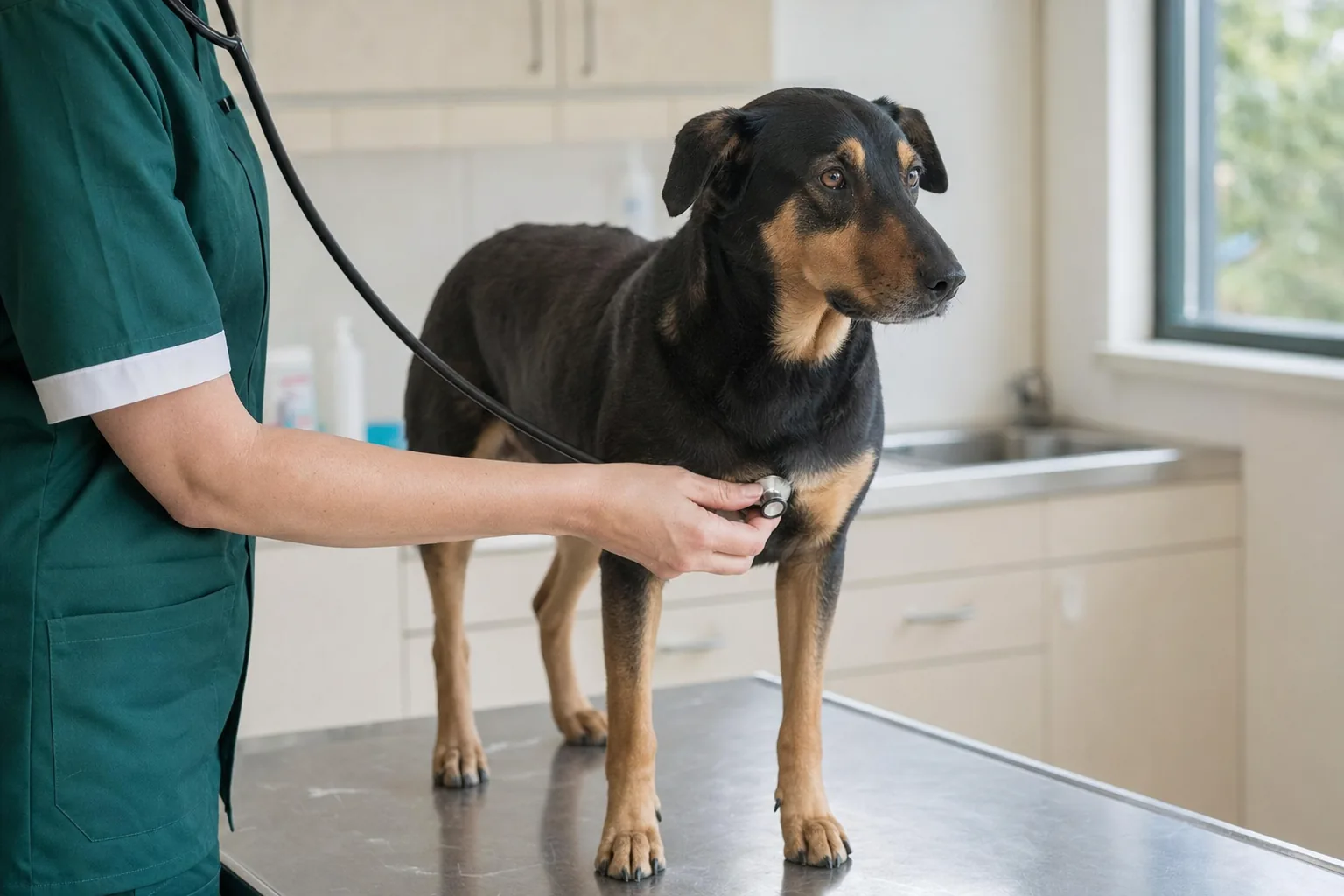
Caution. A pus-like or foul-smelling discharge after the season has finished, heavy thirst, vomiting, lethargy, a swollen belly, or bleeding that is heavy or goes on past three or four weeks: call your own vet the same day. It may be pyometra.
Noticed something different about your dog? Go straight to their vet.
Do not look for the answer in a Facebook group, on TikTok or on a forum. Look for someone trained for this: your dog's own veterinarian, the only person who can examine, investigate and treat them.
- The same sign, dozens of causes. A dog that vomits may have eaten grass or may have an object stuck in the gut. From two lines you typed, nobody can tell which. The vet feels the abdomen, takes the temperature, runs tests.
- Nobody on the internet sees your dog. They see a photo and a story. A diagnosis comes from an examination and investigations, not from a resemblance to someone else's dog.
- In groups you hear from the people whose dog "got better on its own". Those for whom it ended badly rarely post again. What you read there is a selection, not a statistic.
- Doses are calculated by weight and species. Human medicines that look harmless, paracetamol or ibuprofen, are toxic to dogs. "I gave mine half a tablet" is the most dangerous advice you can get.
- Hours matter. With a twisted stomach, a poisoning or a urinary blockage, the time spent asking online is exactly the time that decides the outcome.
- The vet is accountable for what they say. They have your dog's record, history, vaccinations, past treatments. An anonymous account has none of that and answers for nothing.
Use this page to know what to observe, what to note and what to ask at the appointment, not to treat at home. If you still have doubts after a consultation, ask another vet or a specialist (dermatologist, internist) for a second opinion, not a group. And if you do not have a regular vet yet, find one now, while your dog is healthy: how to choose a veterinary clinic.
Three drops of blood on the floor by her bed, and an eight-month-old bitch licking herself more than usual. On the walk, the dog next door, who normally barely lifts his nose, is pulling towards you from two streets away. That is how a first season starts in a lot of homes. Sometimes the story is different: she has been coming into season for years, but this time she has been bleeding for a month, she is drinking for two and leaving food in the bowl. The first case is plain biology, handled with a lead and a calendar. The second needs a vet. Below is what a normal cycle looks like, what to write down and when to pick up the phone.
Warning signs: when to call your vet today
Most seasons come and go without any drama. Call the same day if you see any of the following:
- after the season has finished, usually within the next two months, there is a discharge that looks like pus, is brown or smells bad; or she is drinking and weeing a lot, is flat, vomits, or her belly is swollen. This can be pyometra, an infection of the womb, and it is an emergency;
- she bleeds heavily, with clots, or the bleeding goes on past three or four weeks;
- her gums are pale, she is weak, or she pants without having done anything;
- a spayed bitch shows signs of a season again (swollen vulva, males following her, blood). Some ovarian tissue may have been left behind;
- you saw a mating you did not want. Ring in the first few days, because two months on there are far fewer options. Your vet will explain the risks of each one.
How long a season lasts and what to note at home
The first season
In small and medium breeds it usually arrives between 6 and 12 months. Large and giant breeds can take until 18 to 24 months. A first season is often low-key: a little blood that she cleans up quickly, and that is all you see. Quite often the local males tell you before she does, because they suddenly find her fascinating.
The phases of a cycle
| Phase |
Usual length |
What you see |
| The start (pro-oestrus) |
About 9 days, anywhere from 3 to 17 |
Swollen vulva, bloody discharge, lots of licking. Males follow her, she turns them down and sometimes growls |
| The fertile part (oestrus) |
About 9 days, anywhere from 3 to 21 |
The discharge gets paler, pinkish or straw-coloured. She accepts a male and flicks her tail to one side when you touch her back |
| Afterwards (dioestrus) |
About two months |
The vulva goes back to normal. Pregnancy hormones stay high even if she is not pregnant, which is where false pregnancies come from |
| The quiet phase (anoestrus) |
Several months |
Nothing to see |
The part you notice lasts about three weeks on average. A new cycle comes round roughly every six or seven months, and bitches vary a great deal: some cycle every four months, some once a year, and in a few breeds such as the Basenji once a year is the norm. The gap between seasons gets longer as she ages, but there is no menopause as in women.
This is where most people get caught out. A bitch can get pregnant on any day of her season, including while she is still bleeding, and sperm survives for several days inside her. "She's still bleeding, so we're safe" is a bad bet.
What goes in the calendar
- the day the bleeding starts and the day it has stopped completely;
- how much: a couple of drops a day, or marks on every blanket;
- her behaviour: clingy, restless, trying to wander off, eating less;
- in the two months afterwards: how much she drinks, her appetite, any discharge, swollen teats or a sudden habit of mothering toys.
A calendar on your phone is plenty. After two or three cycles you know her rhythm, and anything out of pattern jumps out at you.
Walks and home life during a season
On lead, all the time. That includes the garden if the fence has any gaps. A bitch with a rock-solid recall can take off after a male without a backward glance, and males will clear fences they would never normally look at.
Pick quiet times of day and routes where dogs do not gather. A male can smell her from a long way off and may well follow you. Dog parks are off the list for the whole season.
Season pants save your sofa. Take them off for walks and a few times a day so she can clean herself and her skin does not get sore.
If you go to training or a dog sport, tell the instructor beforehand. In many sports bitches in season work last and on their own, so the males are not distracted. In mantrailing, for example, a bitch in season can still run her trail, she just goes after the other dogs.
If you also have an entire male at home, the separation has to be real: closed doors, for the whole season and a few days after. "I'll keep an eye on them" does not hold up, because one minute of looking away is enough.
What the vet will check
An ordinary season does not need a vet visit. You go when you want to plan something, or when something looks wrong.
- Spaying. The vet sets the timing. Surgery is usually not done during a season, because the blood vessels are fuller and bleeding is a bigger risk, so it tends to happen a few months later. In large breeds, whether to spay before or after the first season depends on breed and size, and the advice has shifted in recent years, so it is worth talking through for your own dog.
- If you want a litter. The right day to mate is found with tests: a vaginal smear (cells taken with a swab and looked at under a microscope) and blood tests for the hormone that rises before ovulation. The pre-breeding health checks you also plan with your vet.
- When something is not right. An examination, an ultrasound of the womb and ovaries, blood tests. That is how a cycle that is simply long gets told apart from an ovarian cyst, a vaginal infection or pyometra.
- After an unwanted mating. There are a few routes: a scan a few weeks later to confirm or rule out pregnancy, spaying, or a hormone treatment chosen and monitored by your vet. Hormone treatments carry real risks, which is why nobody should hand them out casually.
- False pregnancy. A few weeks after a season some bitches build a nest, carry toys around like puppies, even produce milk. It mostly settles on its own within a few weeks. If it keeps coming back, or the teats turn red and hard, book an appointment.
What not to do at home
- Injections or tablets "so she stops coming into season" without a proper conversation with your vet. Hormone treatments that stop or postpone seasons raise the risk of pyometra and mammary tumours.
- The old line about "one litter for her health". There is no proven health benefit, and whelping brings its own risks.
- "Just five minutes" off lead. A mating happens faster than you think, and once they are tied you cannot stop it without hurting both dogs.
- Pulling a tied pair apart. If it has happened, keep them both calm until they separate on their own, then ring the vet.
- Telling her off for marks, restlessness or scent-marking. That is hormones at work. She is not doing it to spite you.
- Shrugging off the thirst after a season. It is one of the first signs of pyometra, and plenty of owners blame the weather.
- Tampons or products made for women. Bitches have their own season pants, with disposable or washable pads.
The season itself is over in a few weeks and then leaves you alone for months. Your attention matters most in the two months after, when you check every day how far the water bowl has gone down. With the phone calendar kept up to date, you can tell your vet exactly what changed and when.
Frequently asked questions
What dog owners search for most often on the internet about this problem, with the short answer. The answers are a guide only: the decision belongs to your dog's own vet, after an examination.
How long does a dog stay in heat?
The part you can see lasts about three weeks on average. For roughly the first nine days she bleeds and turns males away; then come roughly nine fertile days, with a paler discharge, when she accepts them. Bitches vary a lot, from two to four weeks. If the bleeding goes past three or four weeks, is heavy or has clots, see your vet.
How often does a bitch come into season?
Usually twice a year, about every six or seven months. Some bitches cycle every four months, others once a year, and in a few breeds such as the Basenji once a year is normal. The gap gets longer with age, but seasons never stop completely. Mark them in a calendar and after two or three cycles you will know her rhythm.
At what age does a dog have her first season?
In small and medium breeds, usually between 6 and 12 months. In large and giant breeds, sometimes not until 18 to 24 months. A first season can slip by almost unnoticed, with a little blood she licks away quickly, so the males nearby are often the first to tip you off.
Can she get pregnant while she is still bleeding?
Yes. The fertile days usually start after the first week to ten days, but that varies a lot, and sperm lives for several days. She can get pregnant at any point during her season. Keep her on lead and away from males for the whole of it, not just while you can see blood.
Should a bitch have one litter before she is spayed?
There is no proven health benefit. Whelping has its own risks, and puppies need homes lined up in advance and careful raising. If you are not breeding responsibly, talk to your own vet about when to spay her, based on her size and breed.
The information on this page is educational and does not replace an examination. For full details and a diagnosis, consult your dog's own veterinarian.