Caution. Drinking a lot, listless, vomiting or discharge from the vulva one or two months after a season: ring today, it may be a womb infection. Ring today too for a hard, red, sore gland, a temperature or bloody milk. Do not express or massage the glands.
Noticed something different about your dog? Go straight to their vet.
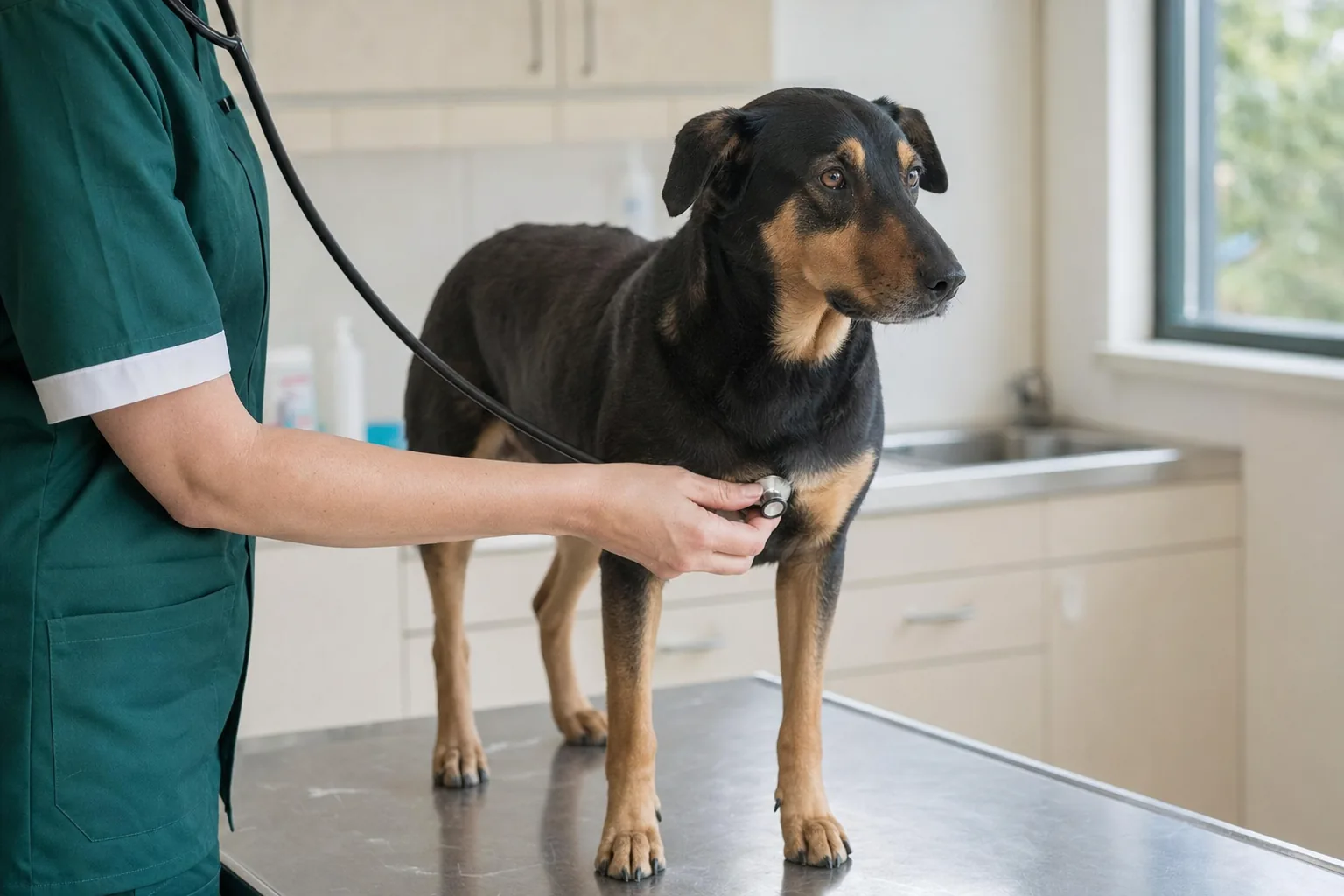
Do not look for the answer in a Facebook group, on TikTok or on a forum. Look for someone trained for this: your dog's own veterinarian, the only person who can examine, investigate and treat them.
- The same sign, dozens of causes. A dog that vomits may have eaten grass or may have an object stuck in the gut. From two lines you typed, nobody can tell which. The vet feels the abdomen, takes the temperature, runs tests.
- Nobody on the internet sees your dog. They see a photo and a story. A diagnosis comes from an examination and investigations, not from a resemblance to someone else's dog.
- In groups you hear from the people whose dog "got better on its own". Those for whom it ended badly rarely post again. What you read there is a selection, not a statistic.
- Doses are calculated by weight and species. Human medicines that look harmless, paracetamol or ibuprofen, are toxic to dogs. "I gave mine half a tablet" is the most dangerous advice you can get.
- Hours matter. With a twisted stomach, a poisoning or a urinary blockage, the time spent asking online is exactly the time that decides the outcome.
- The vet is accountable for what they say. They have your dog's record, history, vaccinations, past treatments. An anonymous account has none of that and answers for nothing.
Use this page to know what to observe, what to note and what to ask at the appointment, not to treat at home. If you still have doubts after a consultation, ask another vet or a specialist (dermatologist, internist) for a second opinion, not a group. And if you do not have a regular vet yet, find one now, while your dog is healthy: how to choose a veterinary clinic.
Your bitch was in season about two months ago, and you are certain no dog got near her. For the last few days she has been building a nest in the wardrobe. She gathers soft toys underneath her, licks them as if they were puppies and growls when you come close. Her teats are swollen, and one of them has even produced a drop of milk. This is a false pregnancy (vets also say pseudopregnancy, and many owners call it a phantom pregnancy), and it is part of life for plenty of unspayed bitches: after a season their bodies go through the same hormonal changes whether puppies follow or not. Most of the time it settles by itself within two or three weeks. Your job is to spot in time the signs that do not belong to it, and to avoid the things that drag it out.
When to ring the vet today
A false pregnancy is not an emergency in itself. The catch is that it happens in exactly the window when a serious womb infection can also turn up, and some of the signs overlap. Ring your own vet today if:
- she is drinking far more than usual and weeing a lot, is listless, vomiting or off her food. In an unspayed bitch one or two months after a season, that can be a womb infection (pyometra), which is a surgical emergency;
- there is discharge from her vulva, particularly pus, blood or a bad smell;
- a gland is hard, red, hot and sore, or the milk is yellowish, bloody or lumpy: that is an infection of the mammary gland (mastitis);
- she has a temperature (over 39.5 °C taken rectally) or is shivering;
- she might have been mated after all: she slipped out, there was a male next door, you lost sight of her in the park. Then it could be a real pregnancy, which your vet confirms with a scan;
- she growls at or bites people at home, especially children, when they go near her "puppies";
- you feel firm lumps, pea-sized or bigger, in the glands, which are still there once everything else has gone down.
What to watch and write down at home
The season calendar. Write down when her last season started and finished. False pregnancy usually shows six to twelve weeks later. Pyometra also tends to come within those first two months. It is the first thing your vet will ask.
Mothering behaviour. She nests: shreds blankets, digs at the sofa, squeezes under the bed. She adopts toys or slippers, carries them about, guards them, whines when they are out of sight. Some bitches get restless, others sleep a lot. Some go off their walks altogether.
The glands. Size, colour, how warm they feel. If milk comes out, what colour it is. Take photos in daylight with her lying on her side every two or three days, so you can see whether they are going down.
Food and water. Some bitches eat less, some more. Water is the sign that matters, so measure it: put a known amount in the bowl in the morning and see what is left in the evening.
Her belly. A few bitches get a slightly rounded tummy and even "contractions", like a labour that never arrives. If you see that, write it down.
The history. Note whether this is the first time. In many bitches false pregnancy comes back after every season, sometimes stronger each time. Note how it went last time and how long it lasted.
False pregnancy, real pregnancy or pyometra?
|
False pregnancy |
Real pregnancy |
Womb infection (pyometra) |
| When it shows |
6 to 12 weeks after a season |
Puppies arrive about 63 days after mating |
Usually within 2 months of a season |
| How she seems |
Well, maybe restless |
Well |
Listless, off food, sometimes vomiting |
| Drinking a lot |
No |
Usually not |
Yes, often |
| Discharge from the vulva |
No |
Not until close to whelping |
Often, but not always |
| Nesting, adopted toys |
Yes |
Yes, towards the end |
Rarely |
| How it is confirmed |
Examination and history |
Scan |
Scan and blood tests |
When the cervix is closed, pyometra produces no discharge, so seeing nothing should not reassure you. Big thirst plus a listless unspayed bitch means a call to the vet today.
At the practice: what your vet checks
- The history: when her season was, whether mating was possible, what you are seeing, how much she drinks, whether it has happened before.
- An examination: temperature, each gland in turn (heat, pain, lumps), the vulva and any discharge, a feel of the belly.
- A scan, if there is any doubt: it shows whether the womb is empty, holds puppies or is full of fluid.
- Blood tests, if she is drinking a lot, listless or running a temperature, to rule out pyometra and see how the kidneys are doing.
- The decision. In most mild cases your vet will tell you to wait it out, leave the glands alone and keep her mind on other things, because it settles by itself. If the signs are strong, go on a long time or she is genuinely suffering, there is also medical treatment, which your vet chooses and doses.
- Spaying, as a conversation for later. It prevents both future false pregnancies and pyometra. Vets usually prefer not to operate mid-episode but once the signs have gone completely; otherwise they can hang on longer. Ask when the right time would be for your bitch.
What not to do at home
- Do not express or massage the glands to "get the milk out". Every bit of that tells her body to make more. Licking has the same effect: if she licks non-stop, ask your vet whether she should wear a body suit or a T-shirt.
- No compresses of alcohol, vinegar, cabbage leaves or creams on the glands. Some irritate the skin, and she licks them off anyway.
- No human hormone tablets and no herbal teas "to dry up the milk". Hormones do dogs harm, and the doses have nothing to do with ours.
- Do not pull the toys out of her mouth while she is guarding them. Take them away without fuss when she is out of the room, one a day rather than all at once. If one is always under her, leave it there, but stop giving her new ones.
- Do not tell her off for growling. It is behaviour driven by hormones; her training has nothing to do with it. Keep children away from the nest and the adopted toys until it passes.
- Do not cut back her water. If she is drinking a lot, that is something to tell your vet. An empty bowl fixes nothing.
- Do not leave her in the nest all day. Longer walks on new routes, games where she has to find something, a bit of nose work. A mind busy with other things gets through the episode more easily.
A few weeks with a "mum" in the house
To her, the plush puppies are real. For you it is an odd few weeks, but they pass. What you can do is give her something else to get on with: a new route, treats scattered in the grass for her to hunt out, an hour of quiet walking with her nose down. If you do a scent sport such as mantrailing, she can carry on working through this, as long as she is well and your vet is happy. We suggest shorter, easier trails than usual, and on a bad day you call it off with no regrets.
If false pregnancies come back after every season and get stronger each time, talk to your vet about spaying once this episode is over.
Frequently asked questions
What dog owners search for most often on the internet about this problem, with the short answer. The answers are a guide only: the decision belongs to your dog's own vet, after an examination.
How long does a false pregnancy last in dogs?
Usually two to three weeks, sometimes a little longer, with the signs fading gradually: the mothering behaviour first, then the glands. Expressing or massaging the glands, or non-stop licking, makes it last longer. If you see no improvement after four weeks, or things are getting worse, see your own vet.
What is a phantom pregnancy in a dog?
It is another name for a false pregnancy. It is not "all in her head": after every season a bitch's body goes through the same hormonal changes as in a real pregnancy, and at the end the hormone that starts milk production rises. That brings the mothering behaviour and full glands, even though there are no puppies. It is common and, in its mild form, normal.
How do I tell a false pregnancy from pyometra?
A bitch with a false pregnancy generally feels fine: she eats, she plays, she is just busy with her nest. Pyometra, a womb infection, brings big thirst, frequent weeing, listlessness, sometimes vomiting and discharge from the vulva, within two months of a season. There may be no discharge, so thirst plus listlessness is reason enough to ring today; your vet confirms with a scan and bloods.
Does spaying prevent false pregnancy?
Yes, spaying prevents both future false pregnancies and pyometra. Vets usually prefer not to operate mid-episode but once the signs have completely gone, because otherwise they can hang on longer. Agree the timing with your own vet, especially if false pregnancies come back after every season.
The information on this page is educational and does not replace an examination. For full details and a diagnosis, consult your dog's own veterinarian.