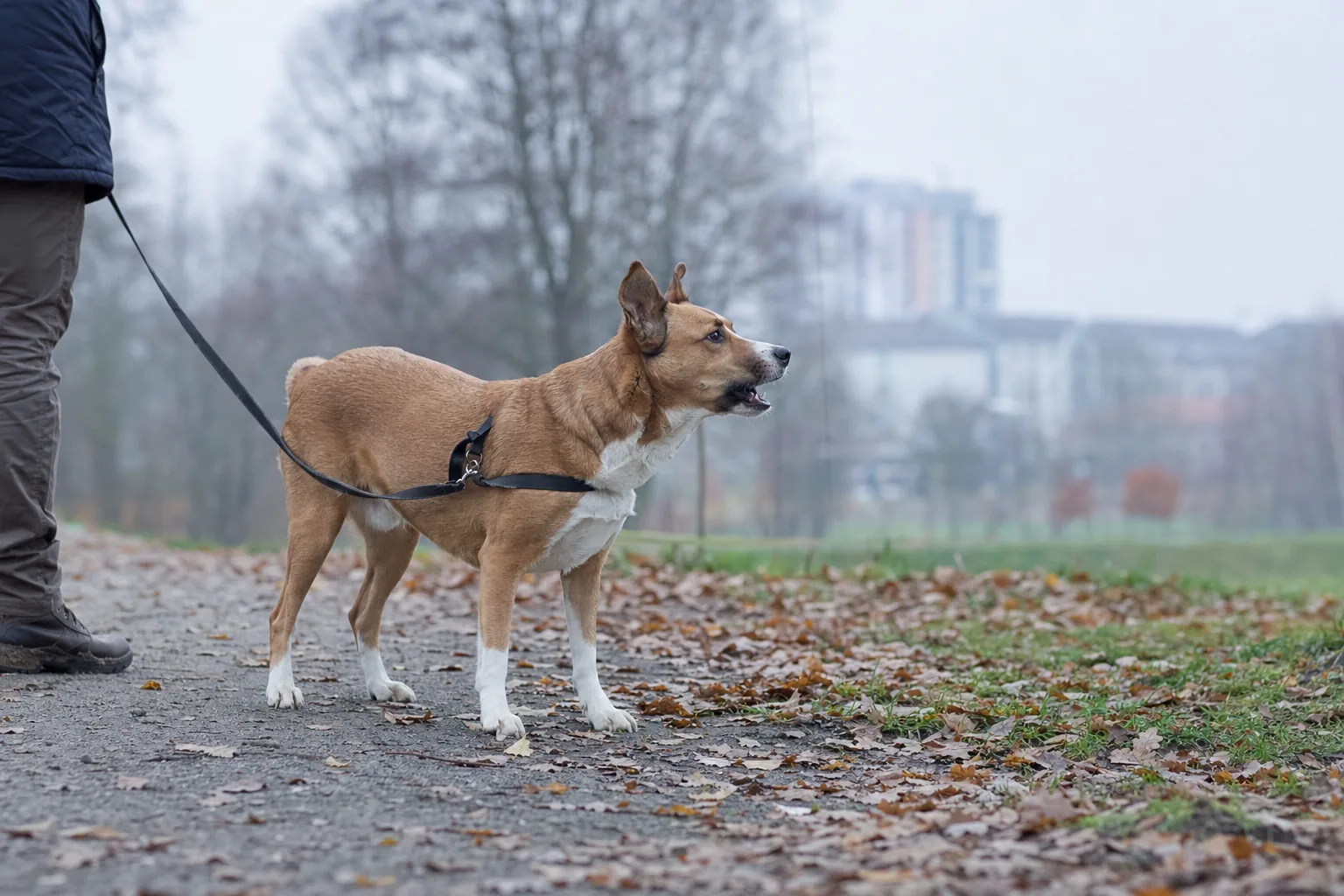
The front door opens and your 30-kilo dog hauls you out like a sledge. Your arm is at full stretch, your shoulder has ached for a month, and the dog is panting with his tongue out and still pulling. You've already bought a "no-pull" harness, and it worked for three days. This page explains why he pulls, why lead jerks and correction collars seem to work without fixing anything, and what a loose-lead walking plan looks like, one you can start tomorrow with the right kit.
Why does my dog pull on the lead?
He pulls because it works. Every time the lead goes tight and you take a step after him, he gets exactly what he wanted: closer to that bush, the dog across the road, the park. A 40-minute walk on a tight lead adds up to several hundred repetitions of the same lesson, "pull and you get there". No 10-minute training session can compete with that. So the plan starts with something simple: from now on, pulling gets him nowhere.
On top of that come a few things to do with the dog's body and nature:
Pace. A medium-sized dog's natural gait is an easy trot, faster than your walking speed. To stay next to you he has to slow down the whole time, and that's something he learns. It doesn't come naturally.
The opposition reflex. When a dog feels pressure on his chest or neck, he pushes the other way. You pull back, he pulls forward, and the tighter you hold, the harder he leans into the harness. It's the same reflex that makes him brace when you try to shift him off the sofa.
A lead that's always tight. If the lead has been short and tight since day one, the dog thinks that's what a lead feels like. He's never felt the difference between a loose lead and a tight one, so he has nothing to choose between.
Excitement. The first five minutes of a walk, the park gate, a dog on the corner, a cat under a car. With his heart rate up, the dog stops feeling the lead and stops hearing anything.
Retractable leads. They keep a little tension on all the time and let out more line exactly when the dog pulls. In practice, it's a device for teaching dogs to pull.
Age. Between 6 and 18 months, the dog who walked nicely at 4 months turns back into a sledge dog. Adolescence in dogs is very real. It passes, but not if you just sit and wait for it.
At our training sessions we see something every time that explains a lot. Mantrailing dogs pull into the harness on a trail with everything they've got, the 10-metre line tight, because that's their job out there. Take the harness off, clip on a collar back at the car, and the same dogs walk on a loose lead. They've learnt two rules, one for each piece of kit. The rule is what matters, and breed matters a lot less than people think.
What doesn't work, even when it looks like it does
Lead jerks. A jerk stops him for a second, then he carries on, because what he wanted (forwards) is still there. Over time the dog learns that the person on the other end of the lead hurts him out of nowhere, and he loses any reason to look at you. Jerks on a collar also land on the windpipe and neck, and a small dog or a flat-faced one ends up with a cough and injuries.
Correction collars: check chains, prongs, shock. They stop pulling through pain, and with some dogs they really do stop it. The trouble is that a dog who feels pain exactly when he sees another dog learns that other dogs bring pain. A few months later you don't have a dog who pulls any more, you have a reactive one. Pressure inside the eyes rises when a dog pulls into a collar, which matters a great deal for dogs with eye problems. Prong and shock collars are banned in several European countries. We don't use them and we don't recommend them. If you need control over a big dog, use a harness with a front ring.
The no-pull harness as the answer. The front ring turns him towards you when he pulls, and early on that helps, especially with a big dog. But a harness teaches nothing on its own, and after a few weeks the dog works out how to pull in it too. Harnesses that tighten under the armpits or across the shoulder stop pulling through discomfort and change the way the dog moves. Use one as a help while you work on the plan; it won't stand in for the plan.
"Keep him short, by your leg, all the time." A walk where the dog isn't allowed to sniff anything is a walk for you alone. His frustration comes out on the lead. Heelwork is an exercise of a few minutes. The walk as a whole is something else.
"Steady, steady, steady." Said over and over while the dog pulls, the word turns into background noise. If you haven't taught him what it means somewhere quiet first, it means nothing out on the street.
The ten-minute toilet trip. A dog who goes out twice a day for ten minutes pulls because that's his only chance to see the world. At that pace there's no time for him to learn anything.
"He'll calm down with age." He'll calm down at about seven, when he can't be bothered any more. Until then you've got six years of shoulder.
The plan, step by step
The plan runs on two kinds of walk side by side, plus decent kit. If you only do the exercise and leave the rest of your walks as they are, the dog practises pulling a hundred times a day and loose-lead walking ten.
1. The kit
A Y-shaped harness that leaves the shoulder free and doesn't rub under the armpit, with a ring on the back and, for big dogs, one on the chest as well. A fixed 2–3 metre lead for ordinary walks and a 5–10 metre long line for sniffing walks. A treat pouch on your hip with small, soft treats. The retractable lead leaves the house. After a week, check the fit: two fingers slide under the straps, and there's no red skin or thinning fur at the armpit.
2. Two kinds of walk
The sniffing walk happens on the long line. The dog chooses where he goes and how long he keeps his nose in one place, and you keep quiet and follow. At least one a day, 30–40 minutes; this walk is his. The training walk lasts 10–15 minutes on the 2-metre lead. You choose the route, and the dog gets praise and tasty treats while the lead is loose. Each has its own signal: the long line clipped to the back means "you're free", the short lead clipped to the front means "we're working". Dogs pick up the difference within a few days, just as mantrailing dogs learn what the working harness means.
3. Start where there's nothing to pull towards
The hallway, the garden, the most boring room in the house. Clip on the lead and hold a tasty treat at knee height, on the side you want him to walk. Take a step, the dog comes up by your knee, he gets the treat. Two steps, another one. Then ten steps. No words for now; first he has to find out that next to your knee is where good things happen. Three sessions a day, three minutes each.
4. A tight lead stops the world
Out on the street, on a training walk, the second the lead goes tight you stop. Don't pull back, don't say anything, stand like a tree. The dog turns round, the lead goes slack, you set off again. At first you stop every two metres and look daft. After three or four days the dog starts checking the lead himself. For dogs who pull with real determination there's a second option: a cheerful about-turn and off in the opposite direction. He learns that pulling takes him exactly where he didn't want to go.
5. A loose lead brings good things
When he walks with the lead hanging in a U, even for three steps, praise him warmly and give him a tasty treat by your knee, on his side. At first every 3–5 steps, then after a week at random: 4, 9, 2, 12 steps. Out on the street, the biggest treat of all is often the bush itself: after ten loose-lead steps, say "go sniff" and let him go to the bush he wanted. What he was trying to get by pulling, he now gets by walking nicely. That convinces him faster than any piece of chicken.
6. Make it harder slowly
First your own street at the quietest time of day. Then the street with people, the edge of the park, the park ten metres from other dogs. If he pulls three times in a row in the same place, you've skipped a step; go back to the one before. On walks where you know you can't train (you're in a hurry, it's busy), clip the long line to the back and call it a sniffing walk, so you don't break your rule.
The first week
| Day |
What you do |
| 1 |
Try on the Y harness, the retractable lead goes in the cupboard. First sniffing walk, 30 minutes on the long line, no commands. |
| 2–3 |
The hallway or garden exercise, 3 sessions of 3 minutes. The daily sniffing walk carries on. |
| 4–5 |
First training walk on the street, 10 minutes: a tight lead stops you, a loose lead brings praise and treats. |
| 6 |
Add "go sniff" as the reward after 5–10 loose-lead steps. |
| 7 |
Count your stops on the same street and compare with day 4. If they haven't dropped, read the sections on the vet and on specialists. |
When there's a medical problem behind it
Pulling isn't an illness in itself. A few things are still worth checking with your own vet, either before you start the plan or when the plan isn't working:
- he pulls crookedly, off to one side, or stops suddenly and won't go on (pain in the back, hips or paws);
- he shies away from the harness, yelps when you put it on or rubs his chest after walks (a poor fit, sore skin, shoulder pain);
- he coughs or breathes noisily when he pulls on a collar, especially in flat-faced breeds (a sensitive windpipe; move to a harness straight away);
- his eyes look red or cloudy (pressure inside the eye rises when he pulls on a collar; with eye problems, a collar is out of the question);
- a dog who walked nicely for years starts pulling towards home, unsettled (pain, hearing, eyesight, cognitive decline).
How nose work helps
The calmest dog on a lead we ever see is the one who's just finished a 40-minute trail. The lead hangs loose and the dog walks next to his handler without anyone saying a word. Working with his head has tired him more than the distance, and he's in no hurry to get anywhere. A sniffing walk does the same on a smaller scale, every day. Mantrailing dogs also learn something very clearly: the working harness means they're allowed to pull, the collar means we walk together. You can teach that same difference at home with two leads, and you end up with a dog who only pulls when he's allowed to.
When to call in a specialist
- he lunges on the lead at other dogs or people, barking, body stiff (we have a separate page on reactivity);
- he has pulled you over or dragged you; with a big dog, safety comes before any plan;
- you've worked at it without a break for four weeks and the number of stops hasn't come down;
- the dog is walked by a child or an older person who can't hold him;
- he pulls towards home with his tail down and gets frightened on the street (that's fear, and fear needs different work).
We do assessments out on the street, lead in hand. Within a few minutes an instructor can see whether the problem is the kit, the way you hold the lead and walk, or how the dog is feeling, and usually changes two or three things you'll notice on the very first walk.
A behaviour that appears suddenly or changes for no apparent reason can have a medical cause. For full details, consult your dog's own veterinarian.