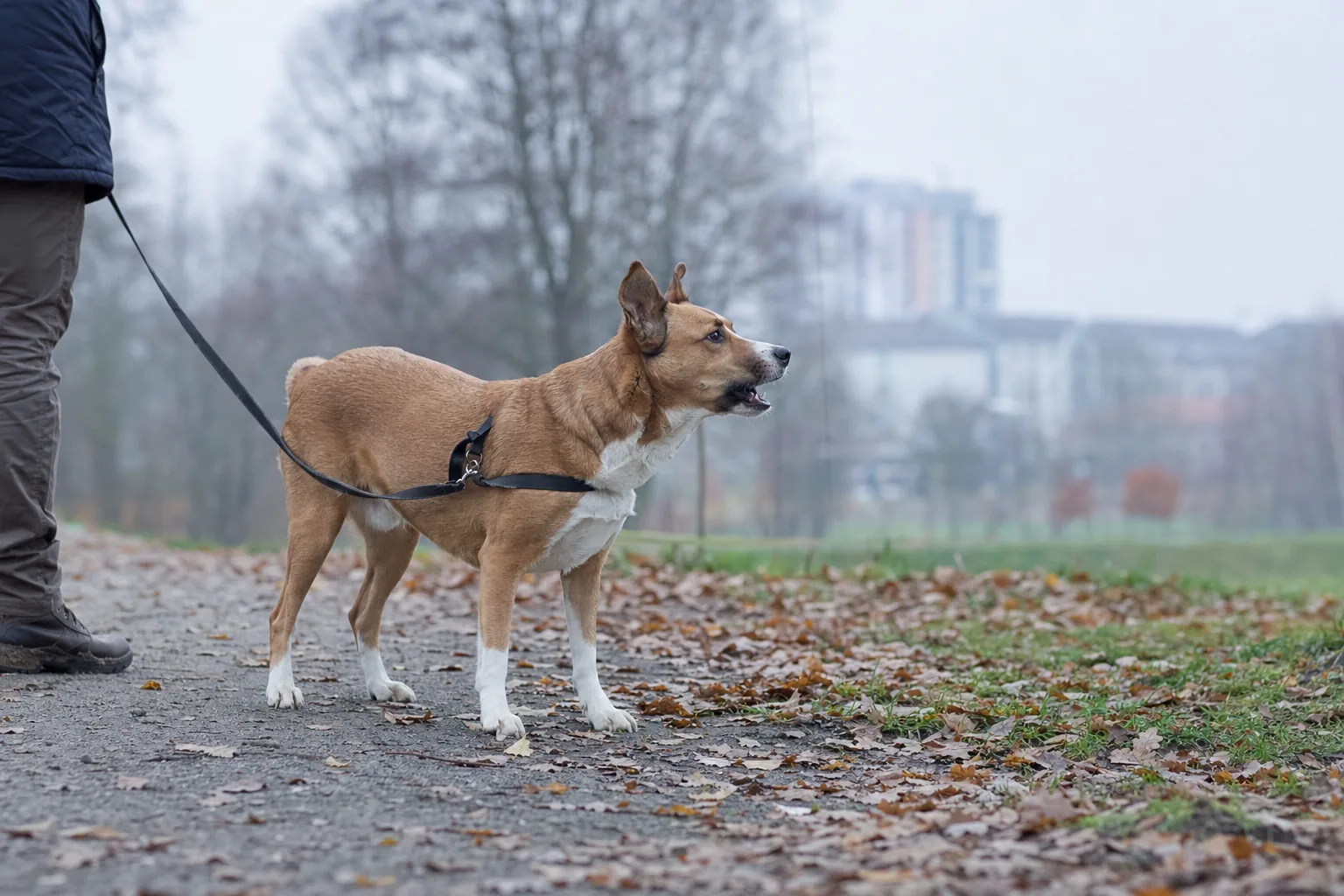
You are walking along the pavement and a cyclist goes by. Your dog hits the end of the lead with his whole weight, and you are left hanging on with your shoulder half out of its socket. Or you have a dog in the garden who races the length of the fence after every car, barking, and who once got through the gate and ended up a metre from the wheels. Or a dog who, off lead in the park, spotted a cat and was four paths away before you could blink. Of all the problems on this list, chasing is the most dangerous, because it ends in the road. It is also the hardest to shift, because for the dog nothing in the world beats it.
Why does my dog chase cars, cyclists and cats?
Because they move. Every dog carries the hunting sequence he inherited from the wolf, one step after another: spot, stare, stalk, chase, grab, bite. People made the breeds by keeping or removing parts of that sequence. Herding dogs kept the stare and the chase, without the bite. Sighthounds kept the chase. Terriers kept the whole chain, right to the end. All dogs, though, have the bit that says "something is moving fast, go after it", and a car, a bike or a cat hits that button squarely.
For the plan, this is what matters most: the running is its own reward. He does not have to catch the car to enjoy it. The chase is the best thing he knows, and every car he goes after gives him a full dose of exactly the thrill he wants. That is why "he chased another one and nothing happened" gets it backwards. Something did happen: one more rehearsal.
"Chasing" covers several different things, and it is worth knowing which one your dog is doing.
Straight hunting. He goes quiet, drops low, locks his eyes on the target, then he is off. No barking, no fuss. This is the most dangerous kind, because you get no warning, and a dog in that state no longer hears you.
Frustration on the lead. He barks, leaps about on the lead, thrashes, hackles up. The target is a cyclist, a jogger, another dog. This is more "go away" or "I want to get there and can't" than hunting. Trainers call it reactivity, and you see a lot of it in dogs kept on a short lead who never get to reach what they can see. It is worked on differently from hunting and has its own page.
Fence running. The dog in the garden who runs the fence after every car and every passer-by has learnt something: he runs, he barks, and the car goes away. A hundred times a day, for years. A fence he can see through is what makes it possible.
Boredom. A young dog with nothing to do, living on a busy road. Chasing is the only interesting thing that ever happens to him.
Fear. Less often, a dog rushes at what frightens him to drive it off. With cars, it shows up mostly in dogs taken in off the street, for whom cars really were a danger.
A game that got out of hand. You let him run after the children on their bikes "because they're only playing". It is the same piece of the sequence and it gets practised the same way.
What does not work, even when it seems to
Punishment, and the shock collar above all. He sees the cyclist, goes for it and gets a shock. What he takes from that is that cyclists bring pain. From then on the next cyclist is both prey and threat, and the dog who used to just run after them starts biting. We have seen it often enough to say so plainly: put a shock collar on a dog who chases and you get a dog who attacks. We do not use them, we do not recommend them, and several European countries have banned them.
Yanking the lead. It stops him there and then. What stays with him is the link between cyclists and pain in his neck, plus a dog who barks at bikes from 50 metres away.
Shouting his name. A dog in full flight cannot hear you, and if you shout his name twenty times for every cat, it turns into background noise.
The extending lead. Eight metres of run-up and a plastic handle that snaps or slips out of your hand. A 25-kilo dog on eight metres of extending lead is in the road before you can hit the brake.
"Let him run, he never catches them." Cats have trees, cars have wheels. The first time he follows a cat out of the park and across the road, it will not matter that he never caught it.
Wearing him out with a ball. A hundred throws are a hundred chases: something moves fast, he runs after it. A dog who does that every day is being trained to chase anything that moves, and he gets fitter for it. Balls are not banned. They just do nothing for the chasing.
Waiting for him to grow out of it. He will not. Every year of chasing only makes him better at it.
The plan, step by step
The plan has three parts running side by side. He stops getting to practise the chase, he learns what to do instead, and he gets a hunt he is allowed, with rules you set.
1. No more successful chases, starting today
- A fixed 2-metre lead wherever there is traffic, clipped to a harness rather than a collar, because a dog who hits the end of the lead on a collar hurts his neck. Loop the lead round your wrist, do not just hold it in your fingers.
- A 5 to 10 metre long line in the park and in open fields, held or trailing, until you reach step 4. Never off lead near roads.
- For the garden dog, make the fence something he cannot see through (shade netting, panels, a hedge), or keep him away from the road side whenever he is out there alone. The fence running only stops once he can no longer see.
- Pick your routes and times. To begin with, keep away from the cycle path and the hour the joggers come out. Every week without a successful chase weakens the habit.
2. Teach him to look, then turn back to you
He is going to notice the bike whatever you do, and that is fine. What you want is for him to look at you once he has noticed it.
- At home, with nothing going on: say a short word ("yes") or use a clicker, then give him a treat. Ten repetitions, three days running. He learns that the sound means food is coming.
- Outside, at a distance from which he can see a bike without tensing up (maybe 50 metres to begin with). The second he looks at the bike, say "yes" and give the treat. Do not wait for him to look at you; reward the looking itself. After a few dozen repetitions he sees a bike and turns to you on his own, because bikes now mean food.
- Close the distance by a few metres a week. If he stiffens, barks or stops taking food, you are too close. Back off and start again from further away.
- The treat has to be serious, cooked meat or cheese rather than kibble. You are up against the best thing in his world.
3. "Down" and "come" at a distance
For the moments when the lead is not in your hand, you need a "down" or "stay" at a distance and an emergency recall.
- The emergency recall is a brand-new word or a whistle, used only in training and followed every single time by a celebration: a handful of meat rather than one treat, and a big fuss. Practise it at home 20 times a day for two weeks, then outside on the long line. Do not try it on real cats until it works 10 times out of 10 with small distractions.
- "Down" at a distance: start a metre away, with a raised hand and the word, and add one step a day. A dog who drops at 20 metres when you raise your hand is a dog you can stop before he reaches the road.
4. A hunt he is allowed
Most people skip this part, and without it the rest is hard to hold together. He needs to run after something. If you do not give him the chance, he will find his own.
- A flirt pole (a stick with a cord and a toy on the end). He gets to hunt, but only when you say so and only until "leave it". Start with "stay", set the toy moving, let him chase and grab it, then say "leave it" and swap it for something tasty. Three minutes a day.
- Searching for toys and food. The steps before the chase, spotting, sniffing, stalking, satisfy him just as much and are far safer. Hide a toy in long grass and send him off with "find it". Ten minutes of creeping through the grass tires him as much as an hour of running.
- Trailing a person, a scent sport we cover further down.
The first week
| Day |
What you do |
| 1 |
Harness and fixed 2-metre lead. Extending lead in the bin. New route, away from the cycle path. Garden dog kept off the road-side fence when alone. |
| 2 |
"Yes" plus treat at home, 10 repetitions. First five minutes with the flirt pole: stay, chase, leave it. |
| 3 |
First "look and get a treat" session 50 metres from the cycle path. Emergency recall starts at home. |
| 4–7 |
One session a day at a distance, a few dozen repetitions. Flirt pole daily, 3 minutes. Emergency recall at home, 20 times a day. |
| 7 |
If at 50 metres he looks at the bike and then at you without being prompted, move to 40 next week. If not, stay where you are. |
When it is a health matter
Chasing is rarely medical. A few things are still worth checking before you start:
- he "chases" shadows, spots of light or flies that are not there, or chases his tail for hours. That is not hunting. It is compulsive behaviour, which can also have a neurological or eyesight cause;
- the chasing started suddenly in an adult dog who never used to care about cyclists. His sight may be going and he is reacting to blurry movement, he may be in pain, or something may have frightened him;
- he goes for cars with obvious fear (tail low, weight back, high-pitched barking), especially after an accident or a life on the street. Fear needs a different plan and sometimes medical help;
- after a chase: limping, cuts, laboured breathing, panting that has not settled after half an hour. A dog who has run flat out at 30 degrees can get heatstroke;
- energy that nothing brings down, a dog who will not sleep and keeps pacing the house. Talk to the vet, because for some dogs the behaviour plan needs a medical step first.
Tell your dog's vet what he chases, since when, what his body looks like while he does it and whether he has ever had an accident.
How nose work helps
Mantrailing is hunting with the nose, on a long line, after a person who is waiting at the end with a warm welcome and something tasty. For a dog who chases cats, it is the very same sequence, given a job. He picks up the scent from the scent article, settles on a direction, works the trail nose-down like a stalk, speeds up over the last few metres when he senses the person close, and makes his catch when he finds them. Except that it all happens on a lead, with you behind him, and the "prey" wants to be found. At our sessions we see dogs with "a chasing problem" who turn out to be among the best on the trail, because they have exactly the engine it takes. They still notice cats. What they get, once a week, is a whole hunt with a proper ending, and a dog who has had his hunt has fewer reasons to go looking for one in traffic. Search games in the garden do the same on a smaller scale, every day.
When to call a specialist
- he has caught and hurt a cat or another animal, or bitten a cyclist or a jogger;
- he has been hit by a car, or come within a whisker of it, and still lunges;
- he pulls you off your feet: when he goes, you physically cannot hold him;
- the chasing comes with barking, raised hackles and biting the lead, which is frustration on the lead, and it does not ease when you move further away;
- he chases shadows or lights compulsively and the vet has ruled out a medical cause;
- you have worked through steps 1 to 4 for four weeks and at 50 metres he still cannot look at you after seeing a bike.
Our assessments happen outdoors, on the long line, and we start by finding the distance from which your dog can still think. The plan starts there, and so does his first trail.
A behaviour that appears suddenly or changes for no apparent reason can have a medical cause. For full details, consult your dog's own veterinarian.