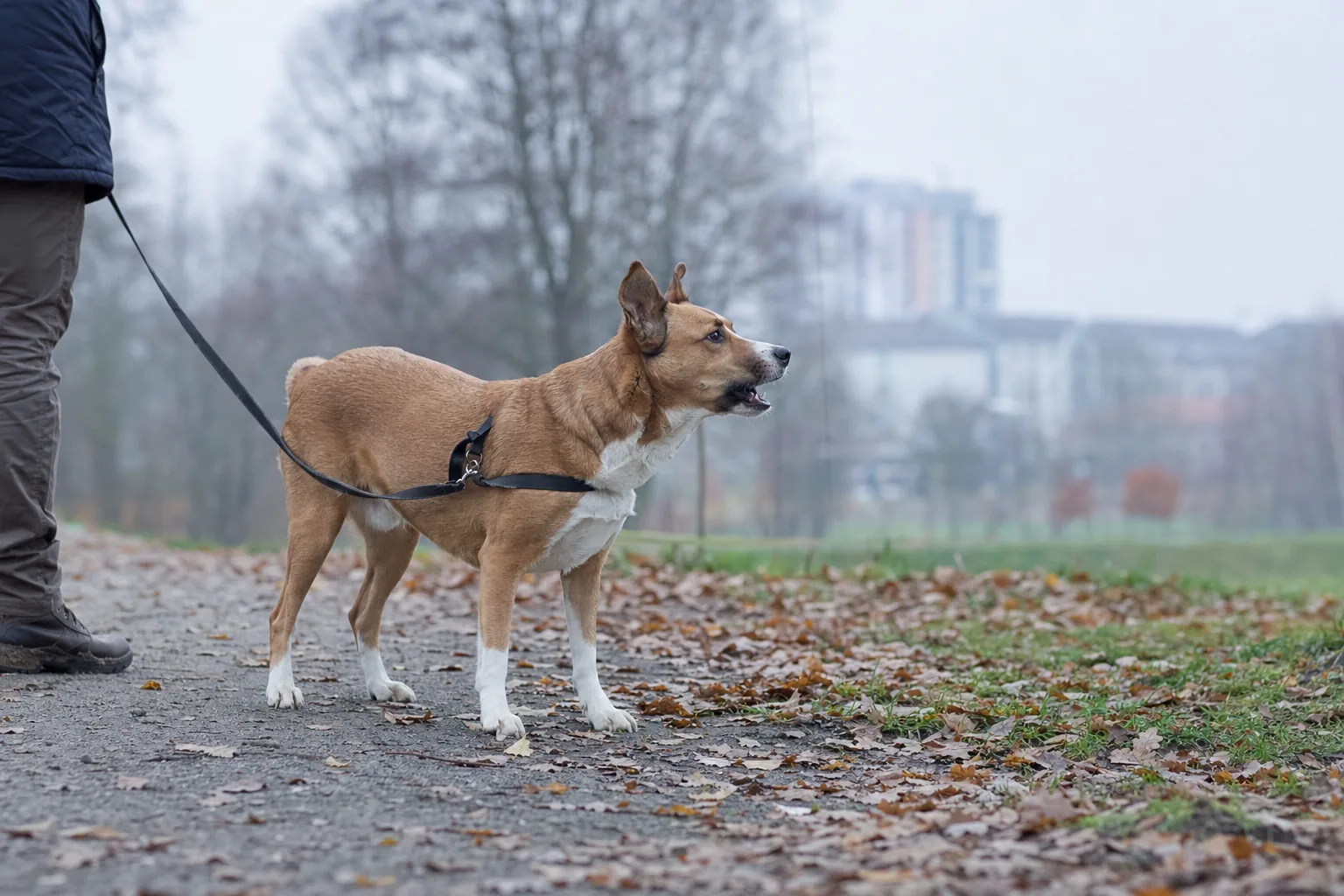
You have a two-year-old crossbreed, a three-room flat and two walks of twenty minutes a day. The dog chews the chair legs, barks at nothing, and at about ten in the evening starts doing laps of the living room at full speed. Last weekend you took him to the park for an hour of ball and he came home even more wired. Someone told you he is "hyperactive". Below is why a dog ends up like this, why more running does not fix it, and what a day looks like after which he is properly tired, in his head and not just in his legs.
Why does my dog have so much energy?
For hundreds of years dogs were bred to work: to guard, to follow game, to herd sheep, to pull. The flat dog of 2026 has the same brain and the same nose, and spends 22 hours a day with nothing to do. What we call "too much energy" is usually a dog who is missing something from a short list.
Sniffing. The nose is how he takes in the world, and ordinary walks rarely let him use it: short lead, brisk pace, "come on, stop dawdling". A dog who never gets to sniff is like a person walking about blindfolded.
Chewing. An adult dog needs to chew every day, for tens of minutes. If he has nothing suitable, he starts on the chair.
Something to learn. A dog who goes weeks without anything new to work out invents his own puzzles: how the cupboard opens, how to reach the bread.
Sleep. An adult needs 12 to 14 hours of sleep a day. Most dogs in homes with children, a TV and a front door that never stays shut get too little, and it is shallow. An under-slept dog looks exactly like one with too much energy: restless, demanding, chewing, jumping up. In puppies it is even more obvious.
Exercise, but not just any exercise. This is the trap. A ball thrown a hundred times leaves you with a dog full of adrenaline asking for the hundred and first. What you are doing is training him: he becomes an athlete who needs more and more to reach the same state. You can tell by how he comes back from the park: panting, wound up, and an hour later raring to go again.
On top of all that comes breed (a Border Collie or a Malinois in a flat with two walks a day has a real need for work that training alone does not cover), age (between 6 and 18 months a dog has an engine and no brakes yet) and the owner's timetable: nine hours alone, then two quarter-hours on the pavement.
A word on "hyperactive". True hyperactivity, as a diagnosis, is rare in dogs, and it is made by a veterinary behaviourist after everything above has been ruled out. Most of the "hyperactive" dogs we meet are short of sleep and have nothing to do with their nose.
What does not work (and why it looks as if it does)
An hour of ball. On day one it seems to work: he comes home and sleeps. Two weeks later he comes home and chews. Chasing a ball is sprint after sprint on adrenaline, and his stamina builds. The ball can stay, as ten throws at the end of a sniff walk. The walk itself needs to be something else.
A second dog "so they can play together". Sometimes that works out. More often you end up with two bored dogs teaching each other to bark, and twice the walking.
Punishing the damage. You come home, find the cushion in shreds and tell him off. He links the telling-off with you arriving; the cushion from four hours ago has nothing to do with it in his mind. The next day he chews just the same and greets you at the door with his ears flat.
Ten toys on the floor all the time. Whatever is always there gets boring. Three toys, swapped every week, keep his interest; a box of twenty is just furniture.
"He'll calm down when he's older." Adolescence passes, habits stay. A dog who learnt at one that evenings are for chewing the furniture will still be chewing it at four.
A treadmill or running beside the bike as the only answer. Plain movement, with nothing to think about and nothing to smell. You get the same bored athlete as with the ball, just with stronger legs.
The crate as the cure for destruction. It stops the damage and leaves the boredom exactly where it was. Eight hours in a crate for a dog who already had too little to do are eight hours in which the problem grows.
The plan, step by step
For a healthy adult dog, the daily target looks like this: something for the nose, something to chew, something to learn, exercise that does not hype him up, and enough sleep. It sounds like a lot. In practice it comes to 60 to 90 minutes of attention a day, half of which you spend with him anyway.
1. A week of diary
For seven days, write down how long he sleeps (properly asleep, not just lying in his bed), how many minutes he sniffs freely, how long he chews, what he learns, and when the chewing and barking happen. Most people find out this way that their dog sleeps 8 hours and sniffs for 5 minutes a day. You build the plan on the gaps in that table.
2. Lose the bowl
All his daily food turns into a search game. Scatter it on the rug or in the grass, roll it up in a towel, put it in cardboard boxes with scrunched-up paper, in stuffed toys (frozen, in summer, they last twice as long), on a snuffle mat. Ten minutes of searching out his meal tires him more than ten minutes of running, and it happens twice a day.
3. The sniff walk
Every day, 30 to 40 minutes, on a 5 to 10 metre long line, somewhere with grass, bushes and fences. He chooses where to go and how long to keep his nose in one spot. You keep quiet and follow. At first it feels as if you are doing nothing. After a week you notice he comes home and lies down without being told.
4. Three five-minute games
New things, learnt through play, with good treats and real delight at every success: touching a target with his nose, circling round you, going to his mat, the names of two toys, "find it" from one room to the next. Five minutes of concentrating on something new tires him out visibly. Three sessions a day, fitted in between your jobs.
5. Something to chew, every day
20 to 30 minutes a day, something that suits his size and teeth, chosen with your vet if he has a sensitive stomach. Chewing is a dog's own way of settling himself. If he has something to chew in the evening, he will not go looking for something of his own.
6. Rest is something you practise too
A mat or bed in a quiet corner, away from the door and the TV. Every time he settles there by himself, tell him softly what a good dog he is and give him a treat; later a stroke and the quiet are enough. In the evening, after the sniff walk and the chew, the lights go down, the house quietens, and he has somewhere to sleep where nobody disturbs him. Sleep is learnt like anything else.
7. Indoor games that really tire him
- Hide and seek: someone holds the dog, someone else hides in another room and calls him once.
- His favourite toy, hidden: first under a cushion, then in another room, then inside a box.
- Which hand is the treat in.
- Plastic cups, with a treat under just one.
- A box of scrunched-up newspaper with treats in among it.
- A rolled-up towel with food inside, which he unrolls himself.
- The stairs, if you have them indoors, with a treat on each step.
Each game lasts five to ten minutes, and afterwards you have a different dog.
8. A sport
If you enjoy it, a dog sport done regularly: mantrailing, nosework, agility, canicross. Results hardly matter here. One hour of real work a week changes what the rest of the week looks like. With us, the dogs people call "hyperactive" are often the ones who run a long trail best: they have the engine, they were just missing a road.
The first week
| Day |
What you do |
| 1 |
Start the diary. The bowl goes: his evening meal scattered on the rug. Put the toys away, leave three out. |
| 2–3 |
First sniff walk, 30 minutes, long line, no commands. The rolled-up towel with food. Something to chew in the evening. |
| 4–5 |
Three five-minute games: "touch" and "on your mat". Hide and seek with the family. |
| 6 |
Praise and a good treat every time he settles on his mat by himself. A quiet evening, lights low. |
| 7 |
Reread the diary: how long he slept compared with day 1, when he still chewed. Keep two things that worked. |
When it is a medical problem
A bored dog is a healthy dog. Restlessness can also have medical causes, though, and your vet needs to rule them out when:
- he has suddenly become restless, cannot settle, pants, wanders round the house at night (pain, especially in the back and joints);
- he scratches, licks his paws or bites at his tail while he "can't settle" (itching, parasites, allergies);
- the restlessness comes after meals, with gulping, eating grass or a gurgling stomach (digestive);
- an older dog wanders aimlessly in the evening and at night, but is calm during the day (cognitive decline);
- he has started a new treatment;
- a dog over two does not calm down at all, neither with the plan nor after sleep. True hyperactivity is rare and is diagnosed by a veterinary behaviourist once everything else has been excluded.
How nose work helps
A dog who has worked a trail for 40 minutes sleeps for the rest of the day. He has not been running: he moved at his own pace, nose down. What he has done is make decisions without a break: which way, how fast, where the scent went at the junction. At our training sessions, the dogs who arrive labelled "never gets tired" are usually the first to fall asleep in the car. At home you have the small version of the same thing, searching for food around the house and the sniff walk. For the full version, come along for an assessment.
When to call in a specialist
- he chews until he bleeds, or swallows pieces of what he destroys (risk of a gut blockage);
- he has started chasing his tail, shadows or lights, or licks himself compulsively;
- he barks for hours when he is alone and the neighbours are complaining;
- frustration comes out as growling or biting when he is stopped from doing something;
- you have followed the plan for three weeks and the diary shows no change at all;
- you have a working breed in a flat and do not know where to start.
An assessment for "too much energy" starts with your diary and usually ends with a one-page daily routine and a sport that suits your dog. It rarely takes more than that.
A behaviour that appears suddenly or changes for no apparent reason can have a medical cause. For full details, consult your dog's own veterinarian.