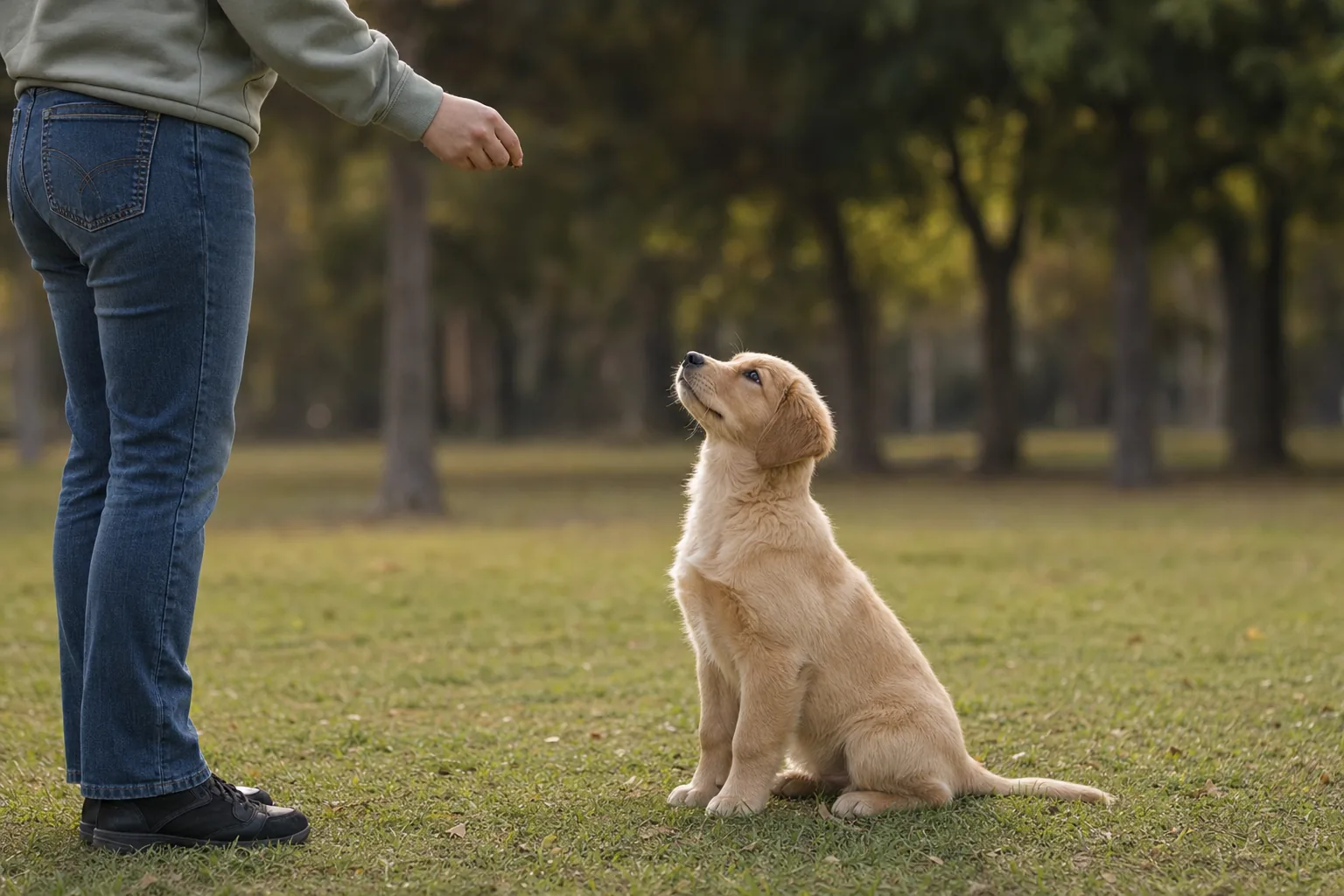
Indoors he comes the first time you call. In the park, five metres from another dog, it is as if you have gone silent. Maybe that is your one-year-old. Or you have a four-month-old puppy who used to stick to you like a magnet and stopped coming a fortnight ago. Or a rescue who arrived at six, doesn't know a single word, and whom you don't dare let off the lead. Recall is the exercise that may one day save your dog's life, and all three learn it the same way: at home, with lots of fun and the best treats you have, long before you need it.
The exercise, step by step
A dog comes back when being with you is better than whatever he is leaving behind. That is pretty much the whole theory. And he remembers very clearly what happened after the last ten recalls. If eight of them meant the lead going on and the walk home, he has learned what the word means.
1. Pick a new word
A "come" that has been shouted five hundred times with nothing happening means nothing to him any more, and it isn't worth fixing. Choose another one: "here", "this way", "with me", or a whistle you always blow the same way (two short pips). From day one the new word has a single rule: it is never used for anything unpleasant. Not for a bath, not for clipping the lead on to leave the park, not for a tablet. For those, you go to him.
2. Three days indoors: the word means a party
Your dog is two metres away and relaxed. Say the word once, in a cheerful voice. The instant he turns towards you, take a step back and feed him five small, tasty bits from your palm, one after another, with happy chatter and a stroke: ten seconds of eating out of your hand. Then say "off you go" and leave him be. Ten repetitions a day, at moments when he would have come anyway.
For these few days you don't test him. You just spoil him, so he learns that this sound means something brilliant.
3. Hide and seek
Someone at home holds him by the harness while you hide in another room and say the word. They let him go to find you, and when he does, you have a party. After a few days you do it on your own, out on a walk: when he isn't looking, slip behind a tree or a parked car and keep quiet. Let him find you, then greet him like a hero.
A dog who has lost his person twice starts checking in roughly every twenty seconds. And a dog who keeps an eye on you is already halfway to a recall.
4. The long line, in the garden and on the street
A light ten-metre long line, clipped to the harness and left trailing on the ground. This is where the nine-out-of-ten rule comes in: only call when you are nine-tenths sure he will come. That means when he has finished a sniff, when he has turned towards you, or when he is doing nothing in particular.
If he still doesn't come, don't repeat the word. Walk over, step on the line, take hold of the harness with a smile and head off in another direction; next time, call earlier. Every unanswered call blunts the word. Every celebrated return sharpens it.
The part almost everybody forgets: after the reward, tell him "off you go" and let him go back to what he was doing. Coming to you doesn't end anything. Out of five recalls on a walk, the short lead goes on only once, and that time with an extra treat.
5. The distraction ladder
| Level |
Where |
When to move on |
| 1 |
Indoors, an empty garden |
9 out of 10 at the first call, three days running |
| 2 |
Quiet street, long line |
Same |
| 3 |
Empty park, early morning |
Same |
| 4 |
Park with dogs 50 metres away |
Same, with his absolute favourite thing |
| 5 |
A dog he knows 10 metres away |
Same |
| 6 |
Called out of the middle of play, then sent back to play |
Graduate |
A level takes as long as it takes: three days or three weeks. If something less good is waiting for him when he arrives, his recall slows down too. From level 4 upwards, what waits for him is boiled chicken, cheese or sausage, not a dry biscuit from the supermarket bag.
6. The emergency recall
This is a second, separate signal, kept for the day your dog heads for the road: a long whistle blast, or a word you never use anywhere else. For a week you link it to something extraordinary without asking for anything: blow the whistle, and the best food in the house follows straight away, twenty times a day, wherever he happens to be. After that you use it once a week at most. Every time, a real celebration follows (a handful of his favourite treats, his favourite game, lots of praise), and you never use it for everyday things. Think of it as a spare tyre you keep pumped up week after week, so it works on the day it matters.
The first week
| Day |
What you do |
| 1 |
Choose the new word and make sure everyone at home knows it. Buy a ten-metre long line. |
| 1–3 |
Ten "parties" a day indoors, from two metres. No using the new word outside at all. |
| 2–7 |
Hide and seek around the house, twice a day. |
| 4–7 |
Long line in the garden or on a quiet street: five recalls per walk, nine out of ten certain, "off you go" after each one. |
| 7 |
Count how many times you called and how many came at the first call. If you are at nine out of ten, start level 2 in week two. |
By age
Puppies, 8–16 weeks
He follows you everywhere, because losing you is the worst thing in his world. Use that. Walk off in the opposite direction, he runs after you, say the word when he is a metre away, and when he arrives praise him and give him something tasty. Within two weeks the word is stuck to running towards you. Never chase him. And don't let him off in open spaces because "he stays close": at five months he won't.
Adolescents, 6–18 months
The puppy who came like a magnet stops coming and seems to have forgotten you exist. That's normal, it is hormonal and it passes, as long as you don't let the training slide right now. The long line stays on in every open space, up to 18 months if need be. Every walk gets three minutes of recall games, with the best treats and lots of fun. Don't take it personally. He isn't defying you; he has discovered the world.
Adults with no recall
Start from scratch, with a new word, exactly as with a puppy. With a rescue dog, give him two weeks to get to know you before step 1: his food comes from your hand, his name means something good, walks are on a long line with no demands at all. Recall rests on a relationship, and a relationship takes time.
Seniors
A dog over ten who "has stopped listening" often can't hear any more. Add a hand signal to the word now (arm raised, then lowered out to the side), and in the evening a torch flicked on and off twice. Reward both exactly as you reward the word. Distances get shorter and you stop asking him to run. Coming back at a walk is still coming back.
Common mistakes
- Calling him only to leave the park. If the only recall is the one before the lead goes on, he learns to steer clear of you at exactly that word. Out of five recalls on a walk, four end with "off you go".
- Repeating the word. "Come. Come! COME!" He learns that only the third shout counts, or that none of them does. One word, once, and if he doesn't come, you go to him.
- Telling him off when he arrives. After three minutes of ignoring you he finally comes, and gets a scolding or a yank on the lead. That is what he remembers about coming back. However cross you are, when he gets to you it's a party.
- Chasing him. For a dog that is the best game in the world, and he always wins. Run the other way, making a bit of noise, and you are twice as interesting.
- Using his name as the recall. His name means "look at me"; the recall word means "come all the way here". Shouted ten times with no result, his name goes blunt too.
- Calling when he can't come. Mid-sprint after a cat, even the best dog won't hear you, and that call just wore the word down. Next time, call before he spots the cat.
- Not celebrating enough. He has just left a game with another dog and he gets a dry biscuit. That effort deserves a celebration: chicken, ten seconds of it, with praise and a happy voice.
- Letting him off too soon. Until he has passed level 5 with the line on, he doesn't go off lead in open spaces. The long line is part of the kit for this exercise, like the harness.
- The shock collar. It stops the dog with pain at a distance, it is banned in more and more countries, and it teaches him that the world is a place where things hurt out of nowhere. A dog recalled with shocks comes because he is afraid of not coming. A dog recalled with fun and treats comes because he wants to. You see the difference the day the battery is flat.
How long it takes and how you know it's working
Indoors and in the garden, about two weeks to reach nine out of ten. On a quiet street and in an empty park, another three or four weeks. For the levels with other dogs, months, and with hunting breeds sometimes a year, with the long line on throughout. Recall is never completely finished. Three recalls per walk, with fun and something tasty at the end, stay for the rest of the dog's life, because a recall that brings nothing good for a whole year slowly fades away.
The signs that it's working come roughly in this order. First his head turns to you at the word before his legs move. Then he starts checking in on walks by himself, every few tens of seconds. He comes back at a trot, then at a gallop. And one day he leaves a game with another dog at the first call, looks at you as if to say "what's up?", takes his treat and his fuss and goes back to play. That is your graduate.
Do the ten-call test once a week. Ten recalls at your current level, and count how many came at the first call within three seconds. Nine or ten: move up a level. Seven or eight: stay another week. Under seven, drop a level and bring better treats.
When to call in a trainer
- he has bolted before and came back after tens of minutes, crossed roads or got lost;
- he is a hunting breed and goes completely "deaf" at the sight of a deer or a cat. The long line stays on, and you need a trainer who knows how to work with the urge to chase, perhaps through a sport that puts it to use;
- he runs away from you rather than towards something: the rescue who shies from a hand, the dog who hides under cars. That is fear, and it is a different problem from recall;
- he growls when you take hold of his harness at the end of a walk;
- you have worked the ladder for six weeks, with a diary, and you are stuck on the same level.
A basic course or a puppy class gives you exactly what you don't have at home: distractions kept under control, other dogs at a distance the trainer chooses, and someone on the sidelines who can see when you call too late. Recall is learned at home, but it is tested in a group.