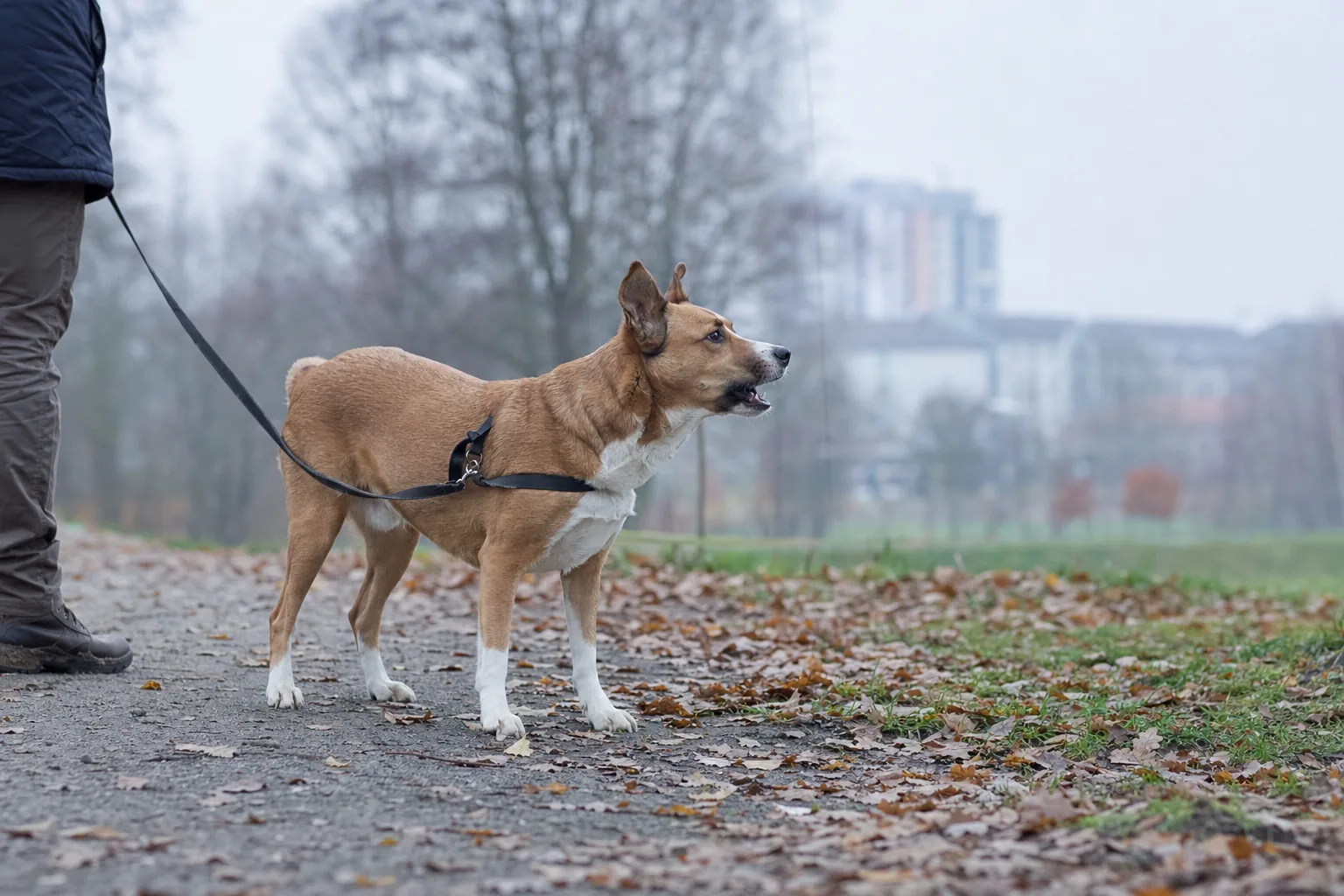
Your dog spots another dog 50 metres away and goes off like a firework: barking, lunging on the lead, teeth on show, and deaf to anything you say. So you cross the road, change the time of your walks, and end up going out at six in the morning so you won't meet anyone. Yet in the park, off lead, he plays nicely with half the dogs he barks at from the end of the lead. This page explains where that comes from, why corrections make it worse and what a distance-based plan looks like, the kind that gets a reactive dog walking past another dog without a scene.
Why does my dog bark and lunge at other dogs?
A reactive dog reacts far beyond what the situation calls for. The other dog is doing nothing; yours is putting on a show. Up to a certain distance he's an ordinary dog. Any closer and his heart rate shoots up, his body locks and he can't learn a thing. Trainers call this the threshold. Below we call it the calm distance, and it's the most important number in the whole plan.
Here are the causes, in the order we come across them most often at assessments:
Fear. By far the most common. Maybe an off-lead dog flattened him at five months, maybe he grew up without seeing other dogs, maybe he's simply more sensitive. On the lead he can't get away, so he's left with the other option: make enough noise that the other dog leaves. And it does leave, nearly every time, because its owner pulls it away. Every encounter gives your dog more proof that the method works.
Frustration. He wants to get to the other dog, the lead won't let him, and all that tension comes out of his mouth. His body leans forward, he whines before he barks, and off lead he plays without any trouble. This is the "frustrated greeter". His barking sounds a lot like a child who's just been told "not now".
The lead, and you. You see a dog, shorten the lead, hold your breath. Your dog feels the lead tighten two seconds before he sees anything, and learns that a dog appearing comes with you tensing up. A few months on, he's reacting to your hands before he's even seen the dog.
Adolescence. Lots of cases start between eight and eighteen months, in a dog who played with everyone at five months. Hormones, a shorter fuse, a few bad encounters, and the habit has set in.
Pain. A dog with a sore joint dreads being touched and would rather keep other dogs at arm's length. If an adult dog has suddenly turned reactive, see the vet first.
Breed and temperament. Guarding and herding breeds react faster to movement and approach, after hundreds of years of selection. With them you put in more work at a distance. More discipline won't help.
One more thing, about loose dogs. In many places, off-lead dogs in parks and stray dogs are simply part of going for a walk, and a good share of the reactive dogs who come to us have been attacked or cornered at least once. The plan stays the same. What changes is how you choose your places and times, and you also need a plan for the dog that comes at you off lead.
What doesn't work, even when it looks like it does
Correcting him the moment he barks. A lead jerk, a sharp "no!", a prong or shock collar. The barking stops on the spot and it looks solved. What your dog has really learnt is that another dog appearing brings pain, which is exactly the link that makes him explode in the first place. A few months later you have a dog who no longer barks and goes straight for it instead, with no warning at all.
"Let them say hello." Two tight leads, two dogs face to face, two people saying "he's friendly". For a reactive dog, an on-lead greeting is the worst set-up there is: he can't back off, the leads tangle and the humans are tense. He doesn't need to meet more dogs. He needs to walk past them.
The dog park. A dog who's afraid of dogs, let loose among ten of them, either ends up in a fight or learns he was right to be afraid. The ones who play happily off lead and bark on lead are the frustrated ones, and for them the dog park just pours petrol on the fire.
Shouting commands when it's already too close. "Sit! Stay! Here!" at a dog who's already barking. He can't hear you. A command is useful while he's still calm, and at that point you usually don't need it.
Avoidance as the whole plan. Going out at six in the morning is fine, even necessary early on. If it's all you ever do, your dog stops rehearsing the reaction but doesn't learn anything new either, and the first surprise encounter looks exactly like it did a year ago.
Retractable leads. When the other dog appears, yours is seven metres away from you, the line's always taut and you've no control left. Use a fixed lead of 2–3 metres, hold it in your hand, and that's that.
The plan, step by step
The plan changes what "another dog" means to your dog. Until now it was a threat or a frustration. From now on it becomes the sign that something good is coming from you. You only ever work from the distance where he's still calm. Anything closer is wasted time, or even a step backwards.
1. Walks with no close encounters, from day one
Pick times when hardly anyone's about and wide routes with somewhere to retreat to. Parked cars, fences and bushes are screens: step behind them when a dog comes. Do a cheerful about-turn before your dog has a chance to freeze. For off-lead dogs heading your way, a handful of treats thrown in front of them stops most of them for a few seconds, long enough for you to back off. An umbrella opened suddenly stops the rest. Don't scoop a small dog up in a hurry unless there's no other way, because plenty of loose dogs will jump up after him.
2. The calm distance
This is the distance at which your dog can see another dog but still takes a treat and still looks at you. It might be 30 metres, it might be 100. You find it over a few walks and write it down. You work outside it, and when you end up any closer, you back off. It shifts from day to day, with tiredness, with the weather, with the dog in front of you, so check it every time.
3. "Look, a dog"
At working distance, the instant your dog sees the other one, say "yes", warm and cheerful, and give him something really good, something he only ever gets at that moment: sausage, cheese, dried liver. When the other dog disappears, the goodies stop too. Ten to twenty repetitions per session. After a few days your dog sees a dog and turns to you by himself, eyes on your pocket. That's when you celebrate with him properly. Something has shifted in his head at that moment, and that's also when you close the distance by a few metres, no more.
4. The emergency turn and "find it"
For the dog who pops out round a corner five metres away, you need two things taught at home, in peace and quiet. The first is a turn-away word ("let's go!"), followed by a full about-turn and a few quick steps. The second is "find it", with a handful of treats scattered in the grass. With his nose down, his heart rate drops faster than with any command. Practise both every day with no dogs anywhere near, so they're ready when you really need them.
5. Parallel walks
Once your working distance is under 20 metres, find a friend with a calm dog who ignores everyone. Walk in the same direction, first on opposite pavements, then on the same pavement ten metres apart, then five. Never face to face, never "let them have a sniff". You want the other dog to become boring. Two or three walks a week, for a few weeks.
6. Quiet walks
Three times a week, a sniffing walk on the long line, somewhere you won't meet anyone, where the dog just gets to use his nose. A reactive dog lives with his heart rate up and needs walks where nothing happens. He needs sleep too. Wound-up dogs sleep badly, and you see it the next day in how close he can cope with another dog.
The first week
| Day |
What you do |
| 1 |
Change the time and the route. Fixed lead of 2–3 metres. First quiet walk, no dogs. |
| 2–3 |
Find the calm distance: how far away he still takes a treat. Write it down. Practise "let's go!" and "find it" indoors. |
| 4–5 |
First "look, a dog" sessions at working distance, 10 minutes, then leave. |
| 6 |
Second quiet walk. A short session somewhere new, same distance. |
| 7 |
Read your diary back: from how far does he turn to you by himself? If you haven't found any distance where he stays calm, read the section on specialists. |
When there's a medical problem behind it
Reactivity isn't an illness. Even so, in a few situations you see your own vet before you start the plan:
- it came on suddenly in an adult dog who used to get on with other dogs;
- he avoids being touched, gets up stiffly, moves differently, won't jump into the car any more (joint or back pain);
- he reacts late and very strongly, only once the other dog is close (eyesight);
- he startles and barks at dogs he didn't see coming (hearing);
- it started after an illness, an operation or a new treatment.
Tell the vet what you've written down: the distance, the moment, what the dog does with his body. A dog who expects contact to hurt keeps other dogs away with the only tool he has.
How nose work helps
Mantrailing suits reactive dogs for a very practical reason: only one dog works the trail at a time, and the other teams wait off to the side, in their cars or tens of metres away. The reactive dog gets exactly what the plan asks for, other dogs in view, at a distance, while he's doing something that absorbs him and that he loves. After a few months, the other dogs at training become part of the scenery. We see it every season: dogs who barked from the car the first time and who, a year on, sleep in the open boot while other teams walk right past. We've written more about this in our article on anxious and reactive dogs.
When to call in a specialist
- he has bitten another dog and injured it, or bitten you when you grabbed him during a reaction;
- he reacts from more than 100 metres away and you can't find any distance at which he'll still eat;
- he's a big dog you physically can't hold when he goes off;
- you have two dogs at home and one's reactivity sets off the other;
- you've worked at it consistently for six weeks and the distance hasn't come down at all;
- he's fearful in other situations too (people, noises), not just with dogs.
We do reactivity assessments out on the street, with a neutral dog at a distance, and within a few minutes it's clear whether it's fear or frustration. The plans for the two differ more than you'd think.
A behaviour that appears suddenly or changes for no apparent reason can have a medical cause. For full details, consult your dog's own veterinarian.