Your dog has had diarrhoea for two days. Someone at the park told you to "give him probiotics", and now you are standing in the pet shop in front of ten boxes covered in happy dogs and big words like "gut flora" and "immunity". Or your vet has prescribed an antibiotic and you are wondering whether you need to "rebuild his flora". We are not going to recommend a product here. What we can tell you is when probiotics genuinely make sense for dogs, where the evidence is thin, and which signs mean the problem is something else that no box off the shelf will sort out.
When to leave the box on the shelf and ring the vet
Probiotics are a conversation for a tummy that is a bit off. Not for a sick dog. If you see any of the signs below, call your own vet today:
- diarrhoea with red blood in it, or black, shiny, tar-like stool;
- repeated vomiting, especially if he cannot keep water down;
- diarrhoea in a puppy under six months, however "mild" it looks; puppies dehydrate within hours, and in a puppy who has not finished his vaccinations diarrhoea can be parvovirus;
- a flat, listless dog who does not get up to greet you, will not eat or has a sore belly when you touch it;
- diarrhoea lasting more than 48 hours in an adult, even if he seems cheerful;
- gums that are pale, tacky or dry to the touch;
- any suspicion that he has eaten something toxic or swallowed an object.
On the phone, say how long the diarrhoea has been going on, how many times a day, what it looks like and whether he has been sick. If you have already given a probiotic, tell the vet. It is no reason to wait another day, though.
What probiotics are, and what to note at home
A probiotic is a mix of live bacteria (sometimes yeasts as well) that, given in the right amount, helps the gut. "Gut flora" is the old name for what vets now call the microbiome: the billions of microbes living in a dog's intestine. It varies a lot from dog to dog, depending on diet, age and lifestyle.
The honest version of the evidence: in dogs the studies are few and small. The best results are in simple acute diarrhoea, where some products shorten the illness by about a day, no more. There is also some evidence that they can reduce soft stool during certain antibiotic courses, and that they help dogs in shelters and kennels, where stress and changes of food often cause diarrhoea. For allergies, "immunity", coat or bad breath, the evidence is weak or missing altogether.
There is something else the box will not tell you. When researchers tested probiotic products for animals, many did not contain what the label said: different bacteria, fewer of them, or none alive. A product your vet recommends, from a manufacturer that tests its batches, is a very different thing from a box picked for its picture.
Your job is to collect what the vet needs to decide whether a probiotic makes sense for your dog.
The stool. Its consistency (formed, soft, watery), its colour, any mucus or blood, how many times a day. One photo a day from the same angle says more than "it's a bit loose".
What has changed. New food, new treats, a pot of bones from a relative, scavenging, kennels, a long car journey, visitors in the house. In most of the dogs we meet with a "sensitive tummy", the cause is somewhere on that list.
Treatment. Anything he has had in the last month, including wormers and antibiotics, with dates.
The pattern. One day of diarrhoea once a year after raiding a bin is an upset tummy. Soft stool three times a month for the past year needs tests.
When probiotics make sense and when they do not
| Situation |
Worth it? |
What to do |
| Simple acute diarrhoea in a bright adult with no warning signs |
Sometimes, shortens it a little |
Ask your vet; a bland diet and water matter more |
| Soft stool during an antibiotic course |
Can help |
Ask your vet whether to give it at a different time from the antibiotic |
| Heavy stress: kennels, shelter, moving house, competition |
Encouraging data, not conclusive |
Talk to your vet beforehand |
| Chronic diarrhoea that comes and goes for months |
Only as part of a plan |
Stool and blood tests first |
| Allergies, itching, coat, "general" immunity |
Weak evidence |
No substitute for a skin consultation |
| Bloody diarrhoea, vomiting, a puppy, a listless dog |
No |
Vet today |
What the vet checks for an upset tummy
The probiotic comes in, if it comes in at all, at the very end of the consultation, after the steps below.
- Questions. Age, vaccinations, last worming, exactly what he eats (brand and since when), what else he has eaten, what treatment he has had. Your stool diary cuts this part in half.
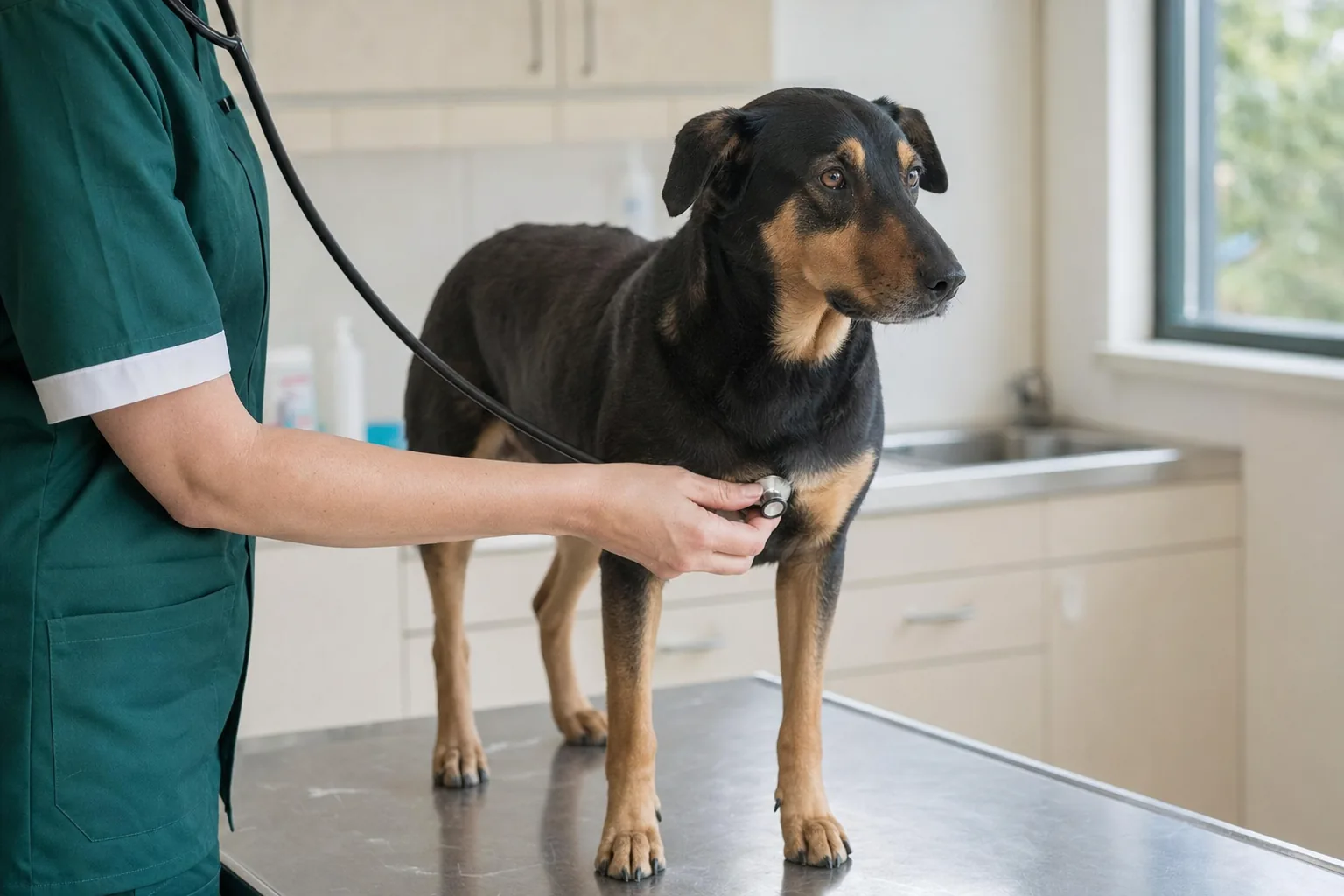
- Clinical exam. Weight, temperature, gum colour, how well hydrated he is (whether the skin lifted at the scruff springs back or stays up like a tent), then a feel of the belly.
- A stool test. Parasites and giardia top the list in dogs whose soft stool comes and goes, and probiotics will not shift them. Puppies often get a rapid parvovirus test too.
- Blood tests, if the diarrhoea drags on or the dog is subdued. They show how dehydrated he is, whether there is inflammation and how the liver, kidneys and pancreas are doing.
- For chronic diarrhoea, more steps: an elimination diet kept up patiently for several weeks, an ultrasound scan, sometimes biopsies. This is where a probiotic may join the plan alongside a change of food, never instead of it.
- The recommendation. If your vet thinks a probiotic is worth it, they will tell you which one and for how long. Ask why that one, and how you will both know it is working. A good answer has a deadline: "give it for a week and we'll look at his stools".
Some large clinics also offer faecal microbiota transplants: the vet puts gut microbes from a healthy, pre-screened dog into the gut of the sick one. It is a veterinary procedure for cases that have not responded to anything else, and nothing to attempt at home.
Probiotic mistakes to avoid
- Human probiotics "since they're in the cupboard anyway". The strains are chosen for people, and some chewable or flavoured tablets contain sweeteners that are dangerous to dogs.
- Using a probiotic as a reason to put off the vet. One day of simple diarrhoea in a cheerful adult can be watched at home. Diarrhoea with any of the signs in the first section cannot.
- Three changes at once. New food, a probiotic, a different wormer, all in the same week. If his stools improve you will not know why, and if they get worse, neither.
- Yoghurt, kefir or buttermilk instead of a probiotic. Many adult dogs struggle with lactose and the tummy can get worse. The useful bacteria in shop-bought yoghurt are nowhere near the amounts used in studies.
- Probiotics forever, for no reason. If he has been on them for three months and you cannot say what has changed, ask your vet whether they still make sense.
- Days of starving to "rest the gut". Some vets suggest a short break from food in adults, but a long fast does the gut no good and is dangerous in puppies. Ask.
- Believing the box. "Boosts immunity", "glossy coat", "detox" are advertising lines. They are not study results.
What does more for his gut than any box
A consistent diet, and when you change it, a gradual switch over a week. Treats counted as part of his daily ration. The bin kept out of reach and scavenging kept in check on walks; for dogs who swallow everything, a basket muzzle he can drink and pant in helps a great deal. Worming on time and fresh water. Enough exercise: the gut of a dog who lies on the sofa all day gets lazy too.
And if after all that his tummy is still not right, you do not need another box from the shelf. You need a plan with your own vet, starting from tests.
The information on this page is educational and does not replace an examination. For full details and a diagnosis, consult your dog's own veterinarian.