Your dog has been chewing his front paw for a year, summer and winter alike. The skin between his toes is red, his ears flare up every two or three months, he rubs his muzzle along the carpet and the skin under his tail is always sore. You have been through three bags of food: one "grain-free", one "with lamb", one "hypoallergenic" from the pet shop. Nothing changed. A friend told you "he's allergic to chicken". He may be. But food allergy in dogs is not something you work out from advice. It is confirmed in one way only, with a food trial run to the end, and below you will see how that is done, which signs need a vet quickly and which mistakes make the whole trial pointless.
A few things surprise almost everyone. Food allergy is rarer than people think: in an itchy dog, the commonest causes are fleas and allergy to what is in the air and the house (pollen, dust mites). Food allergy often comes alongside them. And "additives" are hardly ever to blame: dogs react to proteins, including the proteins in cereals. In the studies pooled by veterinary dermatologists, beef, dairy, chicken and wheat sit at the top; lamb, soya, pork and egg follow. In other words, exactly what dogs have eaten most, year after year.
Warning signs: when to call today
Ordinary food allergy is a long story, with itching that goes on for months. A few situations, though, will not wait at all:
- the muzzle, eyelids or ears swell suddenly, hives or red patches appear on the skin shortly after a meal or a new treat;
- he breathes hard and noisily, starts coughing out of nowhere, his gums are pale or bluish;
- he vomits repeatedly or has bloody diarrhoea;
- he is floppy, staggers or collapses.
These are the signs of an acute allergic reaction. With food they are rare; we see them more often after an insect sting or a medicine. Call and head for the practice, without waiting for it to pass.
Other signs are not night-time emergencies, but you do not leave them until next month either. Call within a day or two if:
- the skin has open sores or wet, smelly patches (the infections a dog gives himself by scratching);
- the ears are red and swollen, with discharge and a smell, and he holds his head to one side;
- he scratches so much he can no longer sleep;
- soft stools or diarrhoea go on for several days.
What you can watch and note at home
When he scratches. Note whether it is all year round or only from spring to autumn. Food allergy takes no notice of seasons; pollen allergy usually does. Write down the month it started and what changed then: new food, new treats, a house move.
Where he scratches. Draw a dog on a sheet of paper and colour in the areas: paws, ears, muzzle, eyes, armpits, belly, under the tail. In food allergy the usual pattern is the face, the ears, the paws and the area around the tail. One photo a week, in the same light, shows you after two months what you cannot see from one day to the next.
Stools. Dogs with food allergy sometimes pass more than three stools a day, softer, with mucus, even when the skin looks like the whole problem. Note vomiting, wind and a gurgling belly as well.
Everything he eats. The part almost everyone underestimates. Make the full list: the main food (brand, variety, every ingredient on the bag), treats, chews, scraps from the table, flavoured tablets, dog toothpaste, whatever he gets from the children, the grandparents or the neighbour across the landing. Every one of them contains protein.
Fleas. A fine comb along the back, near the tail, over a white tissue. Black specks that turn reddish when you wet them are flea dirt. Without up-to-date parasite protection, no diet tells you anything.
Food allergy, environmental allergy or fleas?
| What you see |
More likely |
| Itching all year, on the face, ears, paws and around the tail, sometimes frequent stools |
Food allergy (or a year-round environmental allergy) |
| Itching on the paws and face that starts in spring and eases in winter |
Allergy to pollen and other things in the environment |
| Itching and crusts along the back, towards the tail |
Flea allergy |
| Itching that appeared a few weeks after a new food |
Possibly food; still confirmed only by an elimination diet |
| First-ever itching in an old dog |
Another cause until proven otherwise: parasites, infections, other diseases |
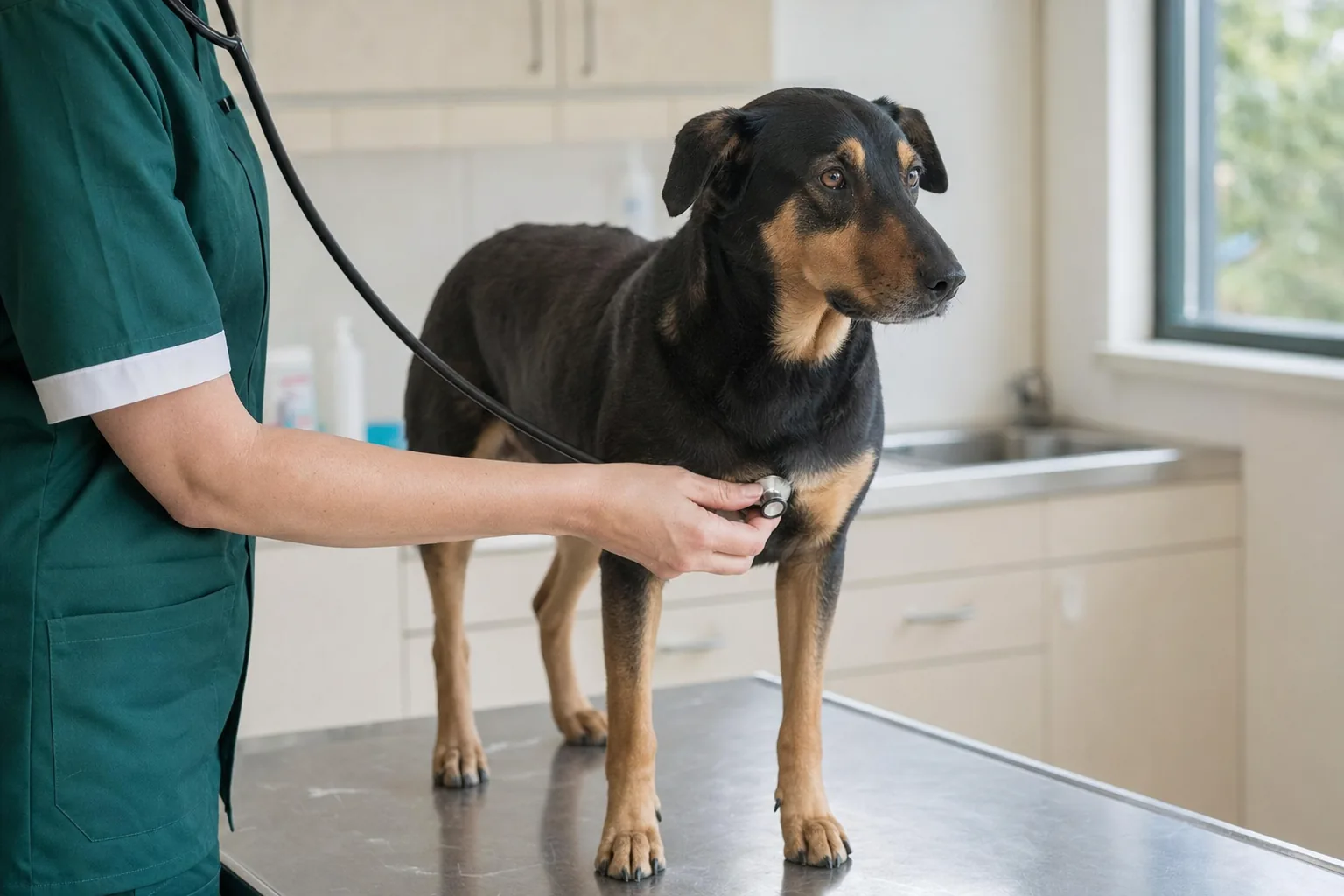
What the vet will check
- History and skin. Where, since when, what you have tried. They look at the skin, inside the ears, at the paws, between the toes.
- Parasites. Fleas, mange, other mites. Sometimes with skin scrapings, sometimes with a trial parasite treatment.
- Infections. Skin and ear infections itch on their own. The vet treats them first; otherwise nobody can see what the diet is doing.
- The elimination diet. The only reliable way to confirm food allergy. For at least eight weeks the dog eats a single food chosen by the vet: either one with a protein he has never eaten, or a special one in which the proteins are "cut" so finely that the body no longer recognises them. And nothing else. International veterinary dermatology guidelines show that most allergic dogs improve by week eight, many of them sooner.
- The challenge. If the itching has dropped a lot on the diet, the old food goes back in. In an allergic dog the signs usually return within days, two weeks at the most. Only then is the diagnosis certain. After that, proteins can be tested one at a time, so you know what to avoid for life.
- Blood, saliva or hair tests. Your vet will probably tell you they do not recommend them. Studies have shown they cannot tell allergic dogs from healthy ones; some have "found" allergies in samples of water and fake fur.
- The itch in the meantime. While the diet runs, the vet may give something for the itching so the dog is comfortable. Agree on what and how much, so it does not muddy the result.
What not to do at home
- Do not change food every two weeks. Any diet needs at least eight weeks to tell you anything. Three bags in two months tell you nothing at all.
- Do not run the diet halfway. One piece of sausage, one slice of cheese, one beef-flavoured chew can undo weeks of work. The whole family has to know the rule. Treats come from the diet food or from whatever the vet approves.
- Do not trust a "hypoallergenic" label from the pet shop. The word is not regulated. Tests on commercial "single-protein" foods have often found traces of other, undeclared proteins. For the trial, use what your vet recommends.
- Do not switch to "grain-free" as a cure. Grains are not the commonest cause; beef, dairy and chicken come up more often. And some grain-free diets have been linked with heart problems in dogs, a link that is still being studied.
- Do not give him your own allergy tablets or steroid creams from the cupboard. Some are dangerous for dogs. The rest hide the signs and spoil the test.
- Do not buy allergy tests online, from hair or saliva. The result is worth nothing.
- Do not give supplements, oils or "detox cures" during the trial. They add variables and, sometimes, protein.
- Do not give up when he scratches a little in week three. Skin needs time to recover. Keep the diary and talk to your vet before you throw in the towel.
What a properly run elimination diet looks like
One food, weighed, in two meals a day. Treats are pieces of the same food or of a wet version of it baked in the oven; for training they work as well as anything else, as long as you hand them over with real enthusiasm. Bowls are washed separately. The dog has no access to the cat's bowl, the other dogs' food, the bin or scraps in the street (a basket muzzle on walks if he scavenges). Flavoured medicines are swapped, with the vet's agreement. The diary goes on every evening: an itch score from 0 to 10, plus the weekly photos.
It is hard, but it is short. Eight weeks for an answer that tells you what he can safely eat for the rest of his life.
The information on this page is educational and does not replace an examination. For full details and a diagnosis, consult your dog's own veterinarian.