Evening, the dog is asleep next to you on the sofa, and every so often the room fills with a smell that sends you to open the window. Or you can hear his stomach from across the room, gurgling like a drainpipe, mostly at night. In most dogs, wind comes down to what they eat and how they eat it, and a few small changes sort it out. In others it is the first sign of a digestive problem that needs testing. One more thing you should know from the start: a swollen, tight belly in a large dog has nothing to do with ordinary wind and is an emergency. Here is how to tell them apart.
When wind is an emergency and when to ring today
Wind on its own isn't an emergency. Some of the signs that can come with it are. Go straight to a clinic, without waiting for an appointment, if:
- his belly is swollen and tight, he can't settle and he keeps retching with nothing coming up, especially in a large, deep-chested dog; this can be a twisted stomach (gastric dilatation-volvulus), which needs surgery within hours;
- he has collapsed, his gums are pale or he is struggling to breathe.
Less urgent, but still the same day, ring your own vet when:
- the wind comes with repeated vomiting, diarrhoea lasting more than two days, or blood in the stool;
- his belly hurts when you touch it, he stands hunched or keeps shifting from place to place;
- he has stopped eating and seems flat;
- he is losing weight even though he eats normally, or more than usual;
- he has eaten something from the bin, a big bone, a toy or something toxic.
What to keep an eye on at home for a week
Gut gas has two sources. The first is swallowed air: when a dog eats or drinks fast, when he pants a lot, and in flat-faced breeds pretty much all the time. The second is the bacteria in the large intestine, which ferment whatever food got through the stomach and small intestine undigested. The more undigested food reaches them, the more gas you get. The gurgling (vets call it borborygmi) is the sound of gas and fluid moving through the gut. A bit of gurgling is normal, especially when he's hungry.
Write a few things down for a week. It gives your vet the full picture, and quite often you'll spot the cause yourself before you even get there.
Everything he eats. His main food (brand, how long he's been on it, whether it changed recently), treats, anything from the table, anything he finds on walks. A lot of wind comes from the extras: the cheese from breakfast, a crust of bread, peas from the soup.
How fast he eats. Time his meal. A dog who empties the bowl in 30 seconds swallows a lot of air along with the food.
When the wind happens. A few hours after a meal, in the morning, after a particular treat, after a walk.
His poo. What it looks like, its colour, how much and how many times a day. Very large, pale, greasy stools with a strong smell, in a dog who eats a lot and doesn't put on weight, are something your vet needs to hear about.
His weight. Weigh him. No big scales? Step on the bathroom scales holding him, then take off your own weight.
The usual causes, by what you see
| Cause |
What you usually notice |
| Sudden change of food |
Wind and soft stool for a few days after the switch |
| Eating fast, swallowed air |
Empties the bowl in seconds, burps, wind after meals; common in flat-faced breeds |
| Table scraps, dairy, vegetables |
Wind after particular foods: milk, cheese, beans, cabbage, peas |
| Scavenging, raiding the bin |
Foul-smelling wind after walks, sometimes with soft stool |
| Food intolerance or allergy |
Wind and soft stool that keep coming back, sometimes with itchy skin or sore ears |
| Worms, giardia |
Soft stool that comes and goes, wind, sometimes weight loss |
| Pancreas not making enough enzymes |
Large, pale, greasy stools, big appetite, weight loss; more common in German Shepherds |
| Inflammatory bowel disease |
Wind, long-running vomiting or diarrhoea, weight loss |
What your vet will do
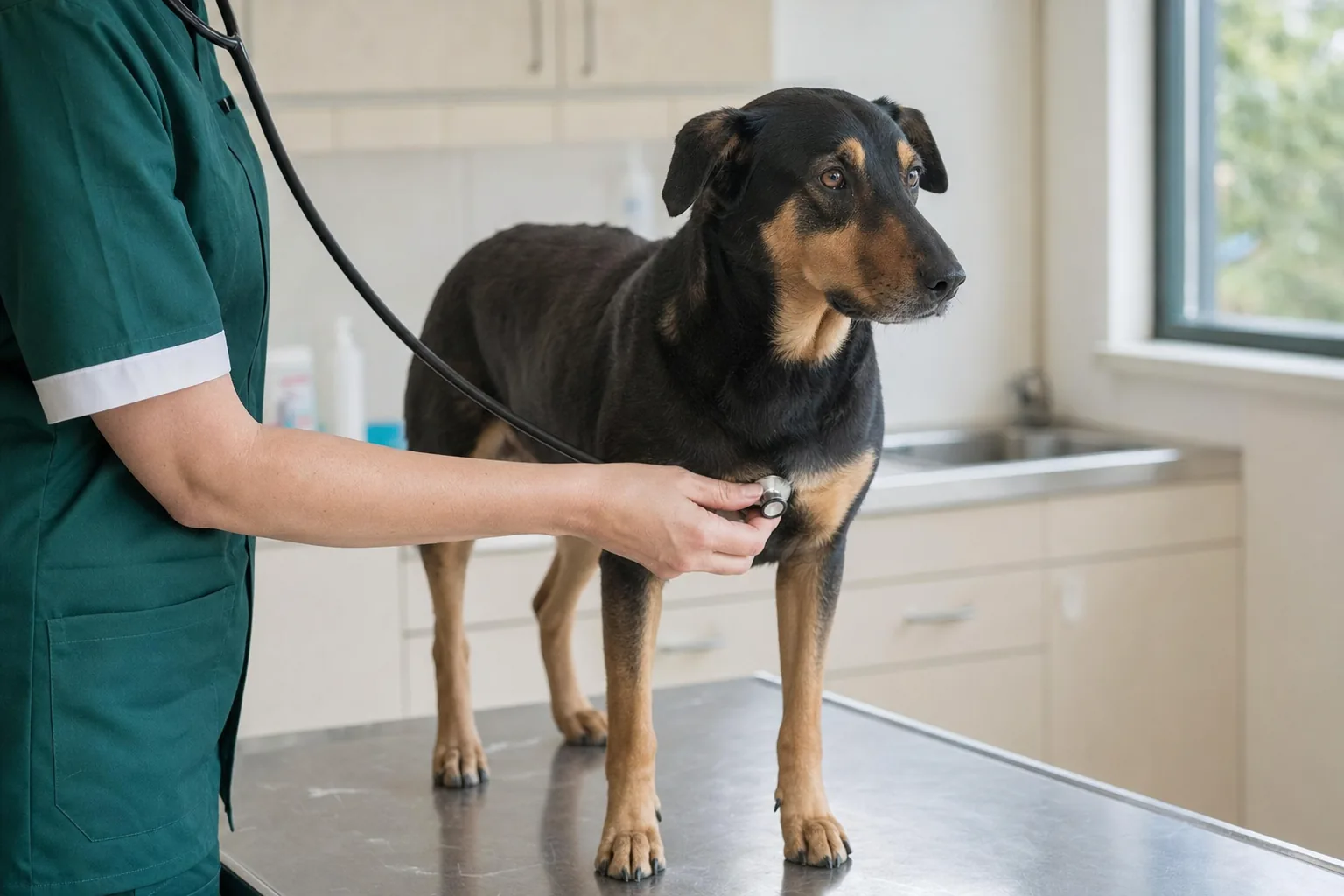
If wind is the only sign and the dog is otherwise well, the vet usually starts with questions about food and suggests a change of diet. If there are other signs, they go further, roughly in this order:
- History and examination. Food, treats, how fast he eats, what his poo looks like, his weight compared with the last visit. They'll feel his belly, listen to his gut sounds and look at his coat.
- A stool test. For worms, giardia and other parasites. With wind and soft stool, this is where they start.
- Blood tests. General health, liver, kidneys and proteins. If the vet suspects the pancreas isn't producing enough enzymes, there is a specific blood test for that.
- A food trial. Several weeks on a single food, either easy to digest or with proteins he hasn't eaten before, and nothing else: no shop-bought treats, no scraps. It's the surest way to find out whether food is behind it. It only works if the whole household sticks to it.
- X-ray or ultrasound, if he's in pain, vomiting, losing weight or has a swollen belly.
- Treatment. That depends on the cause: targeted worming, a suitable diet, pancreatic enzymes for dogs who can't make their own, treatment for gut inflammation. For some dogs the vet may add a probiotic as part of the plan.
Ask how long the food trial should run and which signs mean you should come back sooner.
What not to do at home
- Don't ignore a swollen, tight belly in a dog who is trying to be sick. That isn't "just wind".
- Don't give human wind or bloating remedies, charcoal or anything else without talking to your vet. They can mask a problem and muddle the test results.
- Don't change food three times in a month hunting for the right one. Every sudden switch causes wind of its own. Move from one food to another over at least a week, mixing a bit more of the new into the old each day.
- Don't give milk, yoghurt or cheese to "fix his gut flora". Plenty of adult dogs struggle to digest lactose.
- Don't starve him so he "clears out".
- Don't give table scraps while you're working out the cause, or you won't know which change helped.
What you can change from tomorrow
Slow his meals down. A slow-feeder bowl, a snuffle mat with the kibble hidden in it, food scattered on the grass, or a stuffed toy. If a meal takes him five minutes instead of 30 seconds, he swallows far less air. In flat-faced breeds this matters even more.
Two or three smaller meals instead of one big one. His stomach gets less at a time and the food is better digested before it reaches the bacteria in the large intestine.
Keep count of treats. Take whatever you use as treats out of his daily ration, and keep them simple: kibble from his usual food or a single-ingredient treat.
No scraps, dairy, beans or cabbage, especially in the evening if he sleeps in your room.
A gentle walk after meals. An easy stroll, no running, helps the gut move. With large, deep-chested dogs, keep an hour of quiet before and after the main meal.
Keep scavenging in check. Watch him on walks, teach "leave it" with treats he really likes, and for dogs who swallow anything, use a basket muzzle, which lets him drink and pant comfortably.
If after two or three weeks of these changes the wind hasn't budged, or his poo and weight don't look right, take your notes to your vet.
The information on this page is educational and does not replace an examination. For full details and a diagnosis, consult your dog's own veterinarian.