The puppy is three months old and came from a breeder or a rescue kennel. His stools have been soft since the day he arrived. Three days look fine, then it starts again: pale or yellowish, some mucus, and a sharp smell you have not had from a dog before. You have wormed him and changed his food, and nothing has shifted. Or it is an adult dog who drank from a puddle on a hill walk and has been loose for a fortnight. When the vet says "giardia" it sounds exotic. It is in fact one of the most common gut parasites in young dogs, and getting rid of it depends almost as much on what you clean at home as on the treatment.
Giardia is a microscopic, single-celled parasite that clings to the lining of the small intestine. People often assume it is a worm; it is not. A dog picks it up by swallowing cysts, the tough resting stage, from water, grass, another dog's coat or his own paws. The cysts come out in the faeces ready to infect the next dog, or the same dog a second time.
When to ring the vet today
Most dogs with giardia are not seriously ill. They get soft stools that come and go, and plenty show nothing at all. Some situations, though, should not wait for next week's appointment:
- a young puppy or an elderly dog with watery diarrhoea several times a day;
- diarrhoea with blood in it, or black, tarry stool;
- repeated vomiting, particularly if he cannot keep water down;
- a flat, hunched dog who will not eat or drink;
- tacky gums, sunken eyes, or skin at the scruff that is slow to drop back when you lift it gently (those are signs of dehydration);
- obvious weight loss over a week or two.
In a puppy, severe diarrhoea can be parvovirus. Telling the two apart takes a test at the practice, however many puppies you have raised.
What to watch and write down at home
The diagnosis comes from a faecal test. Your job is to bring a good sample and a clear picture of the last few days.
What the stool looks like. Classic giardia stool is soft to pasty, pale or yellowish, greasy-looking, sometimes with mucus, and it smells strong. It comes in waves: three bad days, two nearly normal ones, then round again. Take photos on the bad days and the good ones; a vet gets more from thirty seconds of scrolling than from a long description.
How often, and how. A dog with giardia tends to go a few times a day and pass a lot. If he goes often, passes little and strains, the problem is more likely in the large bowel, and that tells the vet where to look.
His weight. Once a week, same scales. Giardia interferes with fat absorption, and you do see puppies who eat well but still do not grow as they should.
Where he could have picked it up. Breeder, rescue, pet shop, boarding kennels, group classes, puddles, streams, the dog park. If you have other dogs, check their stools too.
The sample. Your vet will say how they want it. Usually a fresh stool about the size of a walnut, in a clean pot, kept cool until you get there. Cysts are not shed in every stool, so you may be asked for samples from three separate days, in one pot or three.
Giardia or something else?
| What you see |
Does it fit giardia? |
Other common causes |
| Soft, greasy, smelly stool that comes in waves |
Yes, that is the classic picture |
A change of food, pancreas problems |
| Watery, bloody diarrhoea in a puppy |
Rarely |
Parvovirus, worms, a swallowed object |
| Mucus and fresh blood, lots of small stools |
Less likely |
Colitis, whipworm, stress |
| Eating a lot, losing weight, bulky stool |
Possibly |
Pancreas not producing enough enzymes, worms |
| Nothing, but another dog at home has giardia |
Could be a carrier |
Worth testing him as well |
Use the table to get your bearings. Several parasites and several illnesses produce exactly the same stool.
At the practice: what your vet does
- Asks questions. Age, where the dog came from, diet, how long this has been going on, what you have tried. Which wormer you used, because the everyday ones do not cover every parasite.
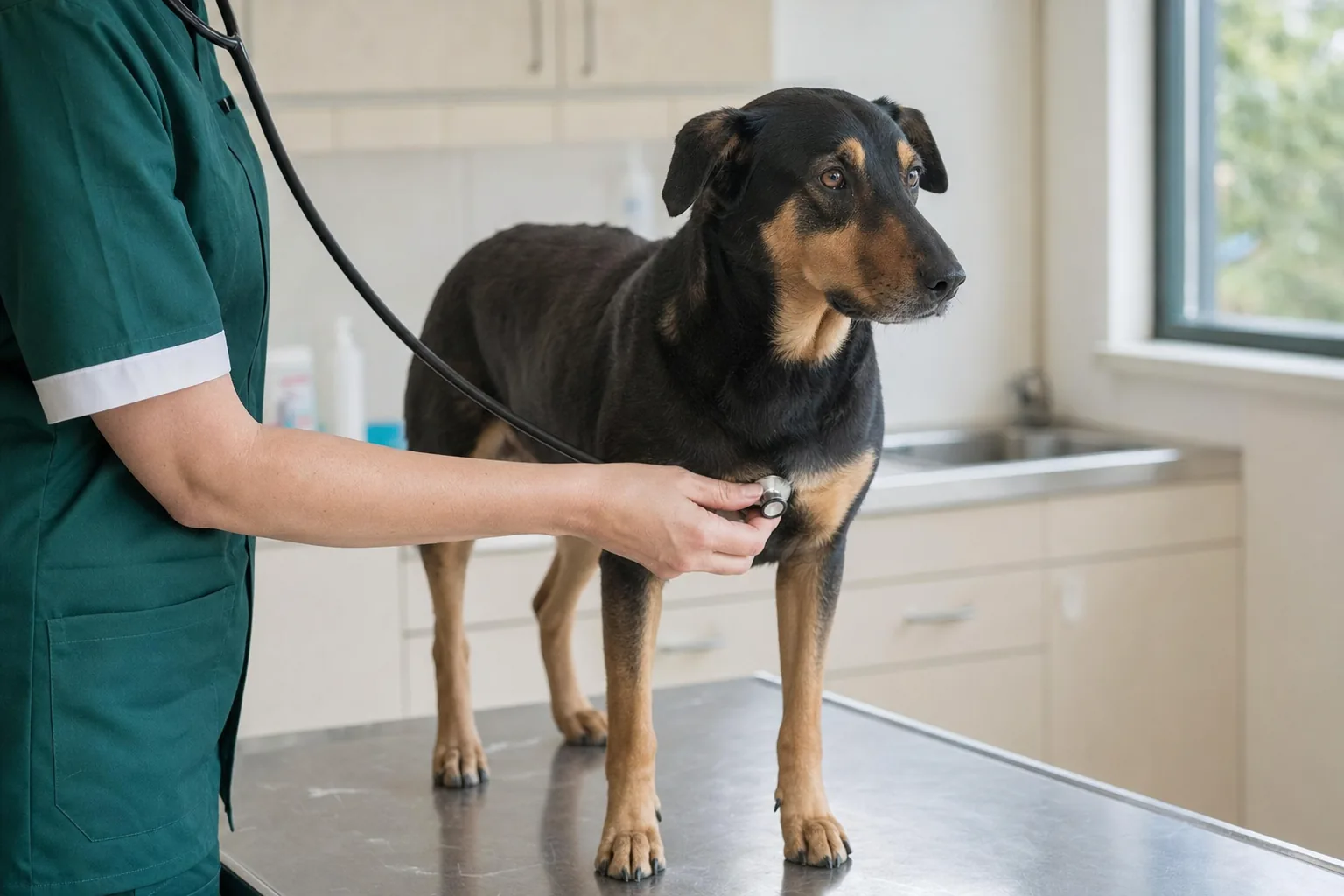
- Examines him. Weight, hydration, a feel of the belly, temperature, gums.
- Tests the stool. Two methods are common for giardia. One is a quick test that looks for a parasite protein in the sample and gives an answer in minutes. The other is the microscope, after a special technique that concentrates the sample. Sometimes the vet runs both. If the result is negative but the dog has signs, it gets repeated on fresh samples.
- Looks for other parasites. The same sample is checked for worm eggs, since a dog can carry more than one thing at once.
- Runs bloods if the dog is dehydrated or thin, or if the diarrhoea does not look like giardia.
- Sets the treatment. The product, the dose for his weight and the length of the course are your vet's decisions. It is usually a few days, sometimes repeated. What happens at home during that time counts for just as much; more on that below.
- Recommends a bath at the end. The European parasite guidelines (ESCCAP) call for a shampoo bath when treatment finishes, to shift the cysts stuck in the coat around the tail. Skip it and the dog licks himself and starts again. Your vet will tell you when and with what.
- Follows up if needed. If the signs have gone, there is usually no need to retest. If they have not, a new sample goes off and the vet looks for another cause or for reinfection.
This one surprises a lot of owners: a dog with no diarrhoea and a positive test found by chance is not always treated. Plenty of healthy dogs carry giardia and clear it themselves. Your vet decides based on the dog, his age and who else lives in the house, two-legged or four.
What not to do at home
- No leftover antibiotics, the dog's from another illness or your own. Not every product works on giardia, and a wrong dose makes the next course harder.
- No extra dose of the usual wormer on the off chance. The one in your cupboard very likely does not cover giardia at all.
- No fasting for days. A day of light food is for your vet to decide, especially in a puppy, who has no reserves to spare.
- No stools left in the garden or the park. Pick up straight away, bag it, bin it. Cysts can infect another dog from day one and last for weeks somewhere cool and damp.
- No washing just the dog. Bedding, blankets and soft toys go in the machine on a hot wash; bowls go in boiling water or the dishwasher. Floors get washed and then left to dry completely, because cysts do not survive drying out. A quick hoover does nothing for them.
- No licking after toileting, if you can stop it. Wipe under the tail with a damp cloth after every trip out, especially with long-coated dogs. For a long coat your vet may suggest clipping the hair round the tail short for the length of the treatment.
- No kennels, group classes or dog park until treatment is finished and his stools are normal.
- No treating only the poorly dog when there are others in the house. Talk to your vet about them; quite often they are all tested or treated together.
- No standing water in an outdoor bowl, and steer him away from puddles, particularly where lots of dogs pass through.
Can people catch it?
Giardia comes in several types. The ones usually found in dogs differ from the ones that make people ill, so the risk to the family is small, but it is there. Wash your hands after picking up or after bathing the dog, after playing with the puppy and before you eat. Small children stay off the patch of garden the dog uses. Anyone with a weakened immune system takes more care than the rest of the household. And if someone at home gets diarrhoea at the same time, they mention to their GP that there is a dog with giardia in the house.
For most dogs giardia is more nuisance than danger. What keeps it going for months is reinfection: cysts left in the coat, in the garden grass, on the blanket in the corner. The treatment comes from your vet. The cleaning is down to you, and if you skip it, you will be doing the treatment twice.
The information on this page is educational and does not replace an examination. For full details and a diagnosis, consult your dog's own veterinarian.