Caution. Bloody or foul-smelling discharge, strong contractions for 20–30 minutes with no puppy, more than two hours between puppies or, after whelping, trembling and a stiff gait: ring your own vet today.
Noticed something different about your dog? Go straight to their vet.
Do not look for the answer in a Facebook group, on TikTok or on a forum. Look for someone trained for this: your dog's own veterinarian, the only person who can examine, investigate and treat them.
- The same sign, dozens of causes. A dog that vomits may have eaten grass or may have an object stuck in the gut. From two lines you typed, nobody can tell which. The vet feels the abdomen, takes the temperature, runs tests.
- Nobody on the internet sees your dog. They see a photo and a story. A diagnosis comes from an examination and investigations, not from a resemblance to someone else's dog.
- In groups you hear from the people whose dog "got better on its own". Those for whom it ended badly rarely post again. What you read there is a selection, not a statistic.
- Doses are calculated by weight and species. Human medicines that look harmless, paracetamol or ibuprofen, are toxic to dogs. "I gave mine half a tablet" is the most dangerous advice you can get.
- Hours matter. With a twisted stomach, a poisoning or a urinary blockage, the time spent asking online is exactly the time that decides the outcome.
- The vet is accountable for what they say. They have your dog's record, history, vaccinations, past treatments. An anonymous account has none of that and answers for nothing.
Use this page to know what to observe, what to note and what to ask at the appointment, not to treat at home. If you still have doubts after a consultation, ask another vet or a specialist (dermatologist, internist) for a second opinion, not a group. And if you do not have a regular vet yet, find one now, while your dog is healthy: how to choose a veterinary clinic.
Three weeks ago your bitch was in season. One evening she got out into the garden with the neighbour's dog, and ever since you've been studying her every morning: same appetite, same games, same belly. Or perhaps you planned a mating and want to know what's coming, week by week. Pregnancy in dogs is short, about nine weeks, and for the first half you can barely see a thing. This page covers what you can spot at home, which signs mean a same-day call to the vet and how your own vet confirms the pregnancy. Treatment and medical decisions stay with them.
When to ring the vet the same day
Most pregnancies go smoothly. For the situations below, though, you don't wait until morning:
- bloody, pus-like or bad-smelling vaginal discharge during the pregnancy;
- dark green or black discharge before the first puppy, with no puppy following within the next two or three hours (after the first puppy, that colour is normal);
- strong, visible contractions for 20–30 minutes in a row with no puppy;
- more than two hours between puppies when you know or suspect there are more to come;
- a puppy visible at the exit, stuck, and not moving forward within a few minutes;
- at any stage of pregnancy, a bitch who is flat, feverish, off her food for a whole day and vomiting;
- 70 days since the mating and still no birth;
- after the birth: restlessness, panting, trembling, a stiff gait, falling onto her side. This can be a drop in blood calcium (eclampsia). It usually shows up in the first four weeks of feeding the litter, especially in small breeds with big litters, and it's an emergency measured in hours.
When you ring, give the day of pregnancy (or the mating date), how many puppies have arrived and what you're seeing. Your vet will tell you whether to set off straight away.
What to watch and write down at home
Start with the date. Write down the day or days she was mated. If she got out and you're not sure, note the first and last day she had the chance. Pregnancy averages 63 days from ovulation. Counted from the mating, though, it can come out anywhere between 57 and 72 days, because sperm survive for several days inside the bitch and ovulation doesn't always fall on the day of the mating.
What you'll see from week to week
| Week |
What you might notice at home |
| 1–3 |
Usually nothing. Some bitches are calmer, some eat a bit less for a few days. |
| 4 |
Nipples turn pinker and grow slightly. Sometimes a clear, odourless vaginal discharge. |
| 5–6 |
The belly starts to round out, especially with a big litter. Her appetite goes up. |
| 7 |
Mammary glands swell, the belly is obvious, she moves more heavily. |
| 8–9 |
You may see puppies moving under the skin when she lies down. She looks for corners, digs at her bed, shreds blankets. |
None of these signs proves anything. A bitch carrying two puppies may look no different until week six. One with a false pregnancy can have a belly, milk and a nest, with no puppies at all. Only your vet can tell them apart.
A simple diary
- Weight, once a week, on the same scales. A steady gain from week five is a good sign. A loss means a phone call.
- Food and water. Plenty of bitches go off their food for a few days around week three, and that's common. A whole day without eating, with vomiting, is a different matter.
- Discharge: colour, smell, amount. Take a photo.
- Rectal temperature, from day 58, twice a day at the same times. Normal is around 38–39 °C. Some 12–24 hours before whelping it usually drops by almost a degree, to below 37.5. It's the best warning you'll get at home.
- What she does in the last week. Nesting, panting, refusing food, pacing about. This is already the first stage of labour and can last from a few hours to a day, a little longer with a first litter.
Where she whelps
Set up the spot from week seven so she has time to get used to it. You want a box or a pen with one lower side, big enough for her to stretch out with room to spare, in a quiet, warm room with no draughts. Line it with newspaper and clean towels and change them often. Keep a kitchen scale nearby, a notebook, small towels for the puppies and the phone numbers of your vet and a 24-hour clinic.
What she eats
In the first half of the pregnancy she eats normally. Double her rations from the start and she lays down fat, which does nothing for the puppies. Her needs rise in the last third, and much more again while she's feeding the litter. Many vets suggest moving her gradually onto a complete puppy food from week five or six. How and how much, you decide with your vet, based on her size and the expected litter.
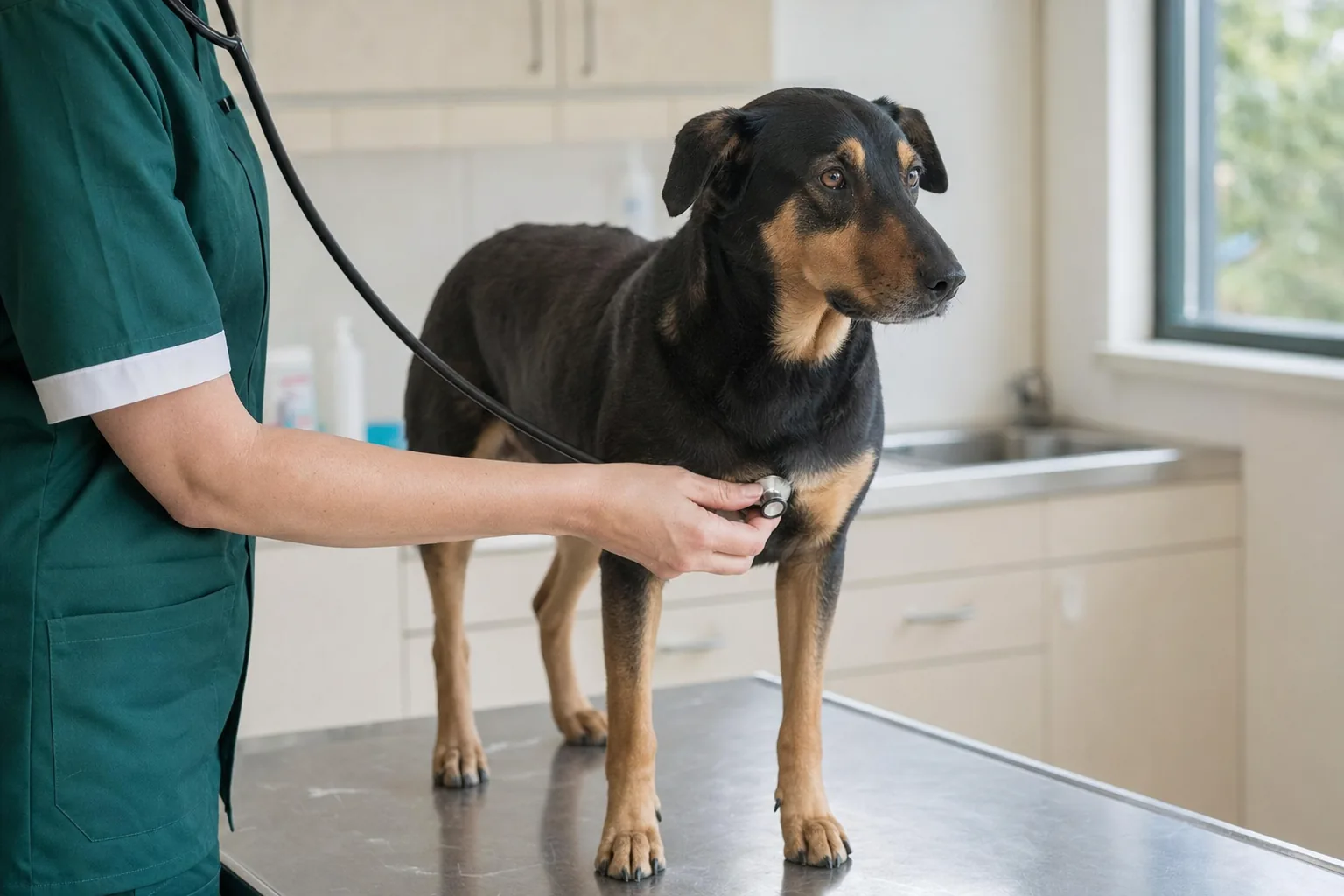
How your vet confirms the pregnancy
The confirmation visit is usually four weeks after mating. Roughly what happens:
- Questions about the mating date or dates, her previous seasons, her age, vaccinations, worming, any other illness and any medicine or parasite treatment she's had in recent weeks. Tell them everything. Some products aren't suitable in pregnancy, and the vet needs to know what she's already had.
- An examination: weight, temperature, general condition.
- Ultrasound, from around day 25 after mating. It shows the gestational sacs and the puppies' heartbeats, so you also learn that they're alive. It's poor at counting; the real number nearly always turns out different.
- Feeling the belly, between days 21 and 30, in some bitches. The vet does this gently. Don't try it yourself at home, because you can hurt the puppies.
- A blood test for a hormone made only by the placenta, from day 25–30. Useful when ultrasound isn't available, and it tells pregnancy apart from a false pregnancy.
- An X-ray, after day 45, once the puppies' skeletons have mineralised. It's the only reliable way to count them and to see whether a head looks too big for the pelvis. We'd recommend it: on the day, you'll know whether she's finished or there's another one to come.
- A plan for the birth and after: what to watch for, who to ring at night, when to bring the puppies in for their first check. For breeds with big heads and narrow pelvises, such as bulldogs, the vet may suggest a planned caesarean.
If the mating wasn't wanted, ring in the first few days, not in week six. Your vet will go through the options and the risks of each. There's no good way to deal with this yourself at home.
What not to do at home
- Calcium supplements in pregnancy on your own initiative. It sounds sensible, "for the bones", but extra calcium during pregnancy can leave her more prone to eclampsia after the birth. A good complete food covers what she needs.
- Medicines, wormers, vaccines or flea and tick products without telling your vet she's pregnant. Some are safe, some aren't, and the box doesn't always say which.
- Jumping out of the car, off the sofa or down steep stairs in the last two weeks. Ordinary, easy-going walks do her good right to the end.
- Contact with sick dogs or dogs you don't know, especially in the last three weeks. Some infections pass to the puppies.
- Pulling on a stuck puppy, or going into the vagina with fingers or instruments. Ring the vet.
- The whole family gathered round during the birth. One or two calm people she knows are enough, and everyone else waits in another room. A stressed bitch can stop contracting for hours.
- Waiting until morning when you see anything from the warning list. Whelping has short windows. A stuck puppy can die within hours, and sometimes the mother is at risk too.
- Skipping the vet for a false pregnancy because "she's definitely not pregnant". A false pregnancy deserves a conversation with your vet as well, especially if it comes back after every season.
After the birth
For a few weeks after whelping she'll have dark, reddish-brown discharge, and that's normal; it tails off gradually. Check her teats every day: if they're hot, hard, red or sore, ring the vet. Take her temperature for the first few days, and weigh each puppy every day on the kitchen scale. A puppy who doesn't gain for two days running, cries constantly or stays away from the others needs to be seen, along with his mother.
If you're not planning another litter, talk to your vet about spaying a few months after the puppies have gone. We have a separate page on when and how it's done.
Frequently asked questions
What dog owners search for most often on the internet about this problem, with the short answer. The answers are a guide only: the decision belongs to your dog's own vet, after an examination.
How long are dogs pregnant?
On average 63 days from ovulation. Counted from the mating it comes out anywhere between 57 and 72 days, because sperm survive several days inside the bitch and ovulation doesn't always fall on the day of the mating. Size makes little difference. If her progesterone was measured during the season, your vet can work out the due date more precisely.
How do I know if my bitch is pregnant?
At home it's hard, at least for the first four weeks. Around day 25–30 the nipples turn pinker, and the belly grows from week five, but exactly the same signs turn up in a false pregnancy. Your vet can tell you for sure: ultrasound from about day 25, a specific blood test from day 25–30, an X-ray after day 45.
When can a dog have a pregnancy scan?
From around day 25 after mating, when the gestational sacs and the puppies' heartbeats show up. Scan earlier and you can get a false negative. Ultrasound confirms the pregnancy and shows the puppies are alive, but it's poor at counting them. For numbers, vets recommend an X-ray after day 45, once the skeletons have mineralised.
How can I tell she's about to give birth?
Take her rectal temperature twice a day from day 58. Some 12–24 hours before whelping it usually drops by almost a degree, to below 37.5 °C. She gets restless, pants, digs at her bed, turns down food and sometimes trembles. This stage lasts from a few hours to a day. Strong contractions for 20–30 minutes with no puppy mean you ring the vet.
What should a pregnant dog eat?
For the first half, her usual food in her usual amount. Her needs rise in the last third, and many vets suggest moving her gradually onto a complete puppy food from week five or six. Don't add calcium on your own initiative, as it can raise the risk of eclampsia after the birth. Agree the amounts with your vet.
The information on this page is educational and does not replace an examination. For full details and a diagnosis, consult your dog's own veterinarian.