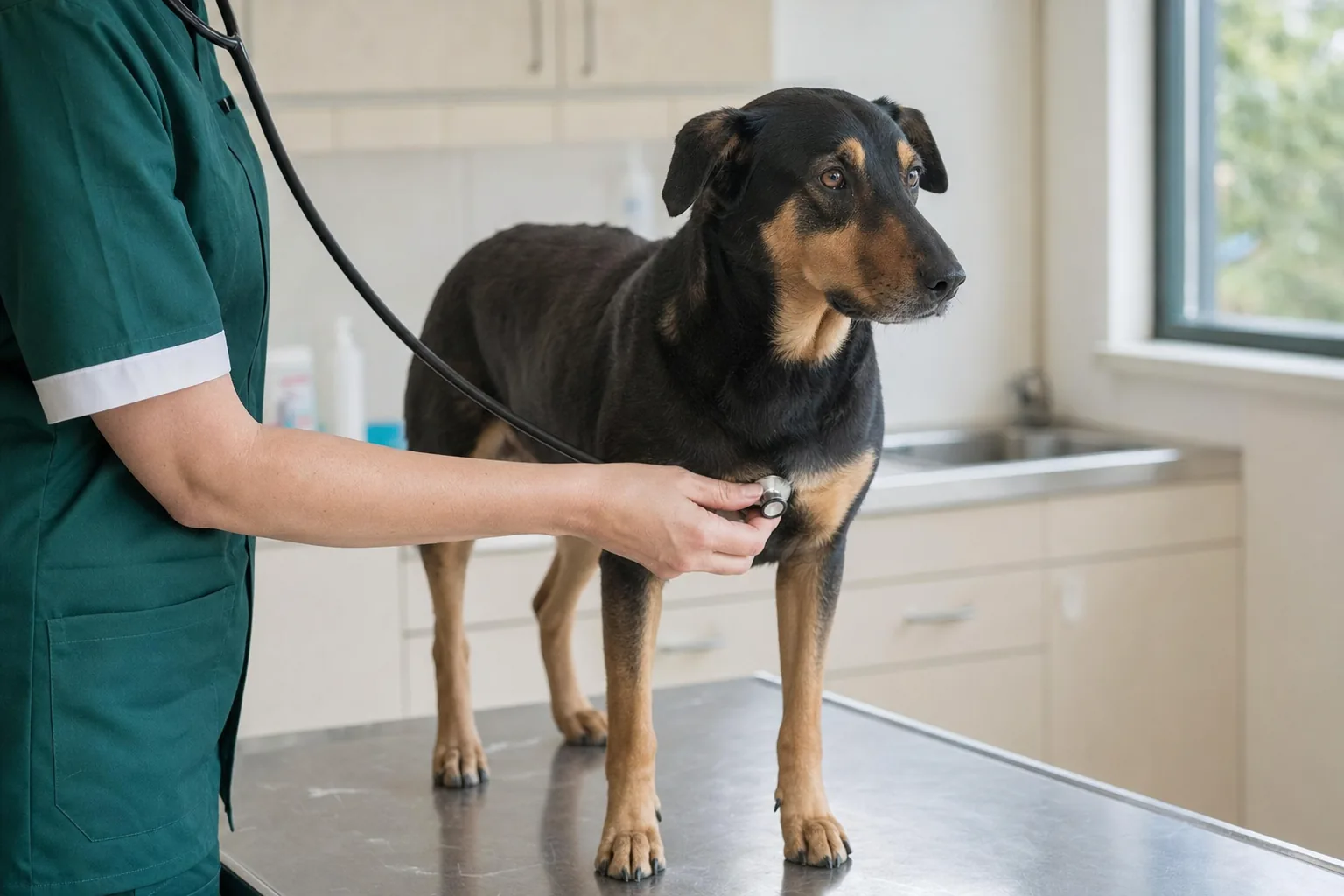
Your puppy is nine weeks old and has been with you for ten days. Yesterday he was quieter than usual. Last night he left half his bowl, this morning he was sick twice, and now he has passed a loose stool with a smell you have never come across before. Someone said "it might be parvo" and you have ended up here on your phone. If that sounds like your puppy, read the first section, ring your vet, and only then read the rest. Parvovirus can be treated. The sooner he gets to the practice, the better his chances.
Parvo symptoms: when to call the vet today
With parvovirus there is no "let's see how he is tomorrow". Call today, straight away, if your puppy shows any of the signs below, especially if he has not finished his vaccinations:
- he is flat, sleeping far more than usual and not interested in playing;
- he will not eat, not even his favourite treat;
- he is vomiting, even if only once or twice;
- he has diarrhoea, particularly watery, bloody, or with a heavy, sweetish smell that fills the room;
- his belly hurts: he tenses up, whimpers or curls into a ball when you pick him up;
- his gums are pale, dry or tacky;
- his ears and paws feel cold or, the other way round, he is hot and floppy as a rag.
Often the first sign is just tiredness, along with a poor appetite. Vomiting and diarrhoea follow a few hours or a day later. A puppy who has lost a lot of fluid can collapse within hours. Go at the first signs, not when you see blood.
On the phone, give his age, which vaccinations he has had and when (take a photo of the vaccination card), how long the signs have been going on, and whether in the last two weeks he has been to parks, other dogs, a pet shop or the vet. The practice needs to know in advance that a suspected parvo puppy is coming. Many will bring you in through a different door or straight into a separate room so dogs in the waiting room do not catch it.
What to watch and note at home
Parvovirus attacks the gut and the bone marrow, which is where the white blood cells that defend the body are made. So the puppy gets severe diarrhoea and is left with no defence against the bacteria in his own gut at the same time. The virus spreads through faeces, and dogs do not need to meet for it to pass between them. You carry it on your shoes, on pushchair wheels, on your hands, on bowls, and grass holds it too. It survives in the environment for months, even a year, in cold and in heat.
Puppies between six weeks and six months are most at risk. Early on, antibodies from their mother protect them. These fade gradually, and there is a window when they no longer protect enough but still get in the way of the vaccine. That is why puppies have a course of vaccinations running to 16 weeks or later.
To help your vet work quickly, jot these down on your phone, even in a rush:
The timeline. When you noticed the first sign, every vomit, every stool. "Sick four times since 7 this morning" tells the vet far more than "he's been sick today".
What goes in and what comes out. Has he drunk? Has he weed? How much food did he leave?
The stool. A photo, so the colour shows. If the vet wants a sample, pick up a little with a glove into a clean bag or pot.
Where he came from. Breeder, rescue, online advert. Then the vaccination card, worming, other dogs in the house and where you have walked in the last two weeks.
Is it parvo or something else?
Diarrhoea in puppies has plenty of causes. The table shows you what the vet will be looking for; the diagnosis is theirs. Any puppy who has not completed his vaccinations and has vomiting with diarrhoea is treated as a suspected case until the test says otherwise.
| Cause |
What it usually looks like |
What sets it apart |
| Parvovirus |
Lethargy, off food, vomiting, then watery diarrhoea with blood and a heavy smell |
Unvaccinated or not fully vaccinated pup; gets worse by the hour |
| Intestinal worms |
Pot belly, loose stools, sometimes worms in the stool |
Puppy is usually bright and eating |
| Giardia |
Soft, greasy stools that come and go |
Rarely makes him seriously flat |
| New food, stress |
Loose stools for a day or two after coming home |
Playing, eating, drinking |
| Something swallowed |
Repeated vomiting, maybe no diarrhoea |
Chews everything; sore belly |
| Poisoning |
Depends on the substance |
Got into something specific |
What the vet will do
So you know what to expect at the practice, a visit for suspected parvo usually goes like this:
- Separate admission. The puppy normally goes straight into isolation. Staff wear gowns and gloves so the virus does not reach puppies who are in for something else.
- Clinical examination. Temperature, how dehydrated he is, gum colour, belly, pulse.
- Rapid faecal test. It looks for the virus in the stool and gives a result in minutes. Early in the illness it can come back negative even though the puppy has parvo, and in the days after a vaccination it can give a false positive. The vet reads it together with the symptoms and sometimes repeats it or sends a sample to a lab.
- Blood tests. White cells (they drop sharply with parvo and show how serious it is), blood sugar (puppies go hypoglycaemic easily), proteins, salts.
- Treatment. No drug kills the virus. Treatment keeps the puppy alive until his own defences take over. A drip replaces lost fluids, sugar and salts. He gets medication for the vomiting and the pain, protection against bacteria crossing the damaged gut wall, and food as early as possible, sometimes through a fine tube. It usually means a few days in hospital.
- When hospital is not an option. Some practices have a home treatment protocol with daily visits. The odds are lower than in hospital and far better than doing nothing. If that is your situation, say so openly; vets would rather know from the start.
- Going home. He is discharged once he is eating on his own and has stopped vomiting. You get rules for isolation and cleaning, and a date for the check-up.
Treated in time, most puppies pull through. Untreated, many die. That gap is the reason to hurry.
What not to do at home
- Do not wait until tomorrow to see if it passes. A puppy can become badly dehydrated overnight.
- Do not give water, teas, food or rehydration solutions by mouth while he is vomiting. Whatever goes in comes back up and wears him out. When and how feeding starts is for the vet to decide.
- Do not give injections or drips ordered online, and do not use "serums" or treatments bought without a prescription. The syringe is not the hard part. The hard part is knowing what to give, how much and when, based on blood results.
- Do not try folk remedies: raw eggs, vinegar, garlic, alcohol, barbecue charcoal.
- Do not take him to the park, the pet shop or other dogs while he is ill and until your vet says he is no longer infectious. The virus is shed in the stool even after recovery, for days or weeks.
- Do not bring a new puppy home in the following months without talking to your vet. The virus stays in the garden and the house.
- Do not leave stools and vomit lying around. Pick them up with gloves into a bag you tie shut.
Cleaning and the other dogs in the house
Ordinary cleaning products do not kill the virus. Your vet will tell you which disinfectant to use; ordinary household bleach, diluted as they tell you, is often used on washable surfaces. Wash fabrics at the highest temperature they will take and throw away anything that cannot be washed. The garden and the lawn are hard to disinfect, so an unvaccinated dog should stay off them for months.
Adult dogs in the household who are properly vaccinated are usually protected. Show your vet their vaccination cards. People do not catch canine parvovirus, but they carry it on clothes and shoes. After handling the puppy, wash your hands and change.
Prevention: the vaccine and a few careful weeks
The vaccine is what really protects him. Your vet sets the schedule. It usually starts at 6–8 weeks and continues every 2–4 weeks until at least 16 weeks, with a booster later on. Until the last jab in the course, he stays out of parks full of dogs and off the grass every dog in the area uses as a toilet.
The catch is that this is exactly when he needs to see the world. Carry him around town in your arms or a pushchair, visit friends with healthy, vaccinated adult dogs, take him in the car, sit with him outside a café. Our page on puppy socialisation explains how to do it safely. A puppy kept indoors until four months old dodges a virus but ends up frightened of the world.
The information on this page is educational and does not replace an examination. For full details and a diagnosis, consult your dog's own veterinarian.