You've brought home a seven-week-old puppy and all the record card says is "vaccinated", with a stamp and no date. Or you've adopted an adult dog with no paperwork whatsoever and no idea whether he has ever had a jab. Or your five-year-old had his booster this year, has slept all day ever since, and you're wondering whether that's normal. This page covers which vaccines there are, what the usual schedule looks like for puppies and adults, which reactions are nothing to worry about and which mean picking up the phone straight away. The exact schedule is your own vet's call, because it depends on your dog's age, the life he leads and the product the practice uses.
When to ring straight away and when to ring today
People usually land on this page for one of two reasons: a reaction after a vaccine, or an unvaccinated or half-vaccinated puppy who has fallen ill.
After a vaccine
Ring immediately, or go straight back to the practice, if in the first minutes or hours you see:
- a muzzle, eyelids or ears that suddenly swell up;
- blisters or red, raised patches on the skin, or intense itching out of nowhere;
- repeated vomiting or diarrhoea, especially in the first hour;
- laboured, noisy breathing, pale or bluish gums;
- a dog who staggers or collapses.
Serious allergic reactions to vaccines are rare, but when they happen they usually happen fast. That's why many vets ask you to wait a quarter of an hour in the waiting room after the injection. Do wait.
In a puppy who hasn't finished his course
Ring the same day if you see any of these signs:
- he vomits several times or has diarrhoea, especially with blood;
- he won't eat and is flat, with no interest in playing;
- he has thick discharge from the eyes or nose, a cough or a fever;
- he has seizures or tremors he has never had before.
That is exactly what parvovirus and distemper look like, and in a puppy both move fast. Say on the phone that the puppy hasn't completed his vaccinations. Many practices will bring you in through a different door so you don't infect the other puppies in the waiting room.
What you can watch for and write down at home
Vaccination is routine, but the routine only works if the paperwork is in order and you know what has been done.
Start with the record card or passport. Every vaccine should have the product sticker attached, with the date, the vet's signature and the practice stamp. A handwritten "vaccinated" tells you nothing: not which disease it covers, not when it runs out. If your puppy comes from a breeder, ask for the card with the stickers on the day you collect him.
Next, what each vaccine covers. Vets split vaccines into two groups. Core vaccines are for every dog, wherever he lives: distemper, parvovirus and infectious canine hepatitis, usually in one combined injection. Rabies counts as core wherever the law requires it, which includes Romania and many other countries, and it is needed for travel within the EU. The rest depend on lifestyle: leptospirosis for dogs who drink from puddles, swim, hunt or live outdoors, kennel cough for dogs who go to boarding kennels, classes or shows, and sometimes Lyme disease or leishmaniosis where the risk exists.
Put the date of the next vaccine in your phone calendar while you're still at the practice. Most schedules fall apart at the second or third booster, when the puppy already looks big and healthy and nobody remembers the date.
In the days after a vaccine, keep an eye on how he is. Note his temperature (if you know how to take it), his appetite, how much he sleeps and whether there's a lump where he had the injection. It's normal for a dog to be a bit flat for a day, eat less and have a small, painless lump where the needle went in. It isn't normal for the lump to be growing after three weeks, or for him to be listless for three days.
The usual schedule, in brief
| Situation |
What is usually done |
Why |
| Puppy, 6–8 weeks |
First core vaccine (combined) |
Antibodies from the mother start to drop |
| Puppy, every 2–4 weeks |
Boosters until at least 16 weeks |
Nobody knows exactly when the mother's antibodies disappear, and they can "cancel out" the vaccine |
| Puppy, from 12 weeks |
Rabies vaccine |
Required by law in many countries; needed for a pet passport |
| At 6 months or 1 year |
Booster of the core vaccines |
Catches puppies whose last dose didn't take |
| Adult |
Core vaccines no more than every 3 years, lifestyle vaccines yearly |
Immunity to distemper, parvovirus and hepatitis lasts years; to leptospirosis, only about a year |
| Adult with no history |
Start as for a puppy, usually with two doses |
You don't know what he had before |
The table follows the international vets' guidelines (WSAVA). Your vet may have reasons to do things differently, such as the product they stock or what a boarding kennel asks for.
So the first vaccine is given at around 6–8 weeks, and a puppy collected at 8 weeks should come with it done. He is protected only one to two weeks after the last dose of the course. The first dose on its own doesn't cover him.
How the vet visit goes
A vaccination appointment is also a check-up, and it should be. It usually goes something like this:
- History. Which vaccines he has had, when, with which product. Where he lives, whether he goes to boarding kennels, training classes or out shooting, whether he travels abroad. That decides which lifestyle vaccines he needs.
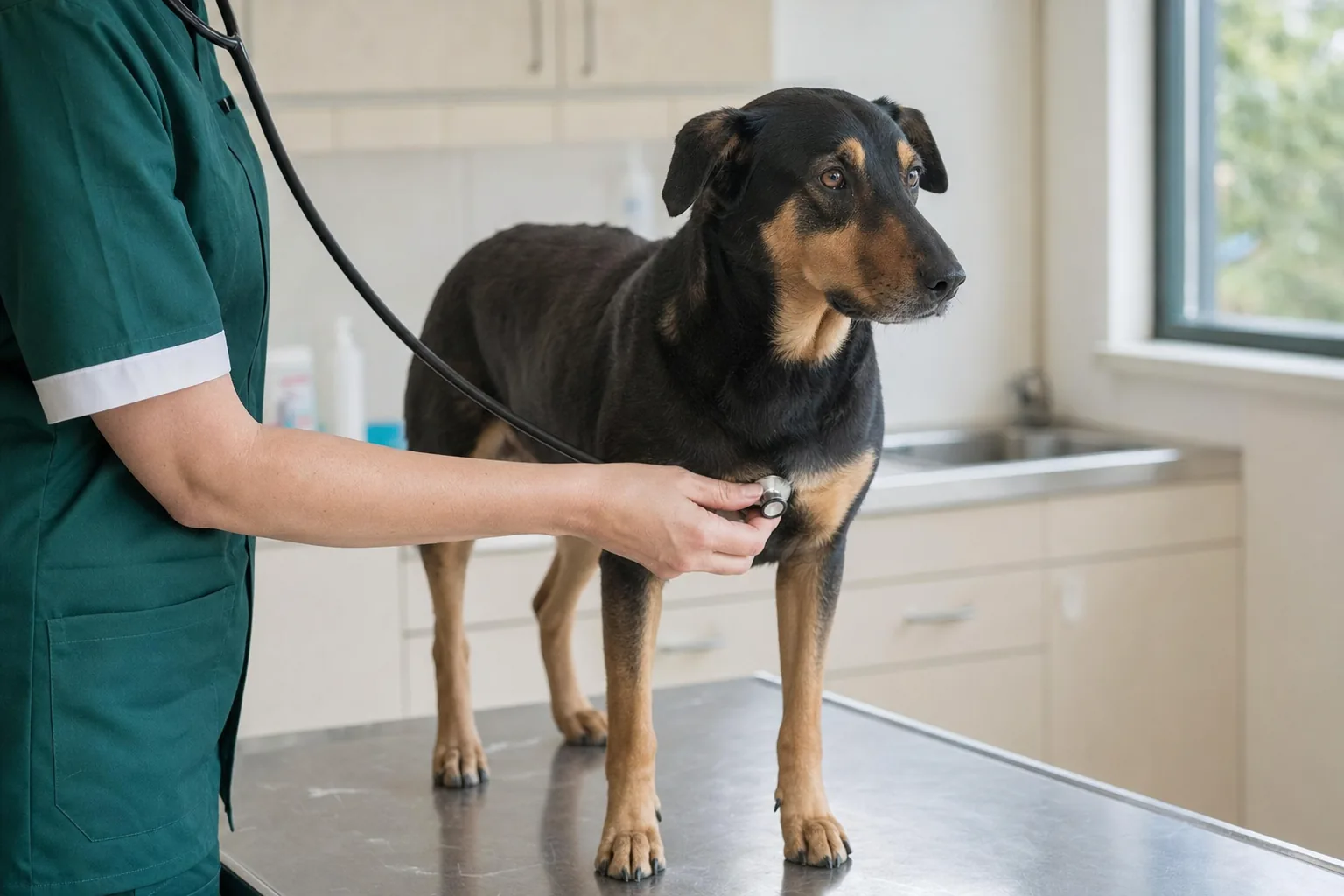
- A clinical exam. The vet takes his temperature, looks at his gums, eyes and nose, listens to his heart and lungs and weighs him. A dog who is ill or feverish isn't vaccinated that day, because the vaccine needs a settled immune system to do its job.
- Worming. Many vets like to know the puppy has been wormed before vaccination. Ask how they prefer to do it.
- The vaccine. An injection under the skin, usually between the shoulder blades, sometimes two at the same visit. The vet sticks the label in the record card or passport and signs it.
- Antibody testing as an option. For core vaccines in adult dogs there are blood tests (often called titre tests) that show whether he still has antibodies against the three core diseases. If he does, the booster can wait. A rabies vaccine required by law is still needed.
- The passport, if you travel. For travel within the European Union a dog needs a microchip, a pet passport and a rabies vaccine given after the chip. After the first rabies vaccine you wait 21 days before travelling. Some countries also ask for other treatments, and your vet will know which.
- The next date. You'll be told it and it'll be written down. Ask at the same time which lifestyle vaccines it makes sense to add next year.
If your puppy reacted to a vaccine, tell the vet next time, even if it was only a day of feeling sorry for himself. They may switch products or split the vaccines over separate visits.
What not to do at home
- Don't buy the vaccine and give it yourself. It's sometimes sold online or in farm supply shops. A vaccine that hasn't been kept at the right temperature no longer protects, and an injection given at home doesn't appear on any valid record: as far as the law, the boarding kennels and border control are concerned, your dog is unvaccinated.
- Don't put the puppy down on pavements and in parks before he's protected, but don't shut him indoors for three months either. The period when a puppy gets used to the world most easily (the socialisation window) closes at around 12–14 weeks, right in the middle of his vaccinations. Carry him around the streets, take him to visit vaccinated, healthy dogs you know, sign him up for a puppy class that asks for the first vaccine. Avoid places lots of unknown dogs pass through: the edge of the park, lamp posts, the grass outside blocks of flats.
- Don't skip a booster because "he's healthy". In a puppy, one dose isn't enough.
- Don't repeat the core vaccines every year out of habit without talking to your vet. It doesn't help and isn't needed.
- Don't give him anything "for a temperature" from your own medicine cabinet after a vaccine. Human fever and pain medicines are dangerous for dogs. If he's flat for more than a day, ring the vet.
- Don't massage or warm the lump at the injection site. Leave it alone and keep an eye on it.
- Don't put off the first visit with a rescue dog who has no paperwork. An adult with no history is treated as unvaccinated until you've spoken to your vet.
What vaccination changes, in practice
Distemper and parvovirus still turn up in puppies, especially in summer, in pups bought online without a record card. Both are hard to treat, with days in hospital, and many cases end badly. Rabies passes to people and is fatal once signs appear. All three can be prevented with a few practice visits in the first months and one every few years after that.
Any decent group class will ask for the record card at the first session. Dogs from all over town meet there, and one sick puppy can make a whole class ill.
The information on this page is educational and does not replace an examination. For full details and a diagnosis, consult your dog's own veterinarian.