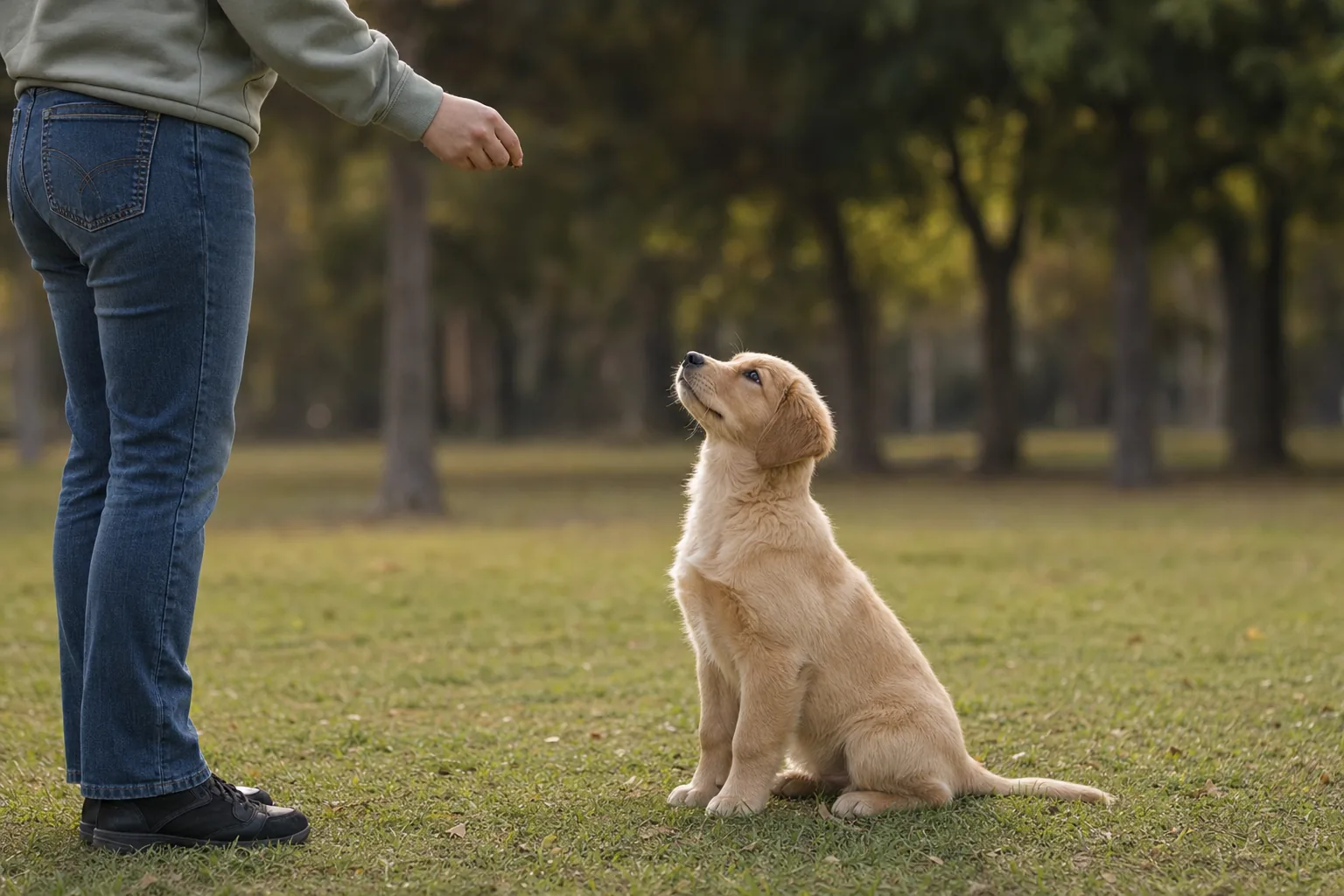
Your puppy is nine weeks old and asleep in a heap by the back door. The vet has told you not to put him down outside until after his last vaccination. A friend says he needs to meet "a hundred people in a month". The internet says that after 12 weeks it is too late for anything. Each of them is partly right, and put together they leave you stuck. Socialisation is how a puppy learns, in his first months, that his world is a safe place he can cope with: people, dogs, noises, cars, the vet's surgery. It can be done without exposing him to disease and without overwhelming him. Here is how.
How to socialise him, step by step
Roughly between 3 and 12–14 weeks, puppies go through a period when they learn very easily what is normal and safe. Whatever they meet calmly then, paired with something pleasant, they usually accept for life. Things they never meet at all may later strike them as odd or dangerous. No door slams shut at 12 weeks. It is simply easiest now, so every week is worth using.
1. He decides how close, you look after the distance
How many things he sees matters very little. What matters is that every meeting ends well. The puppy spots a bike ten metres away, looks, sniffs the air, gets a treat from you and walks on. That is a successful meeting. A puppy held in someone's arms while ten children stroke him at once learns something else entirely: that small humans come in crowds and do not stop.
Learn his signs of unease. He licks his lips, yawns when he is not tired, turns his head away, drops his tail, hides behind your legs, freezes, refuses food. When you see them, add distance or leave, without a telling-off and without "come on, it's fine".
2. Think in categories, not numbers
Think in categories and tick off something from each one, several times, in different places:
| Category |
Examples |
| People |
Men with beards, people in hats or hoods, children (supervised, calm), older people with walking sticks, people in uniform, with umbrellas, in wheelchairs |
| Dogs |
Calm, vaccinated adults who are gentle with puppies; other puppies his age, in small groups |
| Other animals |
The neighbours' cat, at a distance; birds in the park; horses or sheep, from far off, if you get out to the country |
| Noises |
The hoover, the hairdryer, the doorbell, traffic, thunder and fireworks (recordings, at low volume) |
| Surfaces |
Tiles, wooden floors, wet grass, gravel, grates, stairs, small bridges, cardboard boxes |
| Places |
The bus stop, a café terrace, a shop entrance, the car park |
| The car |
Short drives in your own car that end with something nice |
| Handling |
Paws, ears, mouth, tail, brush, towel, harness on and off |
| The vet's |
"Fun" visits: in you go, he gets treats, out you come |
| Home alone |
A few minutes on his own with something good to chew, before life demands it |
3. What to do before his last vaccination
The disease risk is real, parvovirus above all. So is the risk for a puppy who sees nothing of the world until four months old: fear of the world is one of the commonest behaviour problems in adult dogs. Veterinary behaviour guidelines advise against waiting. From day one you can:
- carry him round town in your arms, a rucksack or a pram, to bus stops, café terraces, the market;
- sit on a bench with him and let him watch the world from up high, with treats in your pocket;
- invite friends round one at a time, along with healthy, vaccinated adult dogs;
- visit friends who have vaccinated dogs and a garden that strange dogs cannot get into;
- sign up for a puppy class that checks vaccination cards and disinfects the space;
- walk him on clean pavements and avoid the spots every dog in the neighbourhood uses as a toilet.
4. Short outings
Five to ten minutes of new world, then home, play and sleep. Puppies sleep 16–18 hours a day, and sleep is when they lock in what they have experienced. One good outing a day does more than four long ones that leave him flat out in your arms.
How it changes with age
Under 12–14 weeks. The period when he learns most easily. Put the emphasis on variety and fun; meetings being pleasant matters more than there being lots of them. Start on handling too: paws, ears, mouth gently opened, a second at a time, with a treat afterwards.
Three to six months. Still learning fast. With vaccinations done, parks and proper walks come into play, along with dogs met in the street. Keep going down the list, repeating the things from the first weeks in new places. Many puppies go through a phase at around 4–5 months when new things frighten them more easily. Do not push; go back to working from further away.
Adolescents (6–18 months). A dog well socialised as a puppy can suddenly turn wary, or start barking and lunging on the lead at things that bother him. It is a well-known phase. Socialisation does not stop at four months. Keep it going, less often, with good experiences, until he is around two.
The unsocialised adopted adult. The puppy period has gone, but an adult dog can still learn that certain things are safe. It goes more slowly and needs bigger distances and a lot of patience. What you do here is get him used to what scares him a little at a time, and pair it with something he likes. A very fearful adult dog needs a plan drawn up with a specialist.
Seniors. Old dogs sometimes lose some hearing or sight and startle more easily. The pace stays the same as for a puppy: a few new things, with distance and with something good.
The mistakes we see often
"Leave him, he'll get used to it." Faced with something that scares him and no way out, a puppy does not get used to it. He learns that the thing really is frightening. Specialists call this "flooding" and avoid it.
Quantity over quality. "A hundred people in a hundred days" is fine as a reminder. If half the meetings are unpleasant, the puppy learns the exact opposite.
The dog park free-for-all. Ten strange adult dogs, some of them wound up, piling onto a three-month-old puppy. One bad experience can leave a mark. You pick the dogs he meets.
Stroked by everyone. A puppy is allowed not to want to be touched. You can tell people: "He's in training, we let him come to you."
Kept indoors until four months. Shielded from everything until the last jab, he dodges a virus and ends up afraid of the world.
Told off when he gets scared. Fear is not disobedience. What he does with it depends on you: distance, calm, something good.
How long it takes and how you know it is working
The intensive part runs from his first day home until about four months. After that you carry on, less often, until the end of adolescence at around two.
The good signs: he looks at new things with curiosity. He goes up to them on his own, sniffs and comes back to you. After a fright he recovers within seconds and takes the treat. On new surfaces his tail stays relaxed. He lets you handle his paws and ears.
The signs you are going too fast: outdoors he refuses food, he does not want to leave the house, he barks or hides more often than last week. Then slow down and add distance.
A simple yardstick: at the end of each week, write down three new things he met and enjoyed. If you can find three every week until he is four months old, you are doing a good job.
When to call a trainer
- he is frightened very often and slow to recover, even after weeks of working at a distance;
- he growls or bites when touched, picked up or approached by people;
- he does not want to leave the house or freezes in the street;
- at 4–6 months he barks and lunges at dogs or people;
- you have adopted an adult dog who is afraid of many things.
The easiest place to get socialisation right is a puppy class run by a trainer who works with rewards. The dogs are chosen with care, play is supervised, and someone can show you on the spot what your puppy is trying to tell you.