Boxing Day. Your eight-year-old, carrying a few kilos too many, turned his nose up at breakfast. By lunchtime he had been sick three times. Now he is standing with his bottom in the air and his chest flat on the floor, as if he were stretching, and he whimpers when you try to pick him up. Last night he had the skin off the roast, and he found the greaseproof paper from the sausages in the bin. Fatty food, vomiting, a sore belly: that is the textbook pancreatitis story, and one reason vet practices are packed in the days after a holiday.
When to ring the vet today
Acute pancreatitis can be mild and blow over. It can just as easily turn serious within hours, and from home you have no way of telling which. Ring the same day if you see:
- repeated vomiting, two or three times or more within a few hours, especially if he brings water back up;
- he refuses food, and he is normally a dog who clears the bowl;
- a sore belly: he tenses when you touch it, will not let you lift him, or stands in the "praying position", chest down and bottom up;
- he is flat: sleeping a lot, not coming to the door, moving stiffly;
- diarrhoea, sometimes greasy or yellowish;
- panting or trembling when he is neither hot nor cold (in dogs that is very often pain);
- very red, pale or yellow gums, laboured breathing, collapse: at that point you do not ring, you drive.
If you know he ate something fatty, tell the vet what, how much and when. Tell them too if he has had similar episodes before, even mild ones that cleared up on their own.
What to watch and write down at home
The pancreas is a small gland sitting next to the stomach, and it has two jobs. It makes the enzymes that digest food, and it makes the hormones that keep blood sugar steady, insulin among them. In pancreatitis those enzymes switch on too early, while they are still inside the pancreas, and start attacking it. That brings inflammation, pain and, in severe cases, problems that spread through the whole body.
There are two forms. Owners mix them up all the time, and sometimes so do the tests.
|
Acute |
Chronic |
| How it starts |
Suddenly, within hours |
Slowly, with small episodes that keep coming back |
| What you see |
Repeated vomiting, pain, refusing food |
Picky appetite, the odd vomit, soft stools, a "slower" dog |
| How serious |
Anything from mild to life-threatening |
Usually milder, but leaves its mark over time |
| What it can leave behind |
Sometimes nothing, sometimes it returns |
Sometimes diabetes, or a pancreas that no longer makes enough enzymes |
What set off the episode often stays unclear. A handful of things do come up again and again in these dogs' stories, though, and they are what you write down for your vet.
What he ate in the last 48 hours. Table scraps, fat off a roast, chicken skin, cold meats, a bin raid, a whole bag of treats. Nobody is looking for someone to blame. It is the most useful thing you know.
His weight. Overweight dogs are at higher risk. If you have not seen his ribs for a long while, say so.
Breed and age. Miniature Schnauzers often run high blood fats and get pancreatitis more easily. English Cocker Spaniels and a few other breeds turn up more often with the chronic form. Most affected dogs are middle-aged or older.
Other conditions and medication. Diabetes, thyroid trouble, Cushing's disease and some medicines often go hand in hand with pancreatitis. Make a list of everything your dog takes and since when.
Earlier episodes. A line like "he had one a year ago, after a barbecue" changes a lot about how your vet reads the bloods.
What pain looks like in him. Dogs hide pain better than we give them credit for. One stands frozen in a corner and will not lie down. Another gets up and settles ten times in an hour. Another licks his lips and keeps glancing at his belly. Some growl when you touch the tummy, though they have never growled at you in their lives. Film a minute on your phone: at the practice, nervous, the dog often hides exactly what the vet would have seen on that clip.
What is happening now. How many vomits and at what times, what they look like (food, froth, yellow bile), whether he is drinking, whether he is weeing, what his stools are like. Photos if you can.
At the practice: what your vet checks
No single test says "pancreatitis" for certain. Your vet puts the pieces together.
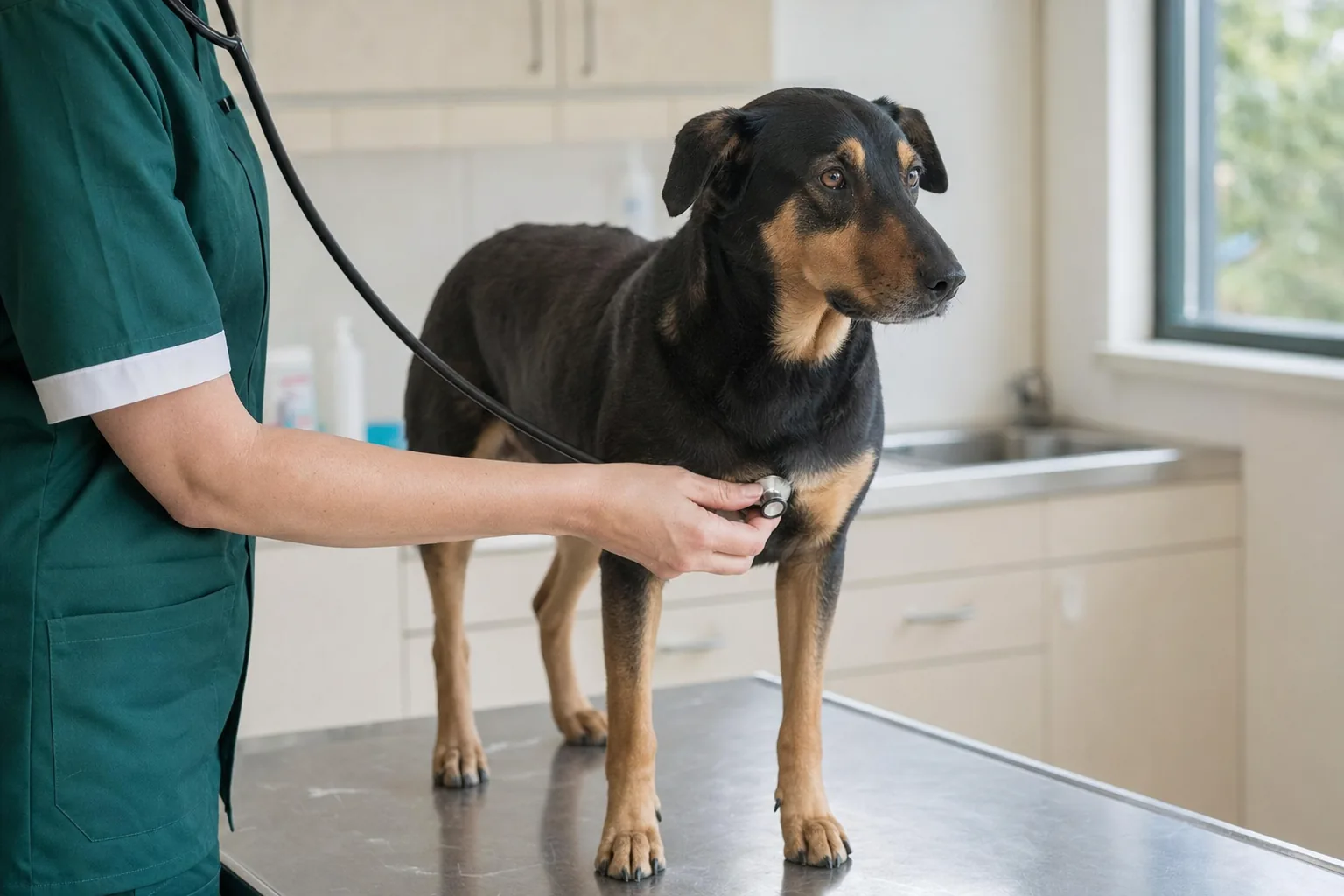
- Questions and examination. The history above, temperature, hydration, gum colour, a feel of the belly. Pain in the upper abdomen is a strong clue.
- The specific pancreatic lipase test. There is a quick in-house version and a quantitative one run by the lab. A normal result makes pancreatitis unlikely. A raised one makes it likely, but it is read alongside the dog's signs.
- Full bloods. These show inflammation, dehydration, the liver (which often suffers along with the pancreas), the kidneys, blood sugar, blood fats and salts. They give the vet an idea of how serious the episode is.
- Abdominal ultrasound. It shows a swollen pancreas and the irritated tissue around it, and rules out other causes of the same pain: something swallowed, a bowel problem, a tumour. X-rays are mostly useful for ruling out a foreign body.
- Treatment. No medicine "cures" the pancreas. Your vet gives the body what it needs to settle down: a drip for dehydration, medication for the pain and the vomiting, and food brought back as early as possible, something easy to digest. The old idea of "resting" the pancreas with days of no food has largely been dropped, because a gut that gets fed heals faster. Mild cases can sometimes be managed at home with check-ups. Severe ones mean hospital, occasionally for a week.
- The plan afterwards. For many dogs, a low-fat diet, sometimes for life, plus weight loss where needed. Blood sugar checks in dogs with repeat episodes. Your vet will tell you which food and which treats suit him.
Before you leave, ask which signs mean you come back before the check-up. Write them down and stick them on the fridge.
What not to do at home
- No human painkillers. The everyday pain tablets in most households are toxic to dogs even in small doses and can damage the stomach, kidneys or liver.
- Do not starve him for days to "rest the pancreas". If he is vomiting, ring the vet. If he is not, your vet will tell you when to start feeding again and with what.
- Do not offer "something light" like fatty chicken soup, rice with butter or a fried egg. For the pancreas, fat is the problem.
- Do not force water or food into a dog who is vomiting.
- Do not wait for it to pass if he keeps vomiting and his belly hurts. Mild episodes do pass, but at home you only recognise the severe ones once it is late.
- Do not slip back into old habits after the first episode. A dog who got pancreatitis after one barbecue can get it again after the next.
Keeping it away, holidays included
You cannot always prevent pancreatitis. A few habits do cut the risk a lot.
Keep him at a weight where you can feel his ribs with a flat hand without pressing. Scraps from the table, especially fat, skin and gravy, stay out of his bowl. If you want to share something from your plate, make it a small piece of lean meat, boiled, no salt. The bin stays shut or up high, particularly on barbecue days and when people come round. Guests get told one rule as they come in: nothing from the table. And if your dog has been through this before, his food stays the same over the holidays too. His Christmas treat can be a toy stuffed with his usual food, or a long walk in the snow.
For dogs who have had several episodes, your own vet may suggest regular blood checks. Keep the appointments.
The information on this page is educational and does not replace an examination. For full details and a diagnosis, consult your dog's own veterinarian.