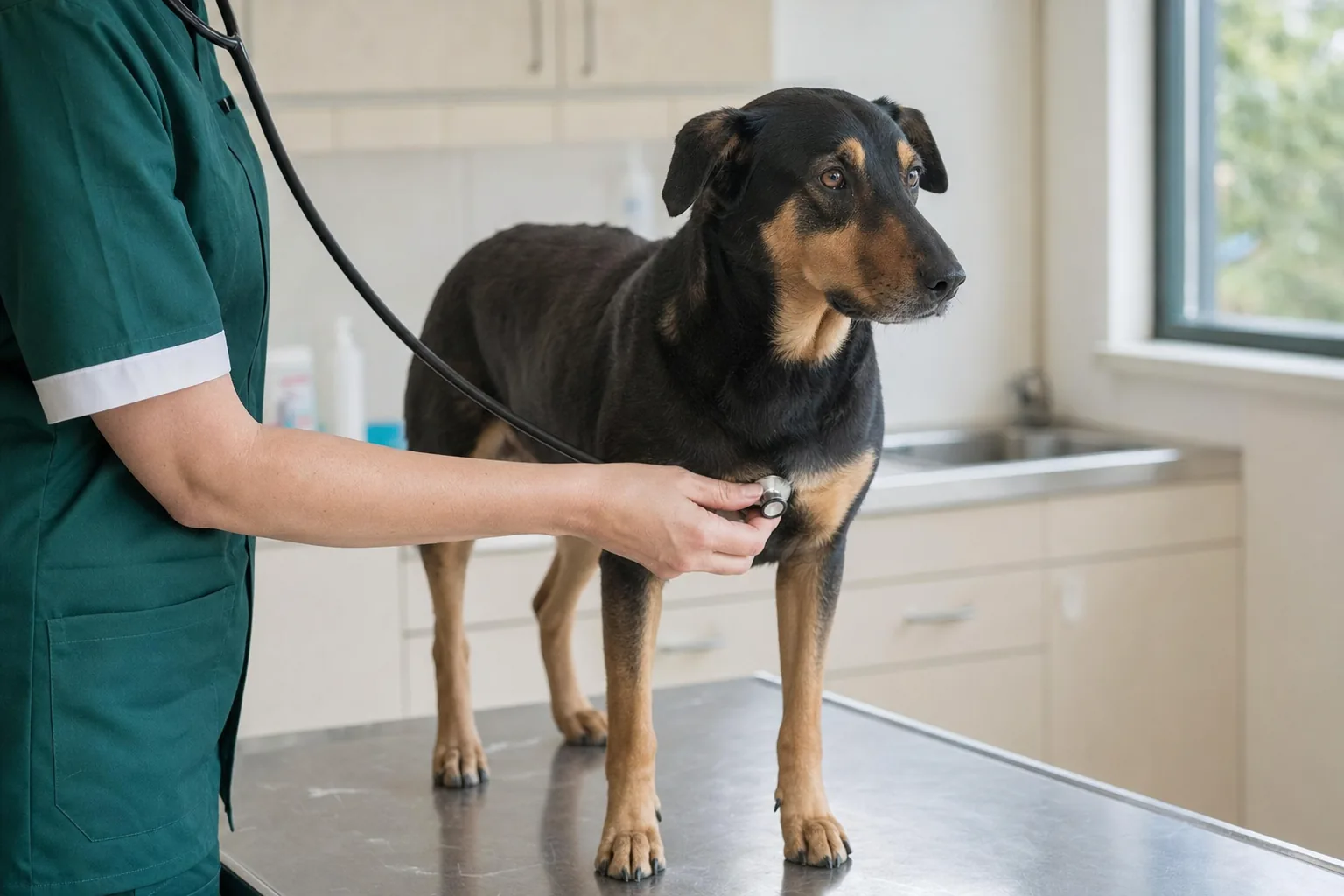
Caution. Drinking and weeing a lot, and now vomiting, off her food, flat or with sweet-smelling breath? Phone your own vet today, within the hour. In a dog already on treatment, trembling, staggering or a fit is an emergency.
Noticed something different about your dog? Go straight to their vet.
Do not look for the answer in a Facebook group, on TikTok or on a forum. Look for someone trained for this: your dog's own veterinarian, the only person who can examine, investigate and treat them.
- The same sign, dozens of causes. A dog that vomits may have eaten grass or may have an object stuck in the gut. From two lines you typed, nobody can tell which. The vet feels the abdomen, takes the temperature, runs tests.
- Nobody on the internet sees your dog. They see a photo and a story. A diagnosis comes from an examination and investigations, not from a resemblance to someone else's dog.
- In groups you hear from the people whose dog "got better on its own". Those for whom it ended badly rarely post again. What you read there is a selection, not a statistic.
- Doses are calculated by weight and species. Human medicines that look harmless, paracetamol or ibuprofen, are toxic to dogs. "I gave mine half a tablet" is the most dangerous advice you can get.
- Hours matter. With a twisted stomach, a poisoning or a urinary blockage, the time spent asking online is exactly the time that decides the outcome.
- The vet is accountable for what they say. They have your dog's record, history, vaccinations, past treatments. An anonymous account has none of that and answers for nothing.
Use this page to know what to observe, what to note and what to ask at the appointment, not to treat at home. If you still have doubts after a consultation, ask another vet or a specialist (dermatologist, internist) for a second opinion, not a group. And if you do not have a regular vet yet, find one now, while your dog is healthy: how to choose a veterinary clinic.
You fill the water bowl in the morning and by lunchtime it is empty. Your bitch is nine, and for about a month she has been drinking as if she had just come off a long trail in August, except she has spent the day on the sofa. She wakes you at night to go out. Twice she has wet the floor indoors, which has not happened since she was a puppy. She clears her bowl and asks for more, and yet when you run a hand along her back the ribs are easier to feel than a month ago. Then one morning her eyes have a milky haze. Put together, that is the textbook picture of diabetes.
In dogs, diabetes is usually for life. It is also very manageable: plenty of diabetic dogs go on for years, and their owners have the routine down within a few weeks. Below are the signs that mean phoning the vet today, what to measure at home before the appointment, what your vet will do, and the mistakes we see most often in the first weeks of treatment.
When should a thirsty dog see the vet today?
Diabetes creeps in over weeks. Some situations will not wait:
- She is vomiting, refusing food, flat and weak, breathing fast, or her breath smells sweet, like overripe fruit or nail-polish remover. This can be a serious complication of untreated diabetes, where the body starts burning its fat and the blood turns acidic. Phone within the hour.
- A dog already on treatment starts trembling, staggers about as if drunk, seems confused or has a fit. Her blood sugar has dropped too low. It is an emergency, and from day one your vet will tell you what to do at home if it happens and who to ring.
- Her sight has gone over a few days, in a dog who is drinking and weeing a lot.
- She has dropped weight noticeably in one or two weeks despite eating.
- An entire bitch has started drinking heavily in the months after a season. Diabetes is one possibility; pyometra is another, an infection of the womb, which is an emergency.
What to measure and write down before the appointment
How much she drinks in a day
Of everything you can do at home, this helps most. Pick an ordinary day, not a heatwave and not the day after a long run, because heat, exercise and dry food all push thirst up. In the morning fill a measuring jug or a marked bottle, top up the bowl from it as needed and note every top-up. In the evening, take away what is left in the bowl.
As a rough guide, a dog normally drinks under 50 to 60 millilitres per kilogram a day. Over 100 millilitres per kilogram is clearly too much. For a 10 kg dog, under half a litre is fine; more than a litre a day is something to get looked at.
The rest of the diary
- how often she goes out to wee, whether she has started having accidents or waking you at night, whether the urine spots dry sticky;
- how much she eats and whether her appetite has changed;
- her weight now and again in a week (step on the scales holding her, then on your own, and take the difference);
- her eyes: a bluish or milky haze behind the pupil, a dog who has begun walking into furniture;
- infections that keep coming back, in the bladder, on the skin or in the ears;
- for an entire bitch, the date of her last season.
A urine sample
Your vet will almost certainly want one, so you might as well bring it. The first wee of the morning is best. Take her out on lead and hold a clean shallow tray or a disposable pot in the stream. Lid on, keep it cool, and get it to the practice within a few hours.
What else makes a dog drink a lot
Heavy thirst has several causes, and what comes with it points the way. The table is not for diagnosing at home; it shows why your vet will want several tests at once.
| Alongside the thirst you see |
What it may be |
| Big appetite, weight loss, milky eyes |
Diabetes |
| Poor appetite, vomiting, weight loss, bad breath |
Kidney disease |
| Pot belly, thin coat, panting, big appetite |
Too much stress hormone from the glands next to the kidneys (Cushing's) |
| Entire bitch after a season, with discharge or a swollen belly |
Womb infection (emergency) |
| Stinging when she wees, going often in small amounts |
Urinary infection |
| Old dog, weakness, constipation |
Raised blood calcium, sometimes from a tumour |
How the vet diagnoses it and what treatment looks like
- History and examination. Weight, hydration, eyes, skin and ears, and a feel of the liver. Bring the water diary and the conversation takes half the time.
- Sugar in the blood and urine. Diabetes is confirmed when blood sugar is well above normal and sugar also shows up in the urine, on more than one reading. One high result on its own can simply be the stress of the visit.
- A test that shows average blood sugar over the past two or three weeks, so the vet knows the rise is lasting and not a blip.
- Ketones, in urine or blood. If they are there, the diabetes has become complicated and treatment often starts with a stay in the hospital on a drip.
- Full bloods and a urine culture. Diabetes often travels with a silent bladder infection, pancreatitis or another hormonal disease, any of which makes it harder to control.
- Sometimes an ultrasound of the pancreas, liver and womb.
- The treatment itself. In dogs, diabetes almost always means a lack of insulin, the hormone that lets sugar into the cells, so treatment is by injection under the skin, usually twice a day with meals. Your vet picks the type and the dose and fine-tunes them over the first weeks. The tablets people take for diabetes do not work in dogs. The needle is very fine, and most dogs stop noticing it after the first few days.
- Routine. The same food, the same amount, at the same times, two meals a day, each with its injection. Exercise carries on, but at roughly the same level every day. An unusually long run can pull blood sugar down a long way.
- Monitoring. In the early weeks your vet will do glucose curves: readings a few hours apart across a day, at the practice or at home with a meter made for animals. There are also sensors that stick to the skin and read continuously for several days. Once the dose has settled, checks drop to every few months.
- Entire bitches. The hormones in the months after a season work against insulin. Vets usually suggest spaying once she is stable, and in some bitches the diabetes gets much easier to manage afterwards.
- Eyes. Most diabetic dogs develop cataracts, usually in the first year, sometimes within weeks. They can be operated on; if her sight is going, ask about a referral to a veterinary eye specialist.
Before you leave the consulting room, ask to be shown how to draw up and give the injection, how to store the vial, and what to do if you miss a dose. Write it all down. In the first week, with nerves and a wriggling dog, you will forget half of it.
What not to do on your own with a diabetic dog
- Do not adjust the dose yourself, up or down, even if she is drinking a lot again or seems to have had an off day. Too much insulin can be more dangerous than too little.
- Do not inject if she has not eaten or has brought her meal back up. Ring the vet. Most vets tell you on day one what to do in that case, so write it down then.
- Do not give a second dose when you are not sure you gave the first. A missed dose is safer than a double one; ask your vet what to do next.
- Do not use your own glucose meter without checking first. Meters made for people can read differently in dogs, and there are meters calibrated for animals.
- Do not hand out sweet treats, bread or biscuits between meals. Treats count towards the day's food. Agree with your vet which ones you can use when you praise her on a walk.
- Do not give human diabetes tablets or supplements that claim to lower blood sugar. They do not work in dogs and can do harm.
- Do not change her food overnight. A different food changes how much insulin she needs, so talk to the vet first.
- Do not skip check-ups because things seem fine. Diabetes shifts over time, and today's right dose can be too much in three months.
The first two or three weeks are hard going: injections at fixed times, weighing out food, alarms on your phone. After that, for most people it becomes as unremarkable as brushing your teeth. A well-controlled diabetic dog can still do long walks, scent games and even light training. Carry a suitable snack, chosen with your vet, and check with them before taking on anything new.
Frequently asked questions
What dog owners search for most often on the internet about this problem, with the short answer. The answers are a guide only: the decision belongs to your dog's own vet, after an examination.
What are the symptoms of diabetes in dogs?
Drinking far more water, weeing often and sometimes indoors, eating more eagerly and still losing weight. Over time the eyes may turn milky from cataracts. When diabetes becomes complicated you see vomiting, lethargy, refusing food and sweet-smelling breath, and at that point it is an emergency.
How much water should a dog drink a day?
Usually under 50 to 60 millilitres per kilogram a day, so under half a litre for a 10 kg dog. Over 100 millilitres per kilogram is clearly too much. Measure on an ordinary day, without a heatwave or hard exercise, and take the figure to your own vet along with a urine sample.
Can diabetes in dogs be treated with tablets?
No. In dogs, diabetes almost always means a lack of insulin, so treatment is an injection under the skin, usually twice a day with meals. The tablets people take for diabetes do not work in dogs. Your vet chooses the type and dose and adjusts them after check-ups.
How long can a dog live with diabetes?
A well-controlled diabetic dog can live for years with a nearly normal life. What matters is how early it was caught, whether complications set in and how steady the routine is: the same meals at the same times, injections on time, check-ups kept. The first months are the hardest.
Do diabetic dogs go blind?
Most diabetic dogs develop cataracts, usually within the first year after diagnosis, sometimes within weeks. Cataracts can be operated on by a veterinary eye specialist if the diabetes is controlled and the eye is otherwise healthy. Dogs who lose their sight gradually cope surprisingly well around the house.
The information on this page is educational and does not replace an examination. For full details and a diagnosis, consult your dog's own veterinarian.