Your six-year-old Yorkie climbs onto your lap on the sofa and you turn your face away. The smell from his mouth has got past the point where you can ignore it. Or it is your German Shepherd who has started chewing only on the left and dropping kibble on the floor, with a hard brown layer on the back teeth that no toothbrush shifts. Or your five-month-old puppy, who has two canines side by side on the same side of his mouth, a little one and a big one, like a shark.
All three are teeth and gum problems, and you can see all three by lifting your dog's lip in good light. This page covers what to look for, which signs need the vet quickly and what a proper professional clean involves. It does not tell you how to treat anything, for a simple reason: what sits under the gum cannot be seen from home and cannot be fixed from home.
When to ring the vet today about your dog's teeth
A dog's mouth goes downhill slowly, over years, and most problems can wait for an ordinary appointment. A few cannot. Ring today if he:
- stops eating, picks up kibble and drops it, chews on one side only or turns his head away when he bites;
- paws at his face or rubs it along the carpet, holds his mouth half open, or has streaks of blood in his saliva;
- has a swollen cheek below the eye, sometimes with a small opening that weeps (the root of an upper back tooth is infected and the infection has come out through the bone);
- has a broken tooth with a pink or black dot in the middle, which is the living core of the tooth exposed, painful and open to infection; a loose tooth or a lost tooth in an adult dog counts here too;
- has a tooth that has turned grey, purple or pink, a sign that it has died;
- has a lump on the gum, the roof of the mouth or under the tongue;
- has breath that changed suddenly, over a few days, and is also flat, drinking a lot or vomiting (an ammonia smell points to the kidneys, a sweet smell to diabetes, and both need blood tests today);
- has a stick or a bone wedged between his back teeth or across the roof of his mouth: frantic pawing at the mouth, drooling, unable to close it;
- is a puppy over 6 to 7 months with baby teeth still sitting next to the adult ones; book him in this week, because the bite starts to go crooked.
When you ring, describe what you see. A photo of the mouth taken with your phone torch helps a great deal.
What to check and write down at home
Once a week, in daylight, lift his lip on both sides. It takes ten seconds and it is the best tool you have.
Start with the gum line. In a healthy dog it is pale pink and sits snugly against the tooth. A thin red line along the teeth is gingivitis, an inflammation that can still go back to normal if you act. Gum that has pulled back to show the root, or bleeds when touched, is already past that stage.
Then the tartar. It starts yellow, turns brown and ends up almost black, hard as stone. You will find it mostly on the big upper back teeth (the carnassials) and on the canines, on the cheek side. Take a photo of the same tooth from the same angle once a month and you will see how fast it builds.
Look at the teeth one by one. A canine with the tip missing, a slab off a back tooth after a bone or an antler. Teeth worn flat, as you see in dogs who chew stones, tennis balls or the fence. One tooth a different colour from its neighbours. Double teeth in a puppy.
Describe the smell as it is, however odd it sounds: rotten, sweet, ammonia, fishy, like poo. Each one points somewhere different, and the table below helps you place it. Note too whether it came on over days or built up over months.
At mealtimes, watch whether he drops kibble, chews on one side, suddenly wants only wet food, swallows his biscuits whole or has lost weight. To know how much he drinks, fill the bowl with a measured amount.
Make a list of what he chews: cooked bones, big raw bones, deer antlers, hooves, hard nylon toys, stones, sticks. That list explains a lot of broken teeth. Veterinary dentists use a simple rule: if you cannot leave a mark in it with your thumbnail, it is too hard for his teeth.
Age and breed matter as well. Small breeds and flat-faced breeds have crowded teeth and get periodontal disease earlier, meaning disease of the gums and of the bone that holds the tooth in place. Puppies have 28 baby teeth and adults 42, and the changeover is done by around 6 to 7 months.
What the smell is telling you
| Smell |
What else you see |
Points to |
| Rotten, heavy, for months |
Brown tartar, red line on the gum, chewing on one side |
Periodontal disease |
| Rotten, came on suddenly, with drooling and pawing at the mouth |
Broken tooth, swollen cheek, something stuck between the teeth |
Tooth abscess, fracture, foreign body |
| Fishy |
Licking under the tail or scooting |
Anal glands rather than the mouth |
| Sweet, like rotting fruit |
Drinking and weeing a lot, losing weight despite eating |
Diabetes; blood tests today |
| Ammonia or urine |
Drinking a lot, vomiting, flat and weak |
Kidneys; blood tests today |
| Like poo |
Eats faeces or has digestive trouble |
Behaviour or the gut |
| Faint, in a puppy changing teeth |
Slightly red gums, wobbly teeth |
Normal, gone by about 7 months |
There is no such thing as normal doggy breath. A healthy mouth smells of nothing much, and you can put your face right next to it.
What the vet does at a dental check
- Asks how long the smell has been there, what he chews, what he eats, whether he drinks more and when he last had a clean. Your monthly photos show how fast the tartar comes back.
- Looks in the mouth with the dog awake: lip lifted, every tooth in turn, the gums, the roof of the mouth, the tongue, the lymph nodes under the jaw. The vet will tell you this exam is incomplete. What matters is below the gum line, and nobody can look there on a conscious dog.
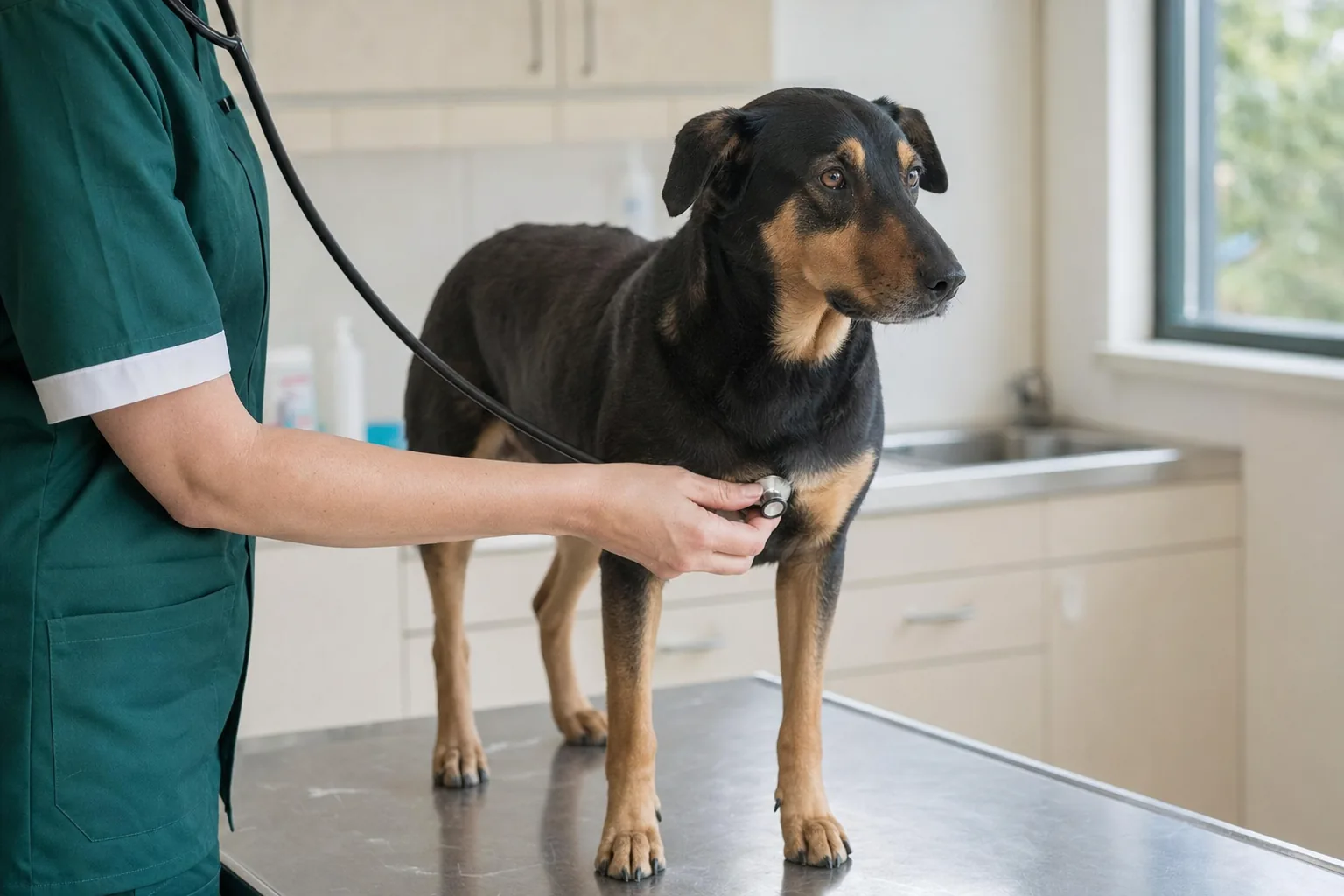
- Does a general check and blood tests before anaesthetic, especially in dogs over seven or with other conditions. This is also where breath that comes from the kidneys or diabetes gets picked up.
- Books the professional clean under general anaesthetic, the only one that achieves anything. The ultrasonic scaling covers the tooth above the gum line and, more to the point, below it. Each tooth is checked with a fine probe to find where the gum has come away. Dental X-rays are taken, because two thirds of each tooth sits under the gum and diseased roots only show on the image. Teeth that cannot be saved come out, and the teeth are polished at the end so new tartar has a harder time sticking. A dog who has ten teeth removed often eats better the next day than he did before, because it no longer hurts.
- Explains why anaesthesia-free dentals are a bad idea. On an awake dog you cannot clean under the gum, take X-rays or probe. Only the visible part gets scraped, for looks, and the disease carries on under a shiny crown, with the dog held down and sharp instruments in his mouth. The veterinary dental colleges in Europe and America are openly against the practice. If a grooming salon offers it, ask who is responsible when the dog moves.
- Shows you the home plan: how to brush, with what and how often, and which dental chews really do help. Look for the VOHC seal, which means the product has been tested. Daily brushing is the standard. Every other day still helps; once a week barely counts.
- Sets the next check: yearly for big dogs, every six months for small breeds and for dogs who have already had extractions.
In puppies, the vet checks at vaccination visits that baby teeth are coming out on time. A baby tooth still in place at 7 months comes out, often at the same time as neutering, because the adult tooth grows in crooked next to it.
What not to do at home
- Human toothpaste is not for dogs. He swallows all of it, our toothpastes are made to be spat out, and some contain a sweetener that is toxic to dogs. Use dog toothpaste only, the meat or chicken kind that is safe to swallow.
- Do not scrape tartar off with a fingernail, a knife or a metal tool bought online. You scratch the enamel, and tartar sticks even faster to a scratched surface. What is under the gum stays put, and you risk getting bitten. The tartar you can see is the small part of the problem.
- Do not book an anaesthesia-free dental, for the reasons above.
- No cooked bones, antlers, hooves, marrow bones cut lengthways or toys you cannot dent with a thumbnail. They split the big back teeth into slabs. A slab fracture leaves the core of the tooth exposed and ends in pain and an extraction. Cooked bones splinter as well.
- Do not pull out wobbly baby teeth. The root can snap and stay in the bone, so let them fall out or leave it to the vet.
- Do not cover the smell with fresh-breath sprays, mint or parsley. The smell is your earliest warning, and masking it means losing it.
- Do not reach for "the antibiotics left over from last time" for a swollen gum. The infected root stays, the vet visit gets put off, and the good bacteria in his body take a hit that shows up later.
- Only pull a stick wedged across the roof of the mouth out by hand if you can see it clearly and it comes out easily first time. Otherwise you push it deeper or snap it.
- Do not tell yourself that dogs just smell like that. A dog with a healthy mouth can lie with his face against yours and you will not turn away.
Brushing, if you are starting from nothing
In the first week, all you do is touch his lips with a finger and a little dog toothpaste for three seconds, then praise him and give him something tasty. In the second week, run your finger over the front teeth with the lip lifted. From the third week, use a finger brush or a soft toothbrush, only on the cheek side of the upper back teeth, which is where the tartar collects. His tongue keeps the inner side clean.
Two minutes a day at the same time, after the evening walk, is enough. If an adult dog already has tartar, brushing will not get it off. It keeps it from coming back after the professional clean.
Periodontal disease is the most common illness in adult dogs and the only one on this page you can slow down at home, with two minutes a day. If you do not have a regular vet yet, our related services page will help you choose a practice. Ask whether they take dental X-rays; the answer tells you a lot about how they work.
The information on this page is educational and does not replace an examination. For full details and a diagnosis, consult your dog's own veterinarian.