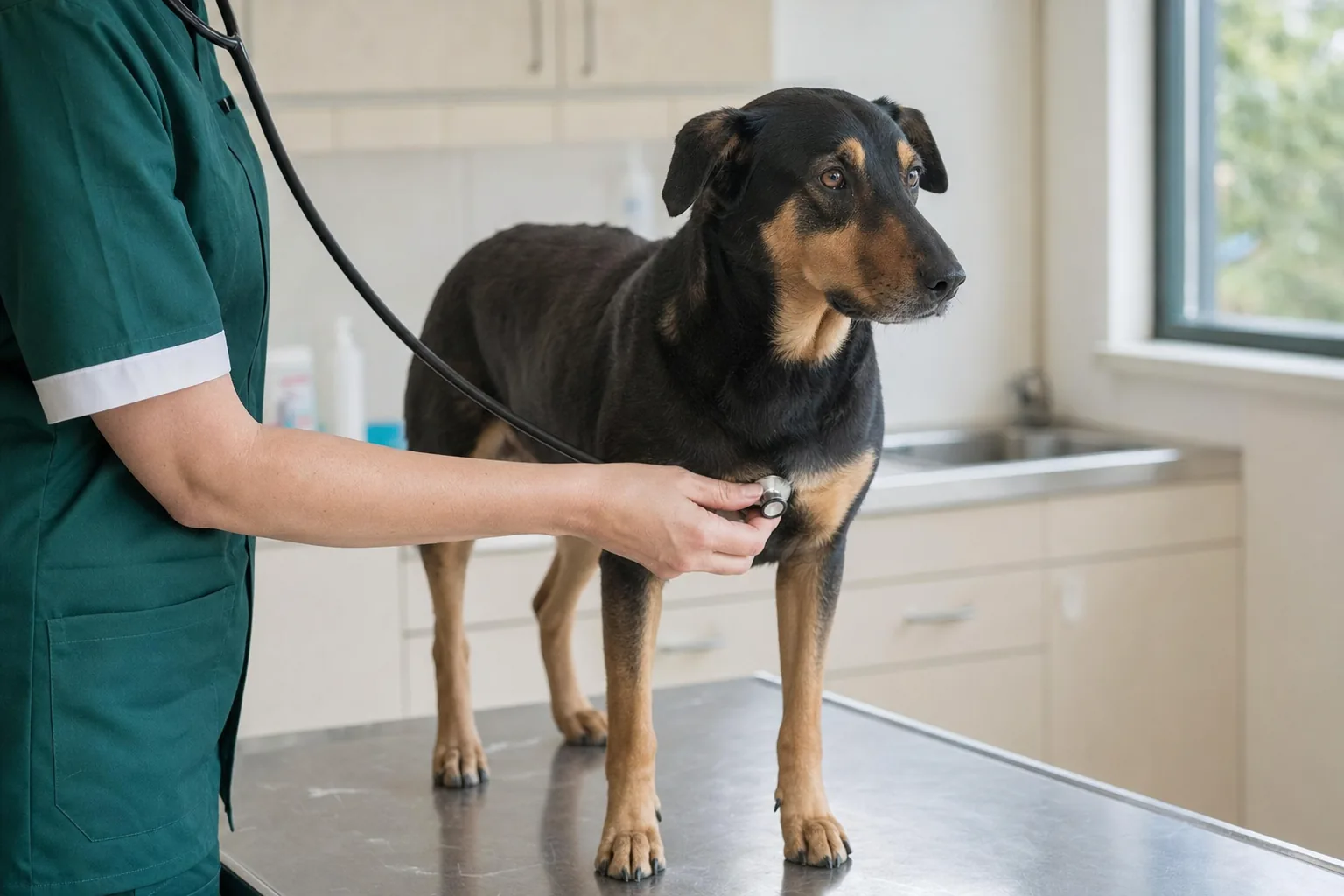
Caution. A lump growing week by week, skin that has broken open or is bleeding, a red, hot, painful area along the mammary chain, or coughing and laboured breathing in a bitch with a lump: call your own vet today. Any new lump should be seen within days.
Noticed something different about your dog? Go straight to their vet.
Do not look for the answer in a Facebook group, on TikTok or on a forum. Look for someone trained for this: your dog's own veterinarian, the only person who can examine, investigate and treat them.
- The same sign, dozens of causes. A dog that vomits may have eaten grass or may have an object stuck in the gut. From two lines you typed, nobody can tell which. The vet feels the abdomen, takes the temperature, runs tests.
- Nobody on the internet sees your dog. They see a photo and a story. A diagnosis comes from an examination and investigations, not from a resemblance to someone else's dog.
- In groups you hear from the people whose dog "got better on its own". Those for whom it ended badly rarely post again. What you read there is a selection, not a statistic.
- Doses are calculated by weight and species. Human medicines that look harmless, paracetamol or ibuprofen, are toxic to dogs. "I gave mine half a tablet" is the most dangerous advice you can get.
- Hours matter. With a twisted stomach, a poisoning or a urinary blockage, the time spent asking online is exactly the time that decides the outcome.
- The vet is accountable for what they say. They have your dog's record, history, vaccinations, past treatments. An anonymous account has none of that and answers for nothing.
Use this page to know what to observe, what to note and what to ask at the appointment, not to treat at home. If you still have doubts after a consultation, ask another vet or a specialist (dermatologist, internist) for a second opinion, not a group. And if you do not have a regular vet yet, find one now, while your dog is healthy: how to choose a veterinary clinic.
She is lying on her back on the sofa, letting you rub her belly, and your fingers find something firm, the size of a pea, next to one of the back teats. It does not hurt her and she does not flinch. It may have been there for weeks before you noticed. Or you have a ten-year-old entire bitch and at her last check-up the vet said "let's keep an eye on that lump". The first reaction is fear; the second is the temptation to wait. This page explains why you should not wait, what to note, and what happens at your own vet's, from the first appointment to the lab result that tells you what the lump is.
Mammary tumours are among the most common tumours in unspayed bitches and in those spayed late. Roughly half are benign and half malignant, with the split varying from one study to the next. You cannot tell which is which from the outside, and neither can your vet without examining the tissue. So you act early, while the lump is still small.
When to call the vet today about a lump near the teats
Any new lump near the mammary glands should be seen within days, not at next year's booster. Call today if:
- the lump is getting bigger week by week;
- the skin over it has broken open, is bleeding or is leaking;
- a whole stretch of the mammary chain is red, swollen, hot and painful with no clear lump (it may be inflammation, but it may also be a very aggressive tumour that mimics an infection);
- she is coughing, breathing hard or tiring quickly and the lump has been there a while;
- she has lost weight, stopped eating or is lethargic;
- the hind leg on the side of the lump has swollen up.
What to check and note at home
The monthly check
A bitch usually has five pairs of mammary glands in two rows, running from the armpit to the groin. Tumours turn up most often in the back pairs, which are also the largest, but they can appear anywhere along the chain.
Pick a moment after a walk when she is relaxed and lay her on her side. With your fingers flat, work slowly along each row of glands from front to back, then over the tissue between them, up towards the armpit and onto the inside of the thigh. Feel with the pads of your fingers, not the tips. Roll her over and do the other side. Two minutes a month; the first day of each month works well.
The glands and the tissue around them are soft and move slightly under your fingers. A lump feels firmer, like a grain of rice, a pea or a hazelnut, sometimes stuck to the skin, sometimes sliding freely beneath it.
What to write down for each lump
- where it is: which gland, which side; sketch her belly with all ten glands and mark it;
- how big it is: measure with a ruler or compare it to a pea, a hazelnut or a walnut, and add the date;
- how it feels: firm or soft, mobile or fixed to what is underneath, with clear or fuzzy edges;
- the skin: normal, red, thinned, broken;
- how many there are: you will often find more on the same row than you expected;
- her cycle: the date of her last season and whether she had a false pregnancy afterwards (swollen belly, milk, nesting), because false-pregnancy swelling is easily mistaken for lumps.
Take a photo with a ruler next to the lump. At the next appointment, a photo from two weeks earlier tells the vet more than any description.
What a lump near the teats might be
| What you find |
What it might be |
How it differs |
| Small, firm, mobile lump |
A benign or malignant tumour, still small |
Only tissue testing can tell |
| Fast-growing lump attached to the skin |
A tumour, more often malignant |
Grows from one month to the next |
| Swollen glands with milk 6–10 weeks after a season |
False pregnancy |
Both rows, symmetrical, no distinct lump |
| Red, hot, painful gland in a nursing bitch |
Mastitis (infection) |
Fever, pain, after whelping |
| Large red, hot, painful area with no pregnancy or nursing |
Inflammatory carcinoma |
Very painful, spreads quickly |
| Soft, mobile lump under the skin |
Lipoma (fatty tumour) |
Confirmed by a needle sample |
The table is not a diagnosis. It shows you why your vet cannot stop at feeling the lump either.
What the vet will do
- History. Her age, whether and when she was spayed, the date of her last season, any pregnancies and false pregnancies, how long you have known about the lump and how much it has grown. This is where your sketch of the glands and your ruler photos come in.
- Clinical examination. The vet feels every gland in both rows, measures each lump and checks the lymph nodes in the armpit and groin, the first place cells travel if the tumour spreads. They listen to the lungs.
- Fine-needle aspirate. A thin needle draws out a few cells for the microscope. On mammary lumps this is good at showing whether it is fat, inflammation or something else, but it often cannot say for sure whether a mammary tumour is benign or malignant. A sample from the lymph node shows whether the tumour has reached it.
- Looking for spread. Before surgery, chest X-rays from several angles to check for nodules in the lungs, and sometimes an abdominal ultrasound. If the lungs are already affected, the plan changes.
- Blood and urine tests, as before any anaesthetic, especially in an older bitch.
- Surgery. With mammary tumours, surgery usually comes first and is treatment and diagnosis in one. Depending on how many lumps there are and how big, the vet removes just the lump, the gland with the lump, several neighbouring glands or the whole chain on one side. Sometimes they suggest spaying under the same anaesthetic; ask them why they recommend it for her.
- Histopathology. The removed tissue goes to the lab. Only the result tells you what kind of tumour it was, benign or malignant, how aggressive, and whether it all came out. It usually takes one to two weeks.
- Check-ups afterwards. X-rays and a hands-on check at the intervals your vet sets, because new lumps can appear on the other glands.
Size matters a great deal. Tumours removed while under three centimetres have, on average, a far better outlook than large ones. That is why we keep saying it: today's small lump is not something to "monitor" for months.
Spaying and prevention
The hormones of each season raise the risk of mammary tumours. The classic studies found that spaying before the first season, or between the first and second, cuts the risk sharply, and the protection shrinks with every cycle and has nearly gone by about two and a half years of age. More recent research questions how solid those old figures are and weighs the tumour risk against other effects of neutering, which vary by breed and size. Work out the right timing for your dog with your own vet, calmly, well before any lump appears.
Males can get mammary tumours too, very rarely. A lump next to a male dog's nipple still goes to the vet.
What not to do at home
- Do not wait for it to go away. Mammary tumours do not shrink on their own. Every month of waiting means a bigger lump and bigger surgery.
- Do not squeeze it, prick it or try to burst it. You can infect the area and damage the tissue, and an open tumour heals badly.
- Do not apply compresses, ointments, leaves or tinctures. None of them shrink a tumour, and they irritate the skin the vet will have to operate on.
- Do not believe the myth that a needle sample or surgery "spreads the cancer". The real risk is leaving the tumour to grow.
- Do not give supplements or "natural anti-cancer" remedies without talking to your vet. Some do not mix well with the anaesthetic or with treatment afterwards.
- Do not put it off because she is old. Age alone does not rule out surgery; the pre-op tests show how well she will cope with the anaesthetic. Decide together, with all the results in front of you.
- Do not skip the check-ups after surgery. New lumps on the remaining glands are common in unspayed bitches.
The monthly check takes two minutes. We tie it to something we do anyway, like the first-of-the-month brush, and that way it does not get forgotten.
Frequently asked questions
What dog owners search for most often on the internet about this problem, with the short answer. The answers are a guide only: the decision belongs to your dog's own vet, after an examination.
Is every lump near my dog's teats cancer?
No. About half of mammary tumours in bitches are benign, and other lumps can be false-pregnancy swelling, mastitis or fat. From the outside, though, you cannot tell what it is, and your vet cannot either just by feeling it. Any new lump gets checked promptly, and the firm diagnosis comes from testing the tissue once it is removed.
How do I check my dog for mammary lumps?
Once a month, lay her on her side and run the pads of your fingers along each row of glands from the armpit to the groin, and over the tissue in between. Then roll her over and repeat. The glands are soft; a lump feels firmer, like a grain of rice or a pea. Note where it is and how big.
Does spaying prevent mammary tumours?
It lowers the risk considerably if done early, before the first season or between the first and second, and the protection shrinks with every cycle. More recent studies question how accurate the old figures are and look at other effects of neutering, which differ by breed and size. Decide the timing with your own vet.
Should an old bitch have surgery for a mammary tumour?
Age alone is no reason not to operate. Beforehand, your vet runs blood tests and chest X-rays to see how she will cope with the anaesthetic and whether the tumour has spread. If the lungs are clear and the bloods are good, surgery is usually still the best option, even for an older bitch.
Does a needle sample or surgery spread the cancer?
No, that is a myth. The fine-needle aspirate and the surgery are how your vet finds out what the lump is and gets it out. The real danger comes from waiting: a malignant tumour left to grow is more likely to reach the lymph nodes and the lungs.
The information on this page is educational and does not replace an examination. For full details and a diagnosis, consult your dog's own veterinarian.