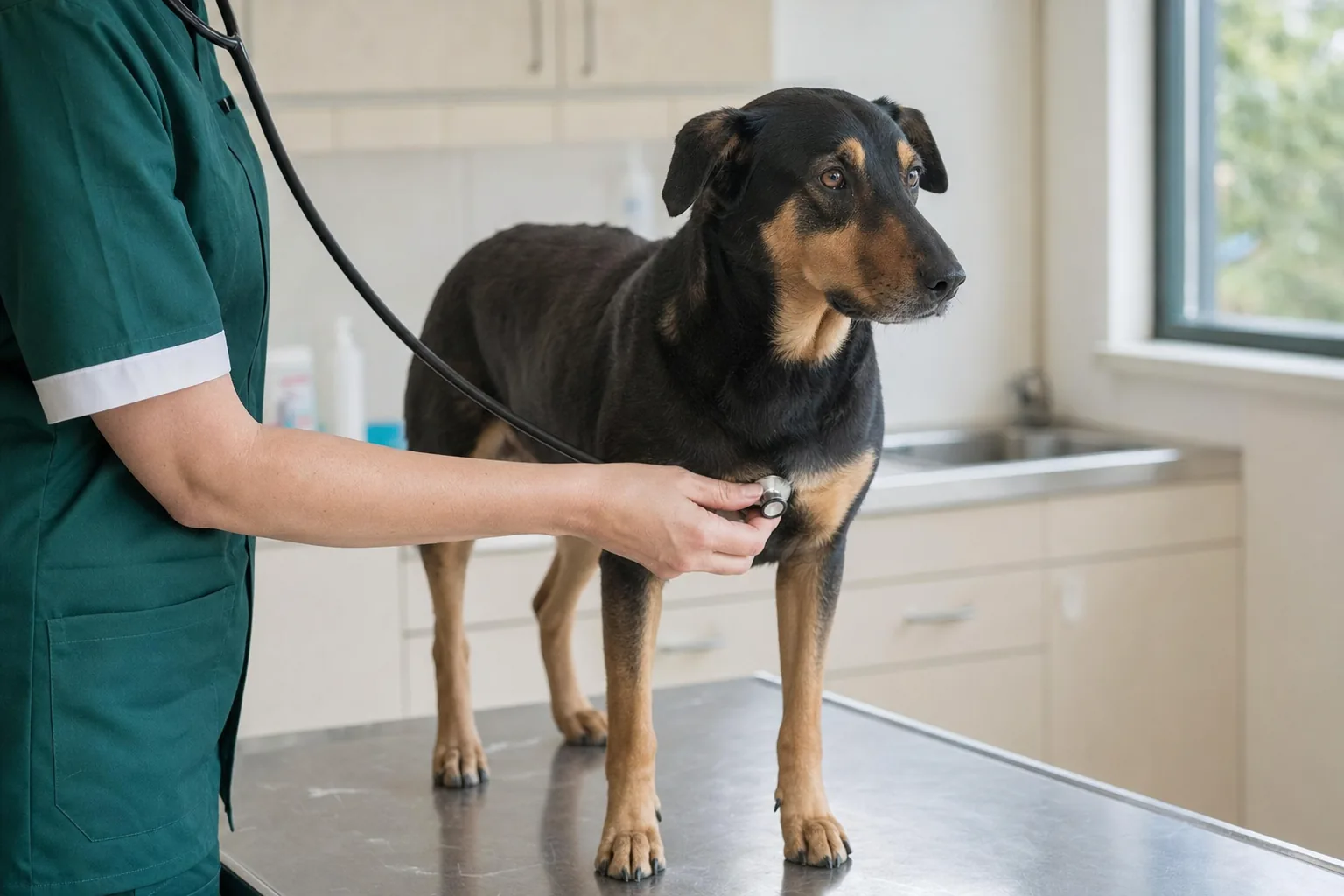
Caution. He has not put the leg down for a few hours, the knee is swollen or warm, he is lame on both back legs, or the lameness has stayed after a jump: call your own vet today. Do not give human painkillers.
Noticed something different about your dog? Go straight to their vet.
Do not look for the answer in a Facebook group, on TikTok or on a forum. Look for someone trained for this: your dog's own veterinarian, the only person who can examine, investigate and treat them.
- The same sign, dozens of causes. A dog that vomits may have eaten grass or may have an object stuck in the gut. From two lines you typed, nobody can tell which. The vet feels the abdomen, takes the temperature, runs tests.
- Nobody on the internet sees your dog. They see a photo and a story. A diagnosis comes from an examination and investigations, not from a resemblance to someone else's dog.
- In groups you hear from the people whose dog "got better on its own". Those for whom it ended badly rarely post again. What you read there is a selection, not a statistic.
- Doses are calculated by weight and species. Human medicines that look harmless, paracetamol or ibuprofen, are toxic to dogs. "I gave mine half a tablet" is the most dangerous advice you can get.
- Hours matter. With a twisted stomach, a poisoning or a urinary blockage, the time spent asking online is exactly the time that decides the outcome.
- The vet is accountable for what they say. They have your dog's record, history, vaccinations, past treatments. An anonymous account has none of that and answers for nothing.
Use this page to know what to observe, what to note and what to ask at the appointment, not to treat at home. If you still have doubts after a consultation, ask another vet or a specialist (dermatologist, internist) for a second opinion, not a group. And if you do not have a regular vet yet, find one now, while your dog is healthy: how to choose a veterinary clinic.
Your three-year-old Yorkie is racing round the park when suddenly he lifts a back leg and goes a few steps on three legs, like a child playing hopscotch. Then he puts the leg down and carries on as if nothing had happened. It happens two or three times a week. Or at his booster the vet mentioned in passing that he has "a slipping kneecap, grade two" and you never got round to asking what that meant. A luxating patella is one of the most common orthopaedic problems in small breeds, and very often this is exactly what it looks like.
When to call the vet today
The patella is the small bone at the front of the knee. Normally it glides in a groove at the bottom of the thigh bone. When it luxates, it slips out of that groove, usually towards the inside, and the leg locks for a few seconds or a few steps. That on its own is not an emergency. Call the same day if:
- he has not put the leg down at all for a few hours, or yelps when you touch it;
- the knee is swollen, warm or sitting at an odd angle;
- he is lame on both back legs, walking hunched or cannot get up;
- the lameness started after a jump or a slip and is not wearing off within a few steps (it may be a torn ligament, which is more common in knees with an unstable kneecap);
- a puppy's back legs are visibly bowed and he is finding it harder and harder to walk.
For a brief skip that comes and goes, book an appointment in the next few weeks. Do not leave it for years.
What to film and note at home
Filming
At the practice he is nervous and walks perfectly. At home, film him from behind and from the side, at a walk and a trot, for several tens of seconds, on a surface that is not slippery. If you catch a skipping episode on video, that is the best evidence you can bring.
The diary
- how many times a week he skips and how long it lasts;
- which leg (often both, one worse than the other);
- what he was doing at the time: running, turning sharply, getting off the sofa, climbing stairs;
- how he "fixes" the leg. Some dogs flick it out behind them, as if kicking, and the kneecap pops back in by itself;
- whether he is slow to get up in the morning or after a nap;
- what he weighs now.
What the grades mean
Your vet will probably give you a grade from 1 to 4. So you know what you are hearing:
| Grade |
What happens |
What you usually see |
| 1 |
The kneecap can be pushed out of the groove by hand but slips back by itself |
Usually nothing; found at a check-up |
| 2 |
The kneecap pops out on its own and goes back when the dog stretches the leg |
A few steps on three legs, then normal |
| 3 |
The kneecap sits out of the groove most of the time; the vet can push it back but it slips out again |
Frequent lameness, bowed legs, odd gait |
| 4 |
The kneecap is out all the time and cannot be put back |
Very bowed legs, crouched gait, weight shifted forward |
The grade tells you how unstable the kneecap is. How much it bothers the dog also depends on his age, his weight, how well muscled his thighs are and how often the kneecap slips.
Which dogs get it
A kneecap that slips inwards is typical of small and toy breeds: Yorkshire Terrier, Chihuahua, Pomeranian, toy and miniature Poodle, Bichon, Maltese, Shih Tzu. Large dogs get it too, less often. It is usually inherited, comes down to the shape of the leg bones and often shows from puppyhood.
What the vet will check
- History and the video. How long, how often, which leg, what the dog does when it happens.
- Orthopaedic examination. The vet feels the knee with the dog standing and lying down, gently pushes the kneecap inwards and outwards, and sees how easily it leaves the groove and whether it goes back. That gives the grade. They also check the knee ligaments, because cruciate ligament rupture is more common in knees with an unstable kneecap.
- The rest of the legs. Hips, the other knee, the spine. In small breeds, hip pain can look a lot like a knee problem.
- X-rays, for the shape of the bones and for arthritis. They are done before any surgery anyway. In dogs with severe deformity, sometimes a CT scan too.
- The plan. It depends on the grade and on how much it bothers the dog.
- Low grades without frequent lameness: weight kept in check, regular exercise, well-built muscles, sometimes rehab exercises with a veterinary physiotherapist, and periodic check-ups.
- High grades, or a dog who is often lame or in pain: your vet will talk to you about surgery, which deepens the groove and moves the point where the kneecap attaches. Ask what it involves, what the few weeks of recovery look like and what results it gets in dogs like yours.
- For pain and inflammation, the vet chooses the treatment.
- Check-ups. An unstable kneecap wears the knee over time and opens the door to arthritis. A yearly check with his weight recorded helps a lot.
Ask, too, whether the problem runs in your dog's line. A dog with a luxating patella should not be bred from.
What not to do at home
- Do not force the kneecap back in. If your vet has shown you how and the leg is stuck, do it gently. Otherwise let the dog pop it back himself.
- Do not give human painkillers. Many are toxic to dogs, even in small amounts.
- Do not let him jump off the sofa or the bed. Jumping down from height and landing on wooden floors is what knocks the kneecap out. A ramp or a soft step makes a big difference.
- Do not keep him on slippery floors. Put down rugs or non-slip runners, especially where he likes to run.
- Do not let him put on weight. One extra kilo on a four-kilo dog is a quarter of his body weight, carried on the same knees. For low grades, losing weight is sometimes the treatment that helps most.
- Do not stop exercise altogether. The thigh muscles hold the kneecap in its groove. Regular on-lead walks over varied ground, at his own pace, do him good. Sprints and sharp turns do the damage, especially chasing a ball thrown a long way.
- Do not swap the vet visit for joint supplements. They may help alongside treatment, but they will not put the kneecap back.
- Do not put off an orthopaedic check because "it wears off in a few steps". Every episode rubs away a little cartilage, and at ten the knee carries every episode that came before.
If it comes to surgery
Recovery usually takes a few weeks: rest in a small space, short on-lead walks that get gradually longer and, ideally, exercises with a veterinary physiotherapist. Your vet gives you the exact plan. The hardest part for you will be keeping him quiet during the weeks when he already feels fine and wants to run.
Frequently asked questions
What dog owners search for most often on the internet about this problem, with the short answer. The answers are a guide only: the decision belongs to your dog's own vet, after an examination.
What is a luxating patella in dogs?
The patella is the small bone at the front of the knee, and normally it glides in a groove in the thigh bone. When it luxates, it slips out of the groove, usually inwards, and the leg locks for a few seconds. The dog goes a few steps on three legs, the kneecap slips back and he walks normally. It is common in small breeds and usually inherited.
What does a grade 2 luxating patella mean?
The kneecap pops out of the groove by itself now and then and goes back when the dog stretches his leg. You usually see a few steps on three legs, then normal walking. Plenty of dogs live well with grade 2 if their weight is kept in check and their muscles are good. If the lameness becomes frequent or painful, your vet may raise surgery.
Does a luxating patella need surgery?
Not always. At low grades, with no pain and no frequent lameness, you usually work on weight, the right exercise and regular check-ups. At high grades, or when the dog is often lame, surgery deepens the groove and moves the point where the kneecap attaches. You decide with your vet after an examination and X-rays.
Can a dog with a luxating patella run and jump?
Regular on-lead walks and exercise over varied ground help him, because the thigh muscles hold the kneecap in place. Jumping off the sofa, sharp turns on wooden floors and long ball throws put too much strain on the knee. A ramp to the sofa and non-slip rugs around the house make a big difference.
Which breeds get luxating patella?
Mainly small and toy breeds: Yorkshire Terrier, Chihuahua, Pomeranian, toy and miniature Poodle, Bichon, Maltese, Shih Tzu. Large dogs get it too, less often. It is usually inherited and comes down to the shape of the leg bones, so it is worth asking the breeder whether the parents were checked.
The information on this page is educational and does not replace an examination. For full details and a diagnosis, consult your dog's own veterinarian.