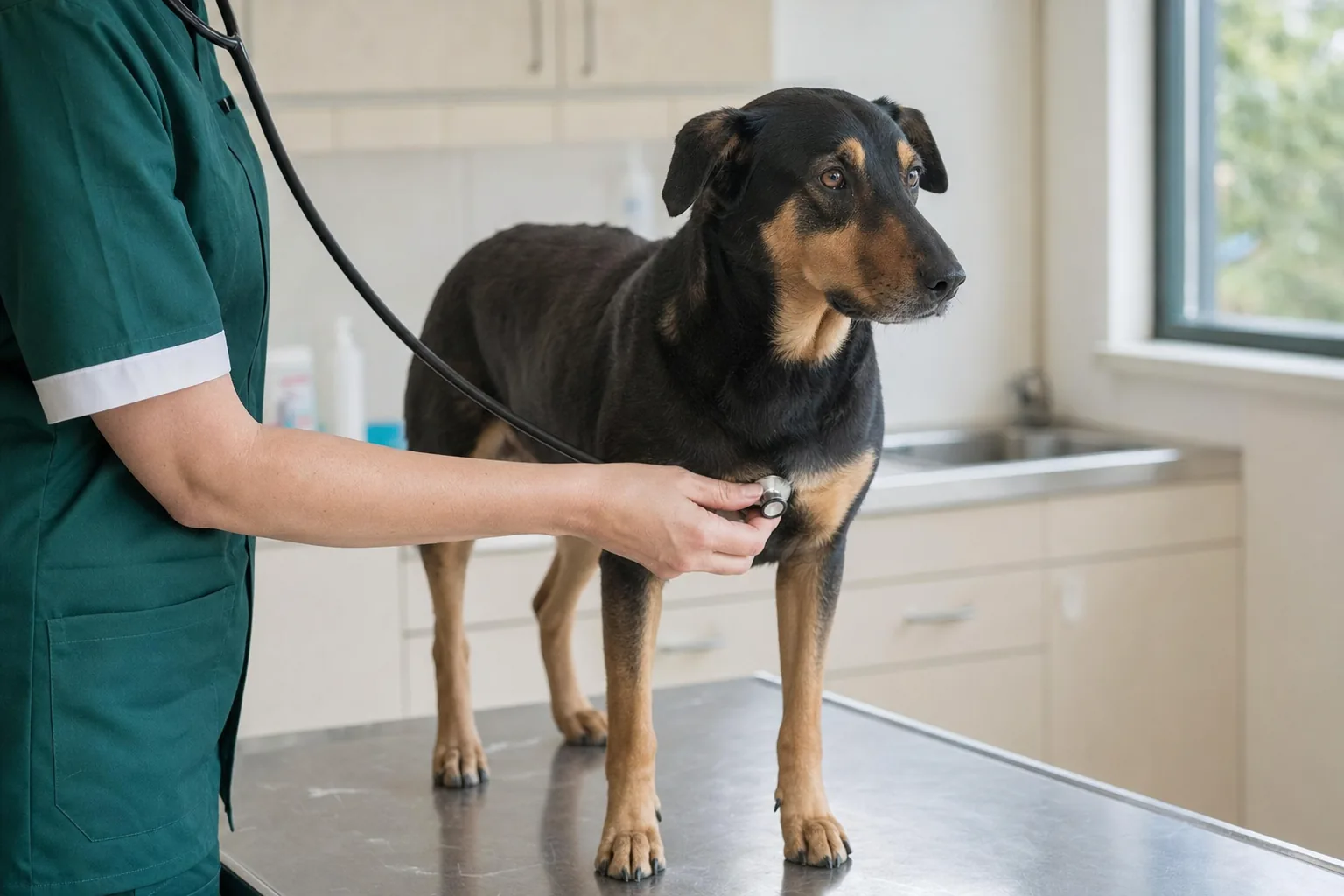
Caution. Not putting the leg down at all after an hour's rest, a swollen and hot knee, a fall or a knock, lameness on both hind legs or a fever too: call your own vet today. Do not give human painkillers.
Noticed something different about your dog? Go straight to their vet.
Do not look for the answer in a Facebook group, on TikTok or on a forum. Look for someone trained for this: your dog's own veterinarian, the only person who can examine, investigate and treat them.
- The same sign, dozens of causes. A dog that vomits may have eaten grass or may have an object stuck in the gut. From two lines you typed, nobody can tell which. The vet feels the abdomen, takes the temperature, runs tests.
- Nobody on the internet sees your dog. They see a photo and a story. A diagnosis comes from an examination and investigations, not from a resemblance to someone else's dog.
- In groups you hear from the people whose dog "got better on its own". Those for whom it ended badly rarely post again. What you read there is a selection, not a statistic.
- Doses are calculated by weight and species. Human medicines that look harmless, paracetamol or ibuprofen, are toxic to dogs. "I gave mine half a tablet" is the most dangerous advice you can get.
- Hours matter. With a twisted stomach, a poisoning or a urinary blockage, the time spent asking online is exactly the time that decides the outcome.
- The vet is accountable for what they say. They have your dog's record, history, vaccinations, past treatments. An anonymous account has none of that and answers for nothing.
Use this page to know what to observe, what to note and what to ask at the appointment, not to treat at home. If you still have doubts after a consultation, ask another vet or a specialist (dermatologist, internist) for a second opinion, not a group. And if you do not have a regular vet yet, find one now, while your dog is healthy: how to choose a veterinary clinic.
He chased the ball, slammed on the brakes on the grass, yelped once, and ever since he has held that hind leg up or barely touched the ground with his toes. For other dogs there was no single moment. For a few weeks he has been limping after long walks, getting up stiffly in the morning, and when he sits he sticks one leg out to the side instead of tucking it under like he used to. A torn cranial cruciate ligament (the dog's version of the ACL in people) is one of the commonest reasons for hind-leg lameness in dogs. People picture a footballer and a bad tackle. In most dogs the ligament gives way after slow weakening over months. This page covers what to watch for and note down, what to expect at the vet, and how to avoid making the knee worse in the meantime.
Warning signs: when to call today
A limp is not automatically an emergency. A few situations do call for a phone call to your own vet today:
- he will not put the leg down at all, even after an hour's rest;
- the knee is visibly swollen, warm, or he cries out when you touch it;
- the limp started after a fall, an accident or being hit by a car, even if it seems to have eased;
- he is lame on both hind legs, struggles badly to get up or cannot get up at all;
- the leg sits at an odd angle, or you hear and feel a click with every step;
- he also has a temperature, is listless or off his food;
- a dog with long-standing knee trouble suddenly gets much worse.
If he is toe-touching but moving about, eating and not in obvious severe pain, an appointment in the next few days is fine. Until then, strict rest.
What to watch and note at home
Video. On level ground, at a walk, from 5 to 10 metres away: from behind, from the front and from the side. Then at a trot if he can manage it. On a screen your vet will spot things that disappear in the consulting room, where the dog is wound up and moves differently.
How he sits. Ask him to sit and look from behind. A dog with healthy knees tucks both hind legs under him evenly. One with a torn ligament often sits with the sore leg slightly out to the side, because he cannot bend the knee fully without pain. It is a clue, not a diagnosis.
How it started. Was there one moment (a hard stop, a jump, a slip)? Or has he been lame on and off for weeks, mainly after exercise? For a vet, the second story is the more typical one.
When it is worst. In the morning, after a long rest? After a walk? On the stairs, jumping into the car or onto the sofa?
The thigh muscles. Put your hands on both thighs at the same spot. After a few weeks the thigh on the sore side is often noticeably thinner, because he uses it less.
The other leg. Look at it just as carefully. In many dogs the ligament in the other knee starts to give way in the following months or years.
Everything else. Age, weight (weigh him), breed, whether he is neutered, whether he has been lame before.
What else it could be
| What you see |
Cruciate tear |
Other possible cause |
| Sudden lameness after a hard stop, adult dog |
Typical |
Thorn in the paw, torn nail, sprain |
| Lameness that comes and goes for weeks |
Typical of a partial tear |
Arthritis, luxating patella |
| The leg "skips" for a few steps, then he walks normally |
Less common |
Luxating patella, especially in small breeds |
| Young, large-breed dog lame on both hind legs |
Possible |
Hip dysplasia |
| Older dog, worsening pain, hard swelling on the bone |
Rare |
Bone tumour: get seen quickly |
Check the paw first: nails, pads, between the toes. A thorn or a cut can cause a limp that looks just as dramatic and takes minutes to sort out.
What the vet will check
- His gait, at a walk and a trot, in the corridor or outside. Your video helps a great deal here.
- The whole leg, by hand, from paw to hip, to rule out other causes. The affected knee is often swollen on the inner side, with fluid in the joint.
- The drawer test and the tibial thrust test. The vet holds the thigh bone with one hand and the shin bone with the other and checks whether the shin slides forward. If the ligament is torn, it slides. In big, muscular or tense dogs the test is often done under sedation; otherwise the muscles clamp the knee and the result comes out falsely negative.
- X-rays of the knee, and usually of the other knee as well. The ligament does not show up on an X-ray, but fluid in the joint and early arthritis do, and other causes can be ruled out.
- Ultrasound, CT or arthroscopy, sometimes, for partial tears or to look at the meniscus. The meniscus, the cartilage cushion inside the knee, often tears along with the ligament and is very painful.
- The decision. For most medium and large dogs the usual recommendation is surgery to stabilise the knee. There are several techniques, and your vet or orthopaedic surgeon will explain why they prefer one for your dog. In small, light dogs, managing it without surgery is sometimes an option: strict rest, weight loss, rehabilitation. Your vet will tell you whether that is realistic for yours.
- Rehab. Surgery is followed by a few months of controlled exercise: short lead walks, built up gradually, no running or jumping, with rehab exercises at home or with a veterinary physiotherapist. Plenty of dogs get back to their old life, sport included, if the rehab is followed properly.
Ask about the other knee too: which signs to watch for and how to spare it.
What not to do at home
- No running, jumping or stairs until you have a diagnosis. Every sprint on a torn ligament risks tearing the meniscus as well.
- No long walks "to loosen him up". A few short outings on lead, just for toileting, on level ground.
- No human painkillers. They are toxic to dogs. If he is in pain, your vet will give him something suitable and safe for him.
- No vigorous massage, and no working the knee to find out where it hurts.
- No knee brace bought online on your own initiative. Some help, but a badly fitted one does harm; choose it with your vet.
- No bare slippery floors. On tiles and wooden floors he slips on exactly the leg that hurts, so put rugs down.
- No extra weight while he is spending more time indoors. Every extra kilo loads both knees. Cut his portion, not the controlled exercise.
- No waiting months for a big dog's limp to go away by itself. The longer he walks on an unstable knee, the more advanced the arthritis will be on the day of surgery.
If he is a sporting dog
Cruciate tears are common in active dogs, often in a knee that has been weakening for a long time. What helps: keeping his weight at the lean end of normal, a few minutes' warm-up before running or training, fewer hard stops on tiles and wet grass, and muscle built up through walks on slopes and mixed terrain. In mantrailing the dog pulls into the harness but rarely makes sharp turns. A dog who has had surgery can go back to trailing after rehab, with the vet's agreement and short trails to start with.
Frequently asked questions
What dog owners search for most often on the internet about this problem, with the short answer. The answers are a guide only: the decision belongs to your dog's own vet, after an examination.
How do I know if my dog has torn his cruciate ligament?
The usual signs: lameness on one hind leg, either sudden after a hard stop or a jump, or on and off for weeks; the leg held out to the side when sitting; trouble getting up; and a thigh that is losing muscle. Only your vet can confirm it, with the drawer test, sometimes under sedation, and X-rays.
Can a torn cruciate ligament in a dog heal on its own?
The ligament does not knit back together. In small, light dogs the knee can sometimes stabilise through scar tissue, with strict rest, weight loss and rehab. In medium and large dogs the usual advice is surgery, because an unstable knee develops arthritis and often tears the meniscus. Your vet will tell you which route suits your dog.
What should I do before the appointment if I suspect a cruciate tear?
Strict rest: short outings on lead, just for toileting, on level ground, with no running, jumping or stairs. Put rugs down on tiles and wooden floors, film him walking and cut his portion so he does not gain weight. Do not give him human painkillers: they are toxic to dogs.
Can the ligament in the other knee tear too?
Yes, it often does, because in dogs a tear usually comes from a weakening of the ligament that tends to affect both knees. That is why vets usually X-ray both legs. Keeping him at the lean end of normal and doing the rehab properly after surgery take load off the healthy knee.
The information on this page is educational and does not replace an examination. For full details and a diagnosis, consult your dog's own veterinarian.