You take the lead off the hook and wait for the scrabble of claws on the floor. Nothing. The dog has opened one eye, thumped his tail twice and stayed in his bed. Yesterday he left half his dinner; today he looked at the bowl and walked off. Or it is not one day at all: for a week now he has slept more, the ball lies where it landed, and when you come home he wanders over late, like an old dog, though he is four. Two explanations fight in your head. Either something has upset him, or he is ill. This page helps you pull those apart and bring your vet exactly what they need to know.
First, how much a perfectly healthy dog sleeps. A lot. An adult sleeps about half the day, sometimes a bit more, in stretches, with one eye on you in between. Puppies and old dogs can manage 18 hours out of 24. A 40-kilo shepherd sleeps more than a two-year-old terrier, and a dog who ran three trails in the woods on Saturday sleeps all of Sunday, which is exactly as it should be. The number of hours tells you very little. The change from the dog you had last week tells you almost everything.
Warning signs: when to call today
Lethargy on its own can mean anything from a tiring day to an illness that kills within hours. That is why you look at what comes with it. Call today, even if it is evening, if a flat dog also has any of these:
- pale, white, grey or yellowish gums;
- urine the colour of strong tea, or with blood in it;
- a swollen, hard belly, retching that brings nothing up, a dog who cannot settle (in large, deep-chested breeds this may be a twisted stomach, and there you count minutes);
- fast or heavy breathing while he is lying still;
- a temperature above 39.5 °C or below 37.5 °C;
- repeated vomiting or bloody diarrhoea;
- not drinking at all, or drinking twice what he normally does;
- staggering, falling, not getting up, or fits;
- possible access to something toxic, time in the sun or in a car;
- tick season and time in long grass in the last three weeks;
- he is a puppy, or very old; things move faster at both ends.
With none of those signs, you have a window of a day, two at most. If the lethargy runs past 24 to 48 hours, if he eats far less, if you can see him losing weight or he hides and no longer wants to be touched, call and book.
What you can watch and note at home
Vets work with facts. "He's a bit flat" is not a fact; "he drank 400 ml instead of 800 and he's at 39.6" is. All of it takes five minutes a day.
Energy, as a number. Each evening, give him a mark from 0 to 5. Five is your dog on a good day, zero is a dog who will not get up. After three or four evenings you can see whether it is an off day or a slope.
Temperature. A digital thermometer, in the rectum, tip greased. Normal is roughly 38 to 39.2 °C. Take it when he is calm; after a run every dog reads higher.
Gums. Lift the lip and look at the colour. Then press with a finger: the spot goes white, and in a healthy dog the pink is back within two seconds.
Food and water. How much of his usual portion he leaves. For water, put down a measured amount in the morning and see what is left at night.
Wee and poo. Colour, amount, how often. Is he straining? Any blood? Diarrhoea?
Pain. Dogs hide it, especially those who ever lived on the street. The small signs give it away: he no longer jumps on the sofa, takes the stairs with pauses, gets up in two stages, pants without having run, licks the same spot, trembles, stands hunched, growls when you touch one particular place.
What has changed around him. A move, someone leaving home, a new dog, a new routine, a new medicine, a vaccine a few days ago, a heatwave.
What may be behind a flat dog
| What else you see |
What your vet may be thinking of |
How fast |
| Fever, pale gums, dark urine, tick season |
Babesiosis or another tick-borne disease |
Today |
| Swollen belly, retching, big dog |
Twisted stomach |
At once |
| Drinks and wees a lot, losing weight |
Diabetes, kidneys, other hormonal disease |
Within days |
| Gaining weight, thin coat, seeks warmth, slow |
A sluggish thyroid |
Within days |
| Lame, slow to rise, older dog |
Joints or back |
Within days |
| Breathes fast, coughs, tires on exercise |
Heart |
Today or tomorrow |
| After a move, a loss, a big change |
Stress, grief |
Once the vet has ruled out the rest |
| Flat for a day after a vaccine |
A common reaction |
Watch; call if it does not pass |
The table has one job: to show you how many explanations come before "he's just sad".
What your vet will check
- The story. Since when, what changed, what he eats, which medicines or parasite treatments he has had, where he has been, what you have written down. A notebook of marks and temperatures halves the consultation.
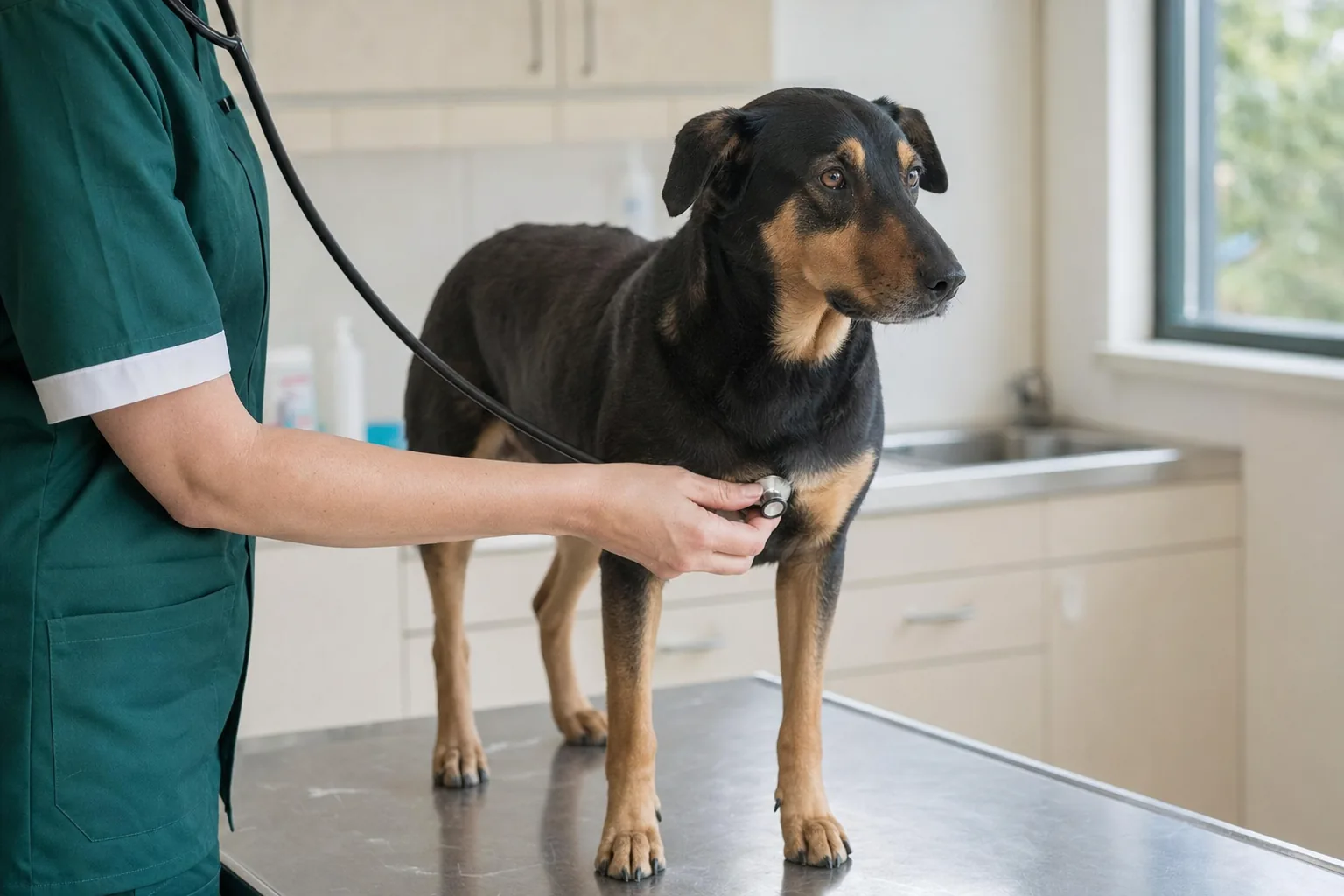
- A nose-to-tail examination. Temperature, gums, lymph nodes, heart and lungs through the stethoscope, the belly by hand, joints, spine, skin, eyes, ears, mouth. Surprisingly often the cause turns up here: a rotten tooth, a sore back, an enlarged node.
- Blood. A full blood count, for anaemia, infection, platelets, and biochemistry, for kidneys, liver, sugar, proteins, salts.
- Urine. Kidneys, diabetes, infections.
- Tick-borne disease tests, in season or if he has travelled.
- Hormones, if the picture calls for it: thyroid, adrenal glands.
- An X-ray or a scan, when the vet suspects something in the belly, the chest or the joints.
- The plan. Treatment for what was found or, if the results are clean and the dog is stable, watching at home with your notes and a recheck in a few days.
Only if everything comes back clean do you talk about boredom, stress or sadness. That conversation is a serious one. A dog who has shut down after a big change needs a day he can predict, exercise, things he enjoys, and sometimes a behaviourist.
What not to do at home
- Do not give him human painkillers or fever medicines. Some are toxic to dogs even at small doses, others hit the kidneys or the stomach. On top of that, they mask exactly the signs your vet goes by.
- Do not force him to eat and do not take him on the hour-long walk "to loosen him up".
- Do not wait a week to see whether it passes when he has any other sign from the list above.
- Do not change his food three times in two days to tempt him. Note what he refused and tell the vet.
- Do not leave him in the heat or in the car, not even "for five minutes".
- Do not put it all down to age. "He's old, that's why he sleeps" is half true. Many diseases of old dogs can be treated or kept in check, from joints to thyroid.
- Do not put it all down to sadness before the consultation. Dogs do not shut down for no reason, and the reason is often pain.
- Do not leave him alone for hours if he is very flat. Someone has to glance at him now and then and see whether he is getting worse.
When he really is sad
Dogs notice when the household changes. A move, a child off to university, the death of the other dog, a new job that leaves them alone for ten hours. Some go quiet for a few days or a few weeks, eat less, sleep more. Once the vet has ruled out illness, what helps is a predictable day, walks where he may sniff as long as he likes, short games with food hidden around the house, and time with you, without smothering him.
In training we often watch a flat, withdrawn dog switch on the moment he is handed a job for his nose. If even that does not move him, nor the game he used to love most, you have one more reason to go back to the vet.
The information on this page is educational and does not replace an examination. For full details and a diagnosis, consult your dog's own veterinarian.