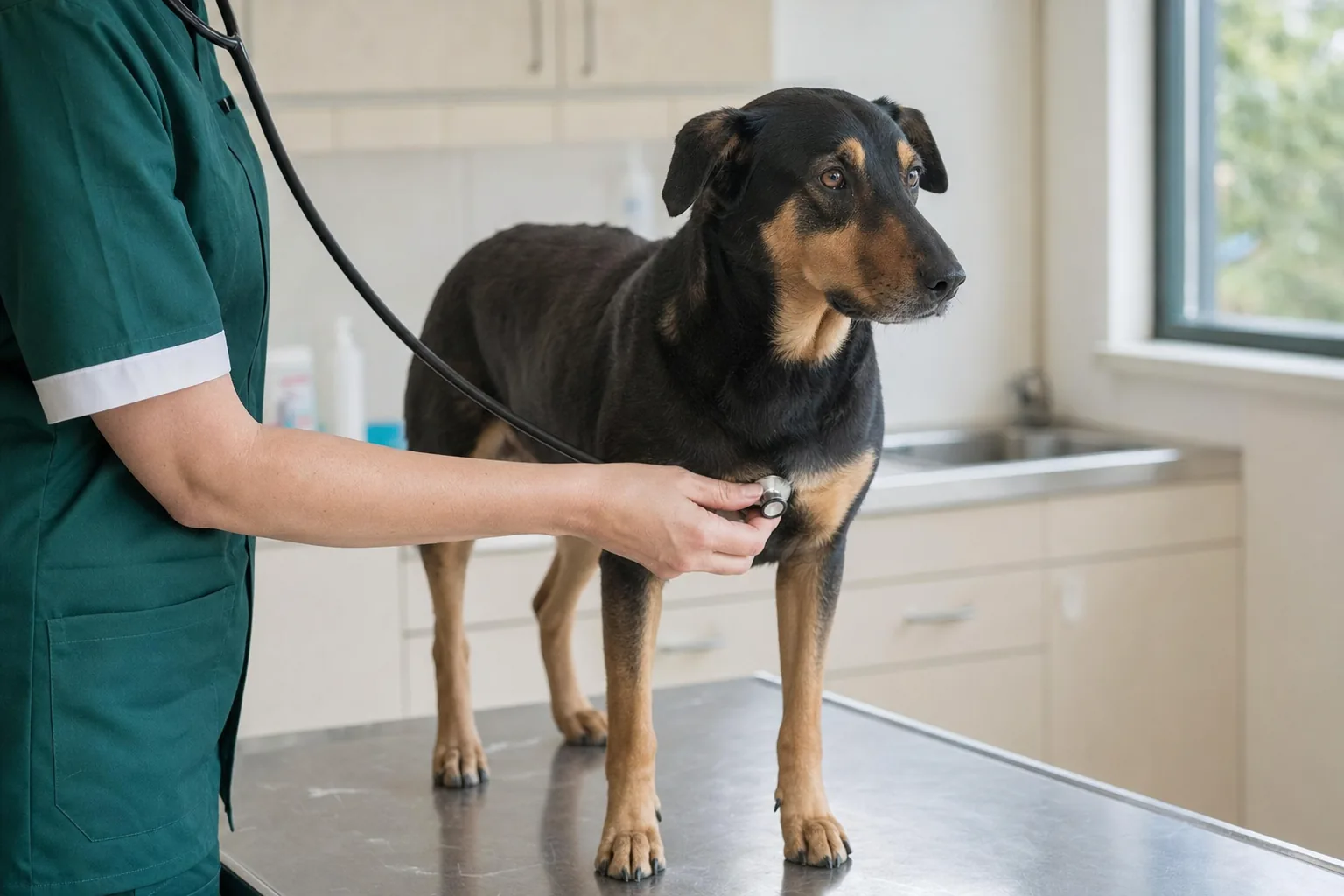
Your labrador is seven. He sleeps more than ever, has given up on the long Sunday walk and is putting on weight even though he eats the same as last year, maybe less. In winter he lives against the radiator. The hair on his flanks has thinned evenly on both sides, and his tail is starting to look like a rat's. Someone at the park told you, "it's his thyroid, mine had the same". It might be. Hypothyroidism is one of the most common hormone diseases in dogs and also one of the most often misdiagnosed, because it looks like ageing, like a few extra kilos and like several other illnesses. What you can do is gather the observations your own vet needs, and understand why a single blood test does not always settle the question.
When to ring the vet today
Hypothyroidism develops slowly, over months, and is usually not an emergency. It calls for an appointment in the next few days, not a dash to the clinic at midnight. A few situations are the exception and need a phone call today:
- the dog is very weak, can barely get up, feels cold to the touch and seems to be in a fog: not reacting, staring into space. This is a severe and rare form of untreated disease;
- his heart beats very slowly, he breathes slowly, faints or collapses;
- he is already diagnosed and on treatment, and now pants, is restless, loses weight suddenly, drinks and wees a lot or has diarrhoea. These can be signs the dose no longer suits him;
- sudden weakness in the legs, his head tilted to one side, his face drooping on one side, or a walk like someone who is dizzy;
- he has stopped eating, is vomiting or has been flat for more than a day, whatever you suspect is behind it.
Everything else (the weight, the tiredness, the coat) can wait for a normal appointment, with the notes below in hand.
What to watch and note at home
The signs creep in so slowly that you get used to them. That is why the most useful thing you can do is write them down and compare with a year ago.
Weight. Weigh him now and then once a month. Write down exactly what and how much he eats, including training treats and anything from the table. A dog who gains weight on the same rations convinces a vet far faster than one who "doesn't seem to eat much".
Energy. How far he walks before he tires, how much he sleeps in a day, whether he still chases the ball, whether he is slow to get up in the morning. Look back at last year's photos and videos too; your phone remembers better than you do.
The cold. He seeks out warm spots, shivers when other dogs are fine, does not want to go out in winter.
Skin and coat. Take photos of his flanks, tail, neck and belly. Note whether the hair is falling out evenly on both sides, whether it fails to grow back where it was clipped, whether the skin has darkened or thickened or keeps getting infections. Some dogs develop a "sad" face, with thickened eyelids and forehead skin.
Ears and gait. List the ear infections from the past year: how many, how long each lasted, whether they came back soon after treatment. Some dogs with a sluggish thyroid also have weak back legs or a shuffling walk, which shows most on stairs and getting into the car. Film him from the side with your phone held low, at his height.
And the rest. Is he drinking a lot? Weeing a lot? That points more towards other hormone diseases, but tell your vet. Is he on any medication, does he have other illnesses, is he neutered?
Looks similar, but is not necessarily the thyroid
| What you see |
Hypothyroidism |
Other common causes |
| Weight gain |
On the same food, slowly |
Eating more than you think, moving less, neutering |
| Tired, sleeps a lot |
Constant, for months |
Age, joint pain, heart, anaemia |
| Symmetrical hair loss on the flanks |
Yes, not itchy at first |
Cushing's disease, other hormone diseases, breed-related hair loss |
| Recurring skin and ear infections |
Yes |
Allergies, more often |
| Drinks and wees a lot |
Usually not |
Cushing's, diabetes, kidneys |
| Seeks warmth |
Yes |
Thin, old or short-coated dog |
The disease mostly turns up in dogs over four or five, of medium or large size. It is described more often in golden retrievers, Dobermanns, cocker spaniels, boxers and Irish setters, but it can affect any dog, and crossbreeds are no exception.
What your vet does
- Talks it through with you and reads your diary: since when, what has changed, how his weight has moved month by month, what he eats, what medication he takes.
- Examines him: weight and body condition, coat, heart (is it slow?), temperature, ears, gait.
- Runs general blood tests. Looks at cholesterol, often raised in hypothyroidism, at any mild anaemia, at the liver, kidneys and blood sugar. This also shows whether another illness is involved.
- Measures the thyroid hormones. Usually starting with total T4. If that comes back low or borderline, free T4 and TSH (the hormone that drives the thyroid) follow, sometimes thyroid antibodies too. The diagnosis rests on all the results together plus the signs your vet sees, never on a single number.
- Explains why one low figure is not enough. T4 also drops in dogs with a healthy thyroid who are ill with something else (vets call it "sick euthyroid syndrome"), with some medicines and, naturally, in sighthounds, which run lower values without being ill. So sometimes your vet treats the other illness first and repeats the tests a few weeks later.
- If the diagnosis is confirmed, the missing hormone is replaced with a daily tablet for the rest of his life. Your vet sets the dose and adjusts it according to the tests.
- Then come the check-ups: a blood test a few weeks after starting, taken at a set time relative to the tablet, then a few times a year. Energy usually comes back in the first weeks, the weight comes off over a few months, and the coat takes longest of all.
Ask at the practice what time, relative to the tablet, the check-up test should be taken. It varies from product to product, and a test taken at the wrong time gives a result that is hard to read.
What not to do on your own
- Do not give "thyroid support" supplements bought online, with seaweed, iodine or gland extract. Some contain hormones in unknown amounts, others muddle the test results, and too much iodine does harm.
- Do not give him a family member's thyroid tablets. Dogs need different doses, and a dog without hypothyroidism who is given hormone ends up with his heart under strain.
- Do not put him on a crash diet before the diagnosis. If it is his thyroid, he will not lose weight without treatment anyway. If it is not, you need a plan worked out with your vet.
- Once treatment has started, do not change the time or the dose as you see fit. And do not stop when he "seems back to normal": he is back to normal because he is getting the tablet.
- Do not move the check-up test to a different day without telling your vet.
- Do not put it all down to age. An eight-year-old dog who sleeps all day is not necessarily just old. A blood test is worth it.
Life after the diagnosis
A dog with hypothyroidism that is properly treated lives a normal life. Long walks, sport, trail work, all of it. Many owners only realise after a few weeks of treatment how much their dog had changed, because it happened so gradually they had stopped seeing it. From then on, your job is not to miss a tablet and to remember the date of the next check-up.
The information on this page is educational and does not replace an examination. For full details and a diagnosis, consult your dog's own veterinarian.