Last Tuesday you walked the dog along the edge of a wood, through wet grass, and pulled a tick off his neck. Or you found nothing. Today is day ten. He did not get up when you came in, his bowl is still full, his ears are burning and he is breathing short and fast from the belly. In the evening, when he goes out, his urine runs brown, like tea left too long in the pot, or like stout. In tick season that picture has a name, and most of the time the name is babesiosis. It also has one rule: you do not wait for morning.
Babesiosis (older vets and some lab reports still call it piroplasmosis) is a disease of the blood. A microscopic parasite, Babesia, causes it, and ticks carry it. In European dogs it is nearly always Babesia canis, and the tick that spreads it is Dermacentor reticulatus, the ornate dog tick. It likes damp meadows, woodland edges, riverbanks and, increasingly, the green strips between blocks of flats. Romania sits squarely in its territory, and the tick has been moving north and west across Europe for years. Inside the dog, the parasite gets into the red blood cells and bursts them; the dog's own immune system, trying to clear the infected cells, destroys more of them. That is where the anaemia and the dark urine come from. Left alone, the kidneys and other organs go next.
When to call today, even in the evening
A dog with babesiosis can go from "a bit quiet today" to "cannot stand" in a day or two. The list below does not wait for morning:
- reddish or brown urine, the colour of strong tea or stout;
- pale, white or yellowish gums, or a yellow tinge to the whites of the eyes;
- fever: hot ears and belly, a dog hunting for cold tiles, a thermometer above 39.5 °C;
- a listless dog who will not eat and will not get up, especially in spring or autumn;
- fast breathing at rest and a pulse you can feel racing under your hand;
- vomiting or diarrhoea, weakness in the back legs;
- very little urine, or none at all.
The first signs usually show one to three weeks after the bite. By then the tick has long since dropped off, and very often you never saw it at all. That is why you tell the vet "he was in long grass a fortnight ago" even if you found nothing on him. That one sentence can save an hour of guessing.
What to check at home, in ten minutes, without delaying the trip
Ten minutes, while you find your coat and keys. If it takes longer, you leave without it.
Gums. Lift his lip and look in daylight or with your phone torch. Pink is fine. White, grey or yellow is not. Press a finger on the gum until it blanches, then let go: in a healthy dog the colour is back within two seconds.
Urine. Catch a little in a clean cup if you can. If not, photograph it on snow, on white tiles or on a tissue. The colour tells the vet far more than "it was dark".
Temperature. If you have a digital thermometer and he tolerates it, take it rectally with a little petroleum jelly on the tip. Between 38 and 39.2 °C is normal. If he fights you, stop; the vet will take it anyway.
Ticks. Where he has been in the last three weeks, which ticks you removed and when, what tick product he is on and since when (a photo of the box answers "what did you put on him?"). The ornate dog tick is bigger than the woodland tick you know, with a whitish-grey marbled pattern on its back. It favours the head, neck, ears and chest.
What has changed, and since when. The first day he turned his nose up at food, the first day he lay around more than usual, whether he has vomited, whether he is drinking more or less.
Where and when dogs catch it most
| Worth knowing |
Why |
| Spring (March to May) and autumn (September to November) |
Peak activity for the tick that carries Babesia canis; in a mild winter it comes out on sunny days too |
| Long grass, riverbanks, woodland edges, parks with meadows |
Where it waits |
| One to three weeks from the outing to the first signs |
How long the parasite takes to multiply in the blood |
| Dark urine, pale gums, fever, listlessness |
The typical combination; you do not need to see all of them |
| A young, active dog who spends a lot of time outdoors |
Working, hunting and sporting dogs meet it most often |
What the vet does
- Listens. Where the dog has been, when, what protection he has, what you have seen and since when. With the notes above, this takes two minutes.
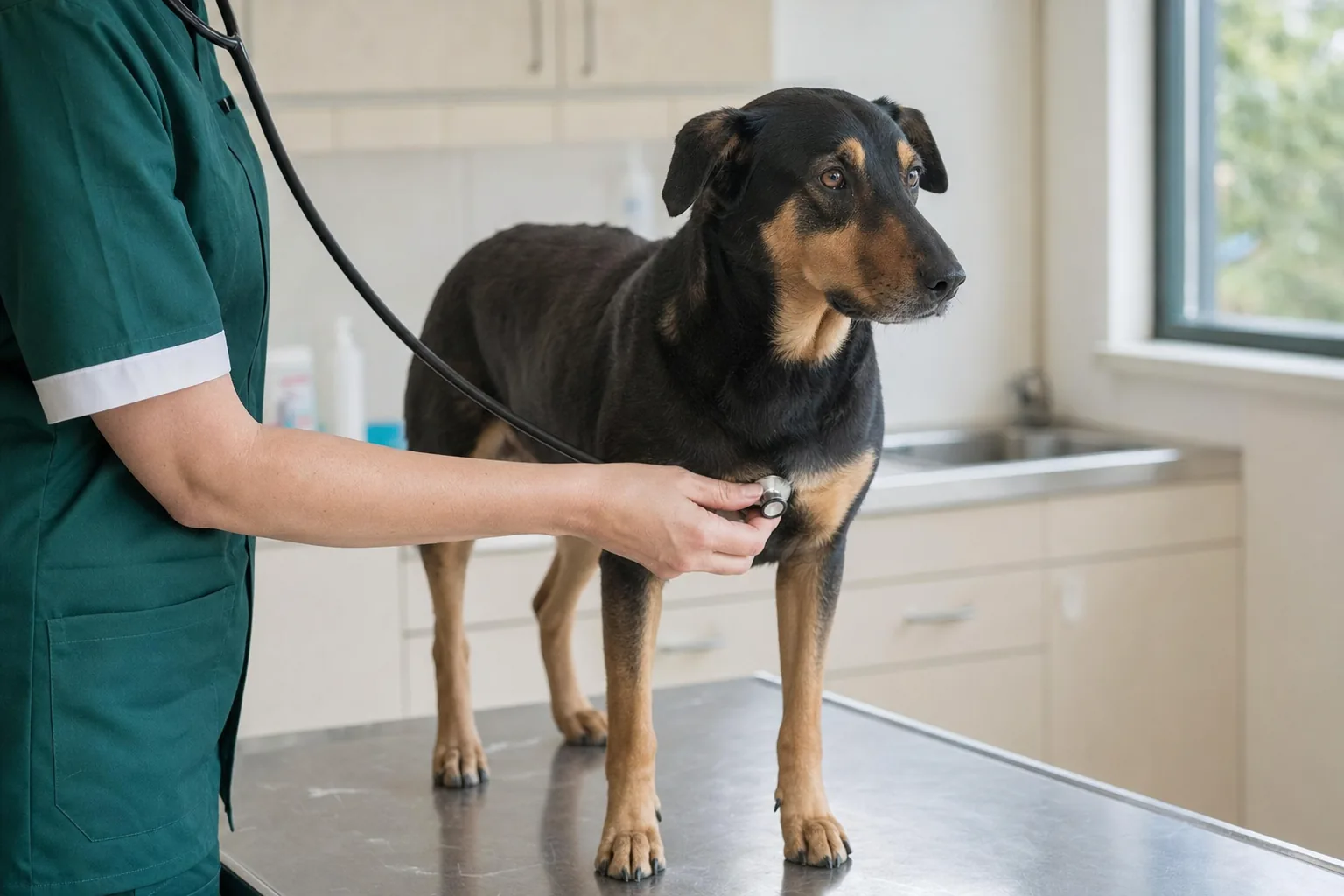
- Examines him. Temperature, colour of gums and eyes, heart, breathing, the belly by hand (an enlarged spleen is a common finding), how dehydrated he is.
- Makes a blood smear. A drop of blood, usually from the tip of the ear, spread on a slide and put under the microscope. Babesia canis shows up as little pear shapes, in pairs, inside the red cells. In many cases the diagnosis is made within minutes.
- Runs a full blood count. It shows how anaemic he is and how far the platelets, the cells that stop bleeding, have dropped; in babesiosis they are almost always low.
- Biochemistry and a urine test. For the kidneys and the liver. They decide how serious the case is and how long recovery takes.
- A PCR test, if the smear is unclear or the vet wants the exact species. Sometimes other tick-borne diseases are tested for as well, because they can arrive together.
- Treats. There is a specific treatment against the parasite, given by the vet, plus whatever the dog needs to get through it: a drip, a blood transfusion if the anaemia is severe, the kidneys watched closely. A case caught early usually resolves without a long stay in hospital. A case caught late spends days on a drip.
- Sees him again. Blood tests are repeated after a few days to check that the anaemia is retreating and the kidneys have recovered.
Before you leave, two questions: how do you protect him for the rest of the season, and is the babesiosis vaccine that exists in some European countries available where you live. It does not stop the disease outright, but it can make it milder. Your vet will know whether it is worth it for your dog.
What not to do
- Do not wait until morning. With babesiosis, a few hours separate an injection from a week in hospital.
- Do not give anything from your own medicine cabinet for fever or pain. Some human medicines are toxic to dogs at small doses; others hit the kidneys, the very organ the disease is already testing.
- Do not force him to eat or walk. Carry him, or use a blanket as a stretcher.
- Do not remove a tick with oil, alcohol, butter or a lighter. A distressed tick empties its gut into the wound. A tick hook or fine tweezers, gripped next to the skin, a slow pull, no squeezing.
- Do not rely on "I put something on him three months ago". Every product lasts a set time. The date goes in your phone's calendar.
- Do not assume a town dog is safe. This tick lives in parks, along lake shores and on the waste ground between housing blocks.
- Do not let him into long grass in season without checking him afterwards. One hand through the coat from head to tail: ears, neck, armpits, between the toes, belly.
Keeping it away
Babesia canis does not pass from tick to dog the moment the tick attaches. It needs time; the literature talks of hours, not minutes. The two rules that matter rest on that window: a tick product that kills or repels the tick quickly, chosen with your own vet and renewed on schedule, and a coat check after every outing into grass for as long as the season lasts.
In mantrailing we train on exactly its ground: woodland edges, meadows, riverbanks. We tell every team the same thing, every time: protection up to date before the grass comes up, and a hand through the coat at the car before the dog gets in.
A dog who has had babesiosis once is not immune. He can get it again, just as badly. The prevention calendar does not change.
The information on this page is educational and does not replace an examination. For full details and a diagnosis, consult your dog's own veterinarian.