Caution. Above 39.5 °C with lethargy or other signs, above 40 °C regardless, below 37.5 °C in a weak dog, or fever in an unvaccinated puppy: call your own vet today. Above 41 °C after heat or exercise, wet him with cold water and leave now. Do not give human fever medicines.
Noticed something different about your dog? Go straight to their vet.
Do not look for the answer in a Facebook group, on TikTok or on a forum. Look for someone trained for this: your dog's own veterinarian, the only person who can examine, investigate and treat them.
- The same sign, dozens of causes. A dog that vomits may have eaten grass or may have an object stuck in the gut. From two lines you typed, nobody can tell which. The vet feels the abdomen, takes the temperature, runs tests.
- Nobody on the internet sees your dog. They see a photo and a story. A diagnosis comes from an examination and investigations, not from a resemblance to someone else's dog.
- In groups you hear from the people whose dog "got better on its own". Those for whom it ended badly rarely post again. What you read there is a selection, not a statistic.
- Doses are calculated by weight and species. Human medicines that look harmless, paracetamol or ibuprofen, are toxic to dogs. "I gave mine half a tablet" is the most dangerous advice you can get.
- Hours matter. With a twisted stomach, a poisoning or a urinary blockage, the time spent asking online is exactly the time that decides the outcome.
- The vet is accountable for what they say. They have your dog's record, history, vaccinations, past treatments. An anonymous account has none of that and answers for nothing.
Use this page to know what to observe, what to note and what to ask at the appointment, not to treat at home. If you still have doubts after a consultation, ask another vet or a specialist (dermatologist, internist) for a second opinion, not a group. And if you do not have a regular vet yet, find one now, while your dog is healthy: how to choose a veterinary clinic.
He has been lying in the corner since morning. He did not get up when you picked up the lead, he has not touched his food, and when you stroke his head his ears feel like they are burning. You touch his nose: warm and dry. Your gran says that means fever; the internet says it means nothing. To find out, you need a thermometer and two minutes of patience. Here you will find a dog's normal temperature, how to take it without anyone getting upset, which readings mean a phone call today, and what never to give him from your own medicine cabinet.
What temperature means calling the vet today
An adult dog's normal temperature, taken rectally, is 38 to 39.2 °C (100.4 to 102.5 °F). Puppies can run slightly higher. In practice, fever starts from about 39.5 °C. Call your own vet today if:
- the reading is above 39.5 °C and he is flat, not eating or has other signs: vomiting, diarrhoea, coughing, lameness, pain;
- the reading is above 40 °C, however he looks;
- the reading is below 37.5 °C in a dog who is shivering, weak or will not get up. Too low is as serious as too high;
- he is a puppy under four months who has not finished his vaccinations and has a temperature with diarrhoea or vomiting;
- she is a bitch who whelped in the last few weeks, or was in season a month or two ago and is now drinking a lot and running a temperature;
- the fever came on after a bite, an operation or a wound;
- he had ticks in the last two weeks and is now flat, with dark urine or pale gums.
When to set off now, without phoning first
Above 41 °C, especially after exercise, heat or a day in the car, it is no longer fever. It is overheating, and within minutes it becomes dangerous. Wet him with cold water, not ice, on the belly, neck and paws, and head for the practice with the air conditioning on. Do the same if he is fitting, his gums are white or blue, or he no longer responds to his name.
How to measure it and what to note at home
The nose tells you nothing. Perfectly healthy dogs have warm, dry noses after a sleep, next to a radiator or after a day in the sun, and a dog with a fever can have a cold, wet one. Warm ears, a warm belly and warm paws are just as unreliable. The only tool you can trust is a thermometer.
How to take his temperature, step by step
- What you need. An ordinary digital thermometer, with a flexible tip if you can find one. Buy it just for the dog and label it. You also need a little petroleum jelly or cooking oil for the tip, some tissues and a second person.
- The second person holds the dog standing, one arm under his belly and one round his chest, and talks to him. A small dog can sit in their arms.
- Lift the tail and slide the greased tip gently into his bottom with a slight twisting motion: 1–2 cm in small dogs, 2–3 cm in large ones. If you feel resistance, do not push.
- Hold the end of the thermometer until it beeps, usually in under a minute. Meanwhile your helper slips him the odd treat to keep him standing.
- Read it, then wipe and disinfect the thermometer. Praise him and give him something good. Next time he will stand more easily.
Ear thermometers for animals exist but read less reliably. Infrared forehead thermometers made for people do not work through fur. If you cannot get a reading at all, tell your vet that rather than guessing a number from how he feels to the touch.
Take it when he is settled, not straight after a walk, a game, a hot bath or an hour by the fire. Exercise and excitement push the temperature up by half a degree, sometimes a whole degree, without it being fever. At the vet's, frightened dogs often read 39.3–39.5 °C from stress alone.
What to write down
- the temperature and the time, twice a day (morning and evening) for a few days, or every few hours if it is high;
- whether he is eating and drinking, and how much;
- how he is behaving: sleeping more, hiding, shivering, panting;
- other signs: cough, runny nose, vomiting, diarrhoea, lameness, sore spots, swellings, dark urine;
- what has happened in the last two weeks: ticks, a bite, a vaccination (a slightly raised temperature for a day or two afterwards can be normal), an operation, a season, a hike, a very hot day.
Where a fever can come from
| What it might be |
What else you usually see |
| Infection (tooth, skin, urinary tract, airways, a wound) |
Signs in that spot: pus, coughing, weeing often, pain |
| Tick-borne disease |
Lethargy, pale gums, dark urine, lameness that shifts from leg to leg |
| Abscess after a bite |
Hot, painful swelling appearing 2–5 days later |
| Womb infection in unspayed bitches |
Great thirst, lethargy, sometimes discharge, 1–2 months after a season |
| Pancreatitis, other internal inflammation |
Vomiting, sore belly, hunched posture |
| Reaction to a vaccination |
A day or two a bit flat, then back to normal |
| Overheating (not a fever) |
After heat or exercise, heavy panting, very high temperature |
A fever tells you something is going on in the body. The vet's job is to find out what.
What the vet will do
- Take his temperature again, because it may read differently at the practice, and go through what you noted.
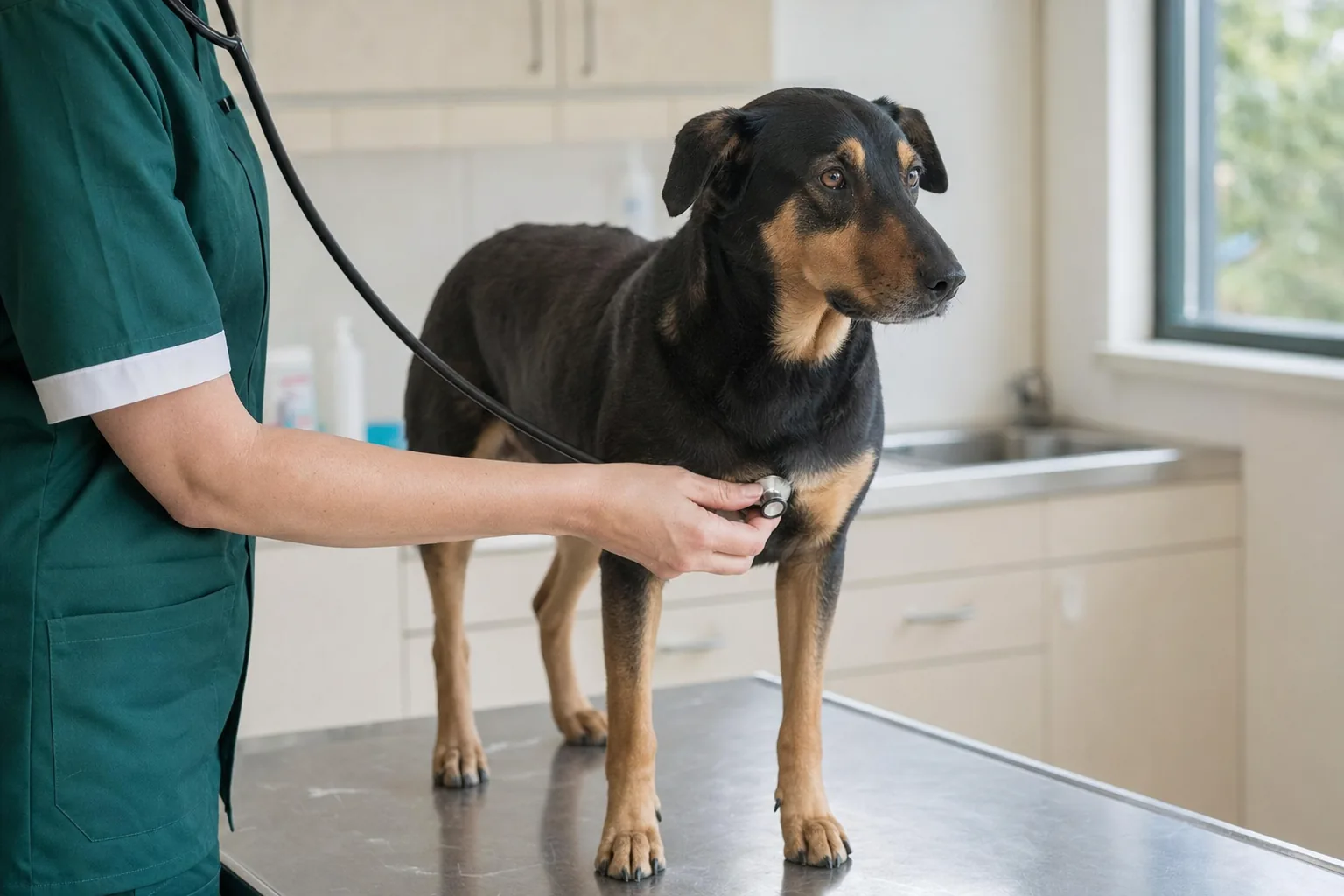
- Examine him nose to tail: mouth and teeth, lymph nodes, heart and lungs, belly, joints, skin. They look for wounds or swellings hidden under the coat, and for ticks.
- Blood tests. A full blood count shows infection, anaemia and inflammation, and biochemistry covers the liver, kidneys and other organs. When there is no obvious cause, rapid tests for tick-borne diseases are usually added, especially in tick season.
- Urine test, for urinary infection and the kidneys.
- X-ray or ultrasound if they suspect something in the chest, the belly or the womb.
- Treatment, depending on the cause. If the fever is very high, the vet can bring it down at the practice, but finding where it comes from matters more. When the cause is unclear, the dog sometimes stays in for a day on a drip, with repeat tests.
Before you leave, ask what to watch for at home, at what temperature to call again, and when the follow-up is.
What not to do at home
- Do not give human fever or pain medicines. Many are toxic to dogs even in amounts that seem tiny to you. They can cause stomach ulcers and damage the kidneys or liver. Not "half a tablet", not "just the once".
- Do not give him his own old medicines left over from another illness. Some do not mix and can do real harm to a dehydrated dog.
- Do not cool him with ice, iced water or alcohol when he has a fever. The blood vessels in the skin clamp down, the heat stays inside, and he starts to shiver. Ordinary cold water is only for overheating, on the way to the vet.
- Do not wrap him in thick blankets when he has a fever. If his temperature is below normal, yes: warm him gently and set off.
- Do not force him to eat. Offer fresh water often, and something light if he wants it. Going without water is more dangerous than a day without food.
- Do not take his temperature in the mouth, under the armpit, or in the ear with a human thermometer. The readings are wrong and give you false reassurance.
- Do not wait three days to see if a fever with lethargy passes. Many illnesses that cause fever in dogs are easier to treat when caught early.
A cheap thermometer kept in the dog's first-aid kit saves you a lot of nights staring at his nose not knowing what to think. Take his temperature now, while he is well. You learn what is normal for him, and he gets used to the thermometer.
Frequently asked questions
What dog owners search for most often on the internet about this problem, with the short answer. The answers are a guide only: the decision belongs to your dog's own vet, after an examination.
What is a normal temperature for a dog?
Between 38 and 39.2 °C, taken rectally, in a calm adult dog. Puppies can run a little higher. After exercise, play or excitement the temperature can rise by half a degree without it being fever, so measure once he has rested. Above 39.5 °C is a fever, below 37.5 °C is too low.
How do I take my dog's temperature?
With a digital thermometer kept just for him, the tip greased with petroleum jelly or oil. Someone holds the dog standing, you lift his tail and slide the tip gently into his bottom, 1–2 cm in small dogs and 2–3 cm in large ones, until it beeps. Then wipe and disinfect the thermometer, and give him praise and something good.
My dog's nose is warm. Does he have a fever?
No. Plenty of healthy dogs have a warm, dry nose after sleeping, in the sun or next to a radiator, and a dog with a fever can have a cold, wet one. Warm ears or a warm belly are not reliable either. Only a thermometer tells you. If you cannot get a reading, tell your vet so.
What can I give my dog for a fever?
Nothing from your own cupboard. Human fever and pain medicines are toxic to dogs even in small amounts and can cause ulcers or damage the kidneys or liver. Give him fresh water, let him rest somewhere cool and call your vet, who will look for the cause of the fever and decide on treatment.
The information on this page is educational and does not replace an examination. For full details and a diagnosis, consult your dog's own veterinarian.