It rained for a week, and your dog had the time of his life splashing through the big puddle at the edge of the woods. Maybe he drank from a water-filled rut. Maybe you live on the edge of town and have seen rats round the bins. Now he is flat, off his food, drinking constantly, and he has been sick twice. You came across the word "leptospirosis" and it frightened you. Fair enough: ring your own vet today. Until you leave, here is what to watch for and how to protect yourself, because this disease spreads to people too.
Leptospira is a bacterium that lives in the kidneys of rats, other rodents and some wild and farm animals, and leaves their bodies in urine. In standing water and damp soil it survives for weeks. Dogs pick it up by drinking or wading in contaminated water, licking wet grass, or through a scratch in the skin. From the bloodstream it heads mainly for the kidneys and liver, sometimes the lungs.
Which signs mean a same-day visit
Signs usually appear one to two weeks after exposure. At first they look like a cold or a tummy upset, and that is what makes the disease dangerous. Ring your vet the same day if you see:
- lethargy and fever: hot ears and belly, curled up, unwilling to get up;
- more than a day off food, with vomiting or diarrhoea;
- heavy drinking and lots of urine, or the reverse, hardly any urine in a whole day;
- muscle pain: walking stiffly with a hunched back, whimpering when you touch his back or belly;
- the whites of the eyes, the gums or the skin on the belly turning yellowish;
- tiny red-purple spots on the gums or belly, nosebleeds, blood in the stool or urine;
- fast or laboured breathing, or a cough, with no reason you can see.
Any combination of those counts in a dog who, over the last three weeks, has been near standing water, floods, rodents or rubbish.
If he is struggling to breathe or has stopped passing urine, don't wait for tomorrow's appointment. Go to a clinic that is open round the clock.
Say in your first sentence on the phone that you suspect leptospirosis. The practice needs to know, because the dog's urine can make the staff ill.
What to note at home before you go
"He's been poorly for two days" doesn't give your vet much. A few short notes give them a lot.
Where he has been. Lakes, puddles, ditches, woods after rain, a yard with rats, flooded fields, kennels, a day's shooting. With rough dates, for the last three weeks.
Vaccination. Bring his vaccination card. Your vet will want to see whether his annual jab includes leptospirosis and when the last booster was. Protection from this vaccine lasts about a year, not three like some others, so one missed booster leaves him uncovered.
Urine. How much and how often. What colour: very pale, dark like strong tea, reddish. If you can, count the walks where he didn't wee at all.
Water and food. Put a known amount of water in his bowl and see what is left in the evening. Note what he ate and what he refused.
Temperature. If you have a digital thermometer and he tolerates it, normal rectal temperature is 38 to 39.2 °C. If he fights it, leave it; your vet will take it.
Colour. Photograph his gums and the whites of his eyes in daylight, not under the yellow kitchen light. Tomorrow's photo next to today's shows whether anything is changing.
Other dogs at home. If they went to the same places, keep an eye on them too.
What looks like what
| What you see |
Leptospirosis? |
What else it could be |
| Fever, lethargy, vomiting after a puddle |
Possibly |
Gastroenteritis, parvovirus in puppies, poisoning |
| Heavy drinking and lots of urine |
Possibly, kidneys affected |
Diabetes, chronic kidney disease, urine infection, hormonal disease |
| Yellowish gums and eyes |
Possibly, liver affected |
Liver disease, destruction of red blood cells (after a tick, for instance) |
| Small red spots, bleeding |
Possibly |
Rat poison, tick-borne diseases |
| Laboured breathing, cough |
The lung form, serious |
Heart disease, pneumonia, heatstroke |
Nearly every row has three or four explanations, some of them just as urgent. From home, by eye, you can't tell them apart.
Protecting yourself
People catch leptospirosis through urine as well. Until the diagnosis is clear, and for as long as treatment lasts:
- let him wee in one spot in the garden or on the street, away from play areas and water;
- clear up accidents indoors with disposable gloves, then clean the spot with an ordinary household disinfectant;
- wash your hands after handling him, especially before eating;
- small children, pregnant women and anyone with weakened immunity don't look after the sick dog;
- if you or anyone at home gets a fever, muscle aches or headaches over the following weeks, tell your GP that the dog was suspected of having leptospirosis.
What your vet will do, and how it is treated
- Questions. Water and rodents, vaccination, when the signs started, what you noted about urine and drinking. With your notes, this part is short.
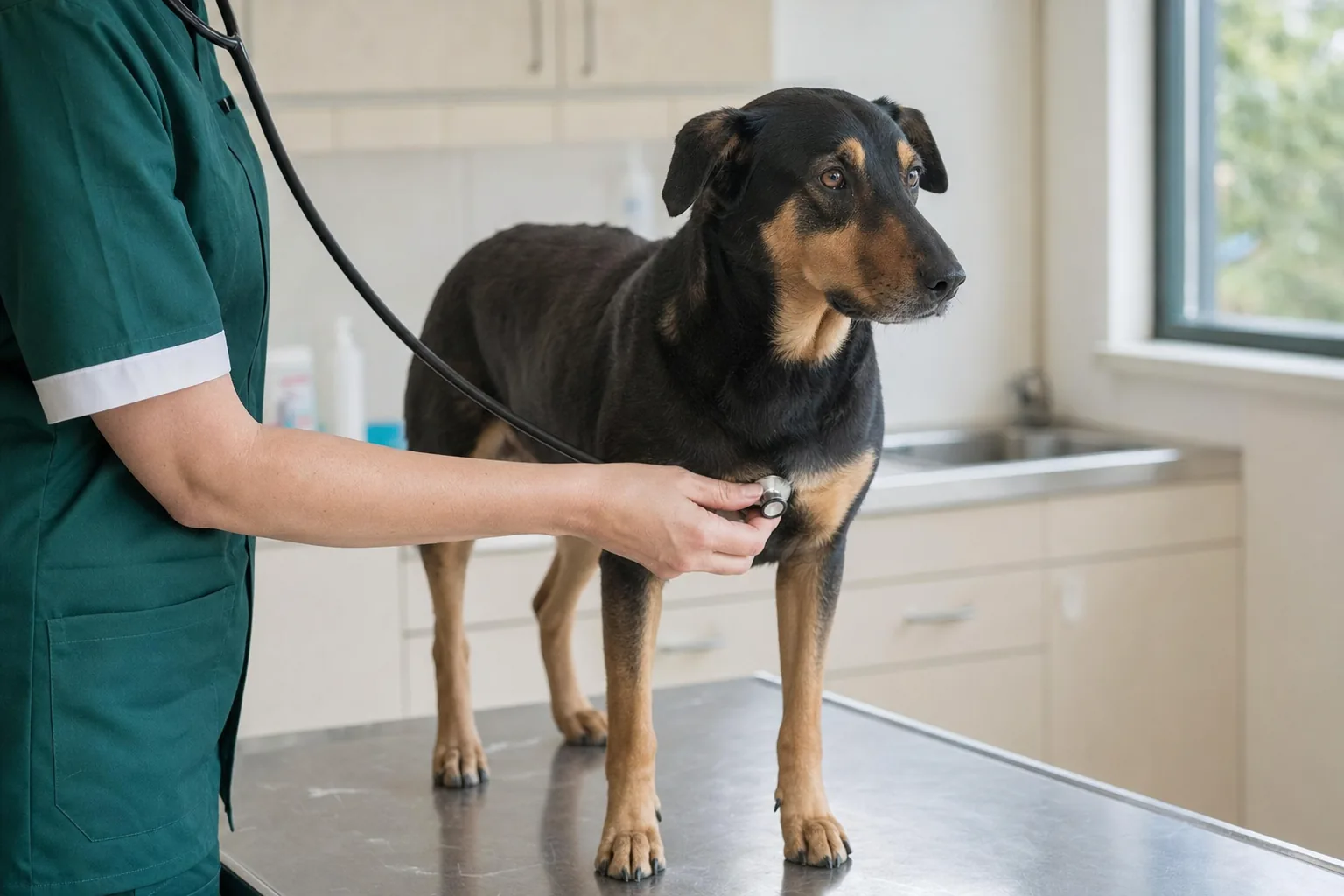
- Examination. Temperature, colour of gums and eyes, how dehydrated he is, kidneys and liver felt through the belly (they may be sore), lungs listened to.
- Blood tests. A full blood count and biochemistry show how badly the kidneys and liver are affected, his platelet count (often low with leptospirosis) and his electrolytes. Those numbers give your vet a first plan.
- Urinalysis. How concentrated the urine is and what turns up in it (protein, blood, glucose) tell your vet about the kidneys.
- Tests for the bacterium. PCR on blood and urine looks for the bacterium's genetic material and is most useful in the first days, before treatment. Antibody tests (serology) show the body's response. They are often repeated after one to two weeks, because the first result can be negative too early, or positive only because of the vaccine. Some practices have a quick antibody test in-house, with the same limitation.
- Chest X-ray and abdominal ultrasound, especially if he is breathing hard or the kidneys look enlarged.
- Hospital. A dog with confirmed or very likely leptospirosis is usually admitted, put on a drip, given treatment against the bacterium chosen by the vet, and has his urine output watched closely. For dogs whose kidneys have shut down, some large referral clinics offer dialysis. Vets often start treatment before results come back, because every day of waiting can leave its mark on the kidneys.
Many dogs treated in time make a full recovery. Others are left with weaker kidneys for life and need regular check-ups. The form with bleeding into the lungs is the most serious. Ask about your own dog's outlook after the first results, when your vet has the numbers in front of them.
The vaccine, at the same visit. There is a leptospirosis vaccine and it is usually part of the annual jab. The first time round he gets two injections a few weeks apart, then a booster every year. It covers the most common types of the bacterium, not all of them, so it cuts the risk a great deal without taking it to zero. International vaccination guidelines recommend it for dogs who live in or visit areas at risk, which in practice means almost any dog who gets out into the countryside. Ask whether yours is up to date.
What not to do at home
- Don't wait for it to pass when lethargy and fever follow a puddle. The window in which treatment can still protect the kidneys is short.
- Don't give leftover antibiotics from another illness, another dog or your own cupboard. They hide the signs and spoil the tests. Nobody chose them for this disease either.
- Don't give human medicines for fever or pain. Many are toxic to dogs, and some hit the very kidneys and liver the disease is already attacking.
- Don't force food or water. If he is vomiting, what goes in comes back out, and he can inhale it.
- Don't touch urine with bare hands. Don't hose the spot down either; the spray scatters it.
- Don't take him round other dogs, to kennels or to training until your vet says so.
- Don't let him drink from puddles again, even once he has recovered. Carry water on walks.
- Don't skip the annual booster because "nothing happened last year".
At our training sessions out in the countryside, every dog has his own bowl and water brought from home, and after long spells of rain we steer clear of routes with big puddles. Together with an up-to-date vaccine, that is all it takes, and his kidneys will thank you.
The information on this page is educational and does not replace an examination. For full details and a diagnosis, consult your dog's own veterinarian.