Caution. Eyes, gums or skin with a yellow tinge: ring your own vet today. Go straight in if he also has very pale gums, weakness, brown urine, a fever after ticks, repeated vomiting or any bleeding.
Noticed something different about your dog? Go straight to their vet.
Do not look for the answer in a Facebook group, on TikTok or on a forum. Look for someone trained for this: your dog's own veterinarian, the only person who can examine, investigate and treat them.
- The same sign, dozens of causes. A dog that vomits may have eaten grass or may have an object stuck in the gut. From two lines you typed, nobody can tell which. The vet feels the abdomen, takes the temperature, runs tests.
- Nobody on the internet sees your dog. They see a photo and a story. A diagnosis comes from an examination and investigations, not from a resemblance to someone else's dog.
- In groups you hear from the people whose dog "got better on its own". Those for whom it ended badly rarely post again. What you read there is a selection, not a statistic.
- Doses are calculated by weight and species. Human medicines that look harmless, paracetamol or ibuprofen, are toxic to dogs. "I gave mine half a tablet" is the most dangerous advice you can get.
- Hours matter. With a twisted stomach, a poisoning or a urinary blockage, the time spent asking online is exactly the time that decides the outcome.
- The vet is accountable for what they say. They have your dog's record, history, vaccinations, past treatments. An anonymous account has none of that and answers for nothing.
Use this page to know what to observe, what to note and what to ask at the appointment, not to treat at home. If you still have doubts after a consultation, ask another vet or a specialist (dermatologist, internist) for a second opinion, not a group. And if you do not have a regular vet yet, find one now, while your dog is healthy: how to choose a veterinary clinic.
You wipe your dog's eyes in the morning and notice the whites aren't white any more. They're yellowish, like an old page. You lift his lip and the gums have a lemon tinge you've never seen before. Maybe his urine is orange too, like strong tea, or he has been flat for a couple of days and picking at his food. That colour is called jaundice (vets also say icterus). It isn't a disease in its own right; it tells you something is wrong with the blood, the liver or the route the bile takes. Some of the causes are serious and get worse quickly, which is why jaundice goes to the vet the same day. Here is what it means, what to write down and what not to do before you get to the practice.
When to ring today and when to go straight in
Any yellow tinge to the eyes, gums or skin means a phone call to your own vet today. Don't wait for an appointment, go straight in, if alongside the yellow you see any of these:
- very pale, whitish-yellow gums and a weak dog who tires after a few steps or breathes fast even lying down;
- red-brown urine, like cola, or very dark urine;
- fever, shivering or a dog who is badly off colour, especially if you have found ticks on him in the last two weeks;
- repeated vomiting, a painful belly, refusing food altogether;
- bleeding: small red spots on the gums or belly, nosebleeds, black stools;
- confusion, staggering, seizures;
- you know or suspect he has eaten something toxic, such as wild mushrooms, chewing gum or anything with sweetener in it, or human medicines.
On the phone, say when you first noticed the colour and what other signs he has. The vet will also ask whether he has had ticks, whether he is vaccinated against leptospirosis and whether he has been near stagnant water, rats or household chemicals, so have those answers ready.
What you can watch for and write down at home
First, briefly, where the yellow comes from. Every day the body breaks down old red blood cells. What is left is a yellow pigment, bilirubin, which the liver picks up and sends through the bile into the gut. Jaundice appears when bilirubin builds up in the blood: either too much is being made, or the liver can't keep up, or the bile has nowhere to go. Vets sort the causes into three groups, and knowing them helps you understand why they ask what they ask.
| Group |
What is happening |
Examples |
What else you usually see |
| Before the liver |
Red cells are being destroyed too fast |
Babesiosis (spread by ticks), anaemia where the body attacks its own red cells, some poisonings (onion, zinc) |
Pale gums, weakness, dark urine, sometimes fever |
| In the liver |
The liver is diseased and can't process bilirubin |
Leptospirosis, hepatitis, poisoning (the sweetener in chewing gum, some mushrooms), some medicines, tumours, inherited liver disease in some breeds |
Vomiting, poor appetite, heavy thirst, a dull dog |
| After the liver |
Bile can't get into the gut |
Pancreatitis, gallbladder problems, tumours pressing on the bile ducts |
Belly pain, vomiting, pale, clay-coloured stools |
The table is there to help you follow what's going on. You can't pick the cause from it; only tests show that.
Before you set off, jot down a few things. It takes ten minutes and cuts a lot of time off the route to a diagnosis.
- Where you see the yellow: the whites of the eyes (gently lift the upper lid), the gums, the inside of the ears, the skin on the belly. Take photos in daylight, not under a light bulb. Warm indoor light makes everything look yellow.
- Urine: its colour, how much there is, whether he is going more or less often than usual. If you can, catch a little first thing in the morning in a clean container and bring it along. Wear gloves, because leptospirosis passes to people through urine.
- Stools, especially the colour: bright orange or, the other way, very pale, like clay.
- How much he has eaten and drunk over the last few days.
- Ticks: whether you have found any on him in the last three weeks, when he last had parasite protection and which product (take a photo of the box).
- Anything he might have swallowed: mushrooms in the park or woods, chewing gum, pills dropped on the floor, onion, garden products, rat poison.
- His vaccination record, with the date of his leptospirosis vaccine.
- His breed. A few breeds (Bedlington Terriers, Labradors, Dobermanns, West Highland White Terriers and others) have inherited diseases in which the liver stores too much copper. Tell the vet the breed and, if you know, what his parents suffered from.
How to check the gums
Lift the upper lip above the canine tooth, in daylight. A healthy gum is pink, moist and shiny. In dogs with pigmented, black gums, look at the whites of the eyes or the inside of the lower eyelid instead. Press with a finger for a second: the spot goes pale and should get its colour back in under two seconds. A yellow, pale gum that is slow to recover means you go straight in. Practise this while your dog is healthy too, so you know what normal looks like for him.
What the vet will be looking for
For the vet, jaundice is only the starting point. The cause is usually tracked down in these steps, sometimes all on the same day:
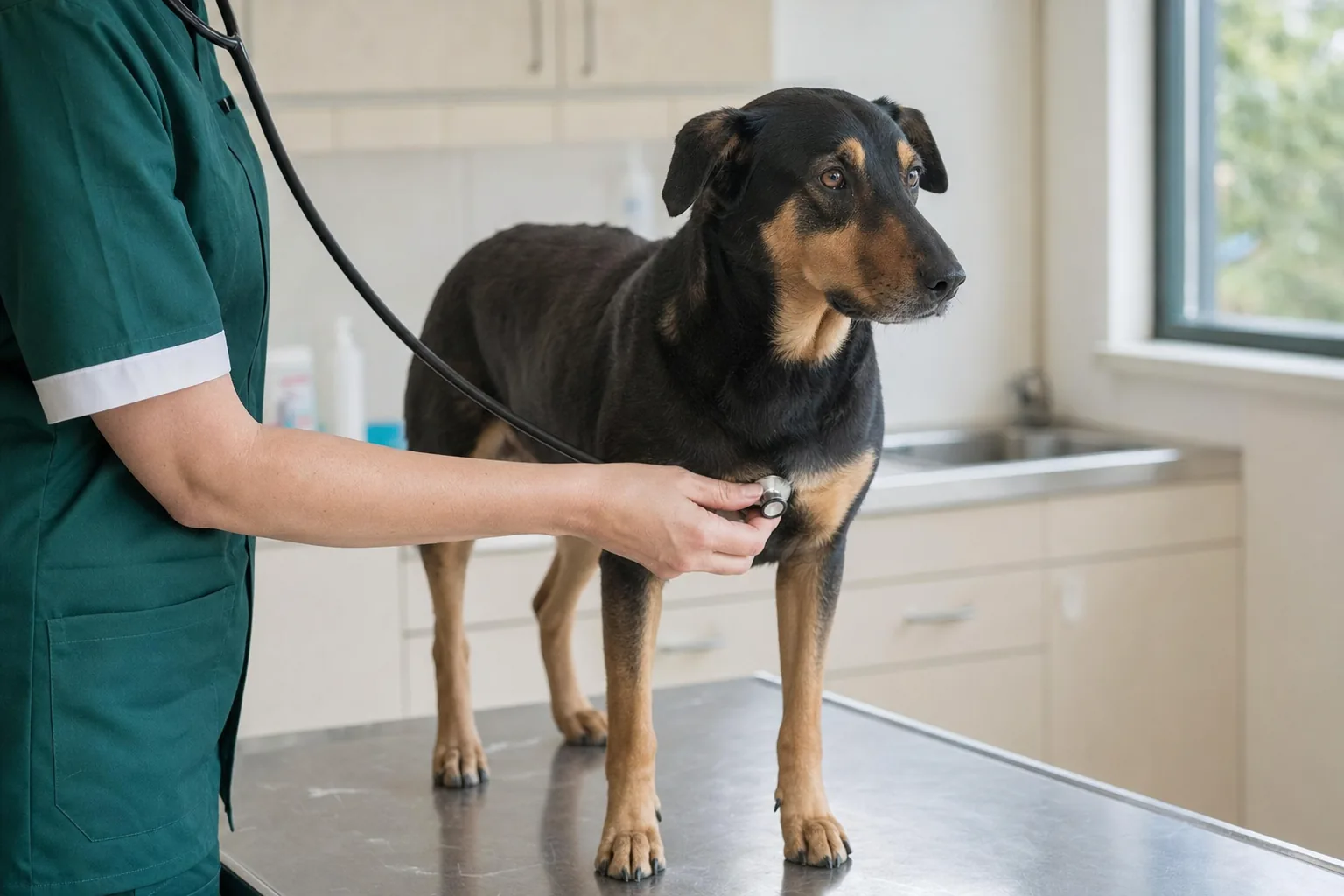
- A clinical exam: how yellow he is, gum colour, temperature, the size of the liver and spleen on palpation, belly pain, signs of bleeding.
- A complete blood count. It shows whether there is anaemia and how bad it is. A dog who is yellow and pale points towards destroyed red cells; one who is yellow with pink gums points more often to the liver or the bile ducts.
- A blood smear. Under the microscope the babesia parasites can sometimes be seen inside the red cells, or the changes in cell shape typical of anaemia where the body attacks its own cells.
- Biochemistry: bilirubin, liver enzymes, proteins, blood sugar and the kidneys (leptospirosis often hits both liver and kidneys).
- A urine test.
- Tests for infections, based on the dog's history: babesiosis, leptospirosis, other tick-borne diseases.
- Clotting tests. The liver makes the substances that stop bleeding, so these tests are essential before any biopsy.
- An abdominal ultrasound: liver, gallbladder, bile ducts, pancreas, spleen. It shows whether the bile is blocked, in which case surgery may be needed.
- Sometimes a liver biopsy, if the tests point to liver disease without a clear cause.
Treatment depends entirely on the cause. It might mean a stay in hospital on a drip, a blood transfusion, treatment for an infection, surgery or a special diet for the long term. Ask which result you are waiting for and when the next check-up is: with most of the diseases behind jaundice, repeat blood tests are what tell you whether the treatment is working.
What not to do at home
- Don't wait for "the yellow to fade". Babesiosis or severe anaemia can become life-threatening within days, sometimes within hours.
- Don't give "liver support" supplements, herbal teas or natural remedies before a diagnosis. Some do nothing, some put extra strain on the liver, and all of them can delay the trip to the vet.
- Don't give painkillers or any other human medicines. Many are toxic to a dog's liver.
- Don't starve him to "rest the liver". A sick liver needs food, and your vet will tell you what kind.
- Don't touch his urine with bare hands until leptospirosis has been ruled out. Clean any spot where he has wee'd indoors wearing gloves, and keep children away.
- Don't remove ticks with oil, alcohol or a flame. Use a proper tick hook, with a twisting motion, and keep them in a jar in case the vet wants to see them.
What you can prevent
Some of the causes can be avoided. Tick protection is kept up all year: in Romania, the tick that spreads babesiosis is active on mild winter days too. The leptospirosis vaccine is boosted when your vet says, especially for dogs who spend time near water, in woodland or in the countryside. Keep the bin closed, chewing gum and medicines out of reach, and mushrooms in the park away from his mouth. In older dogs, a yearly blood test sometimes picks up liver disease before any yellow appears.
Frequently asked questions
What dog owners search for most often on the internet about this problem, with the short answer. The answers are a guide only: the decision belongs to your dog's own vet, after an examination.
Why does my dog have yellow eyes?
Because of bilirubin, a yellow pigment that builds up in the blood when red cells are destroyed too quickly, when the liver can't keep up or when bile can't drain into the gut. Behind it there may be babesiosis, leptospirosis, a poisoning, liver disease or pancreatitis. Whatever the cause, the tests are done the same day.
Is jaundice in dogs serious?
It can be. Some causes, such as babesiosis or the anaemia in which the body attacks its own red cells, can become life-threatening within days. Others move more slowly. You can't tell them apart at home, so jaundice is seen by a vet the same day. If he also has pale gums, weakness or brown urine, go straight in.
What tests are done on a dog with jaundice?
Usually a complete blood count and a blood smear, which show anaemia and sometimes the babesia parasites themselves, biochemistry with bilirubin and liver enzymes, a urine test, tests for leptospirosis and other tick-borne diseases, clotting tests and an abdominal ultrasound. Sometimes, at the end, a liver biopsy. Your vet decides the order from the dog's signs.
Can I catch anything from a jaundiced dog?
Yes, if the jaundice comes from leptospirosis: it passes to people through the dog's urine and through contaminated water. Until your vet has ruled it out, clean up wearing gloves, wash your hands and keep children away from where he has wee'd. Babesiosis doesn't pass directly from the dog; only ticks spread it.
What should a dog with liver problems eat?
Whatever your own vet recommends after the diagnosis, because the diet varies a lot from one liver disease to another: some need less copper, others carefully chosen protein or small, frequent meals. The dog isn't starved, and liver supplements are given only if your vet recommends them, after tests.
The information on this page is educational and does not replace an examination. For full details and a diagnosis, consult your dog's own veterinarian.