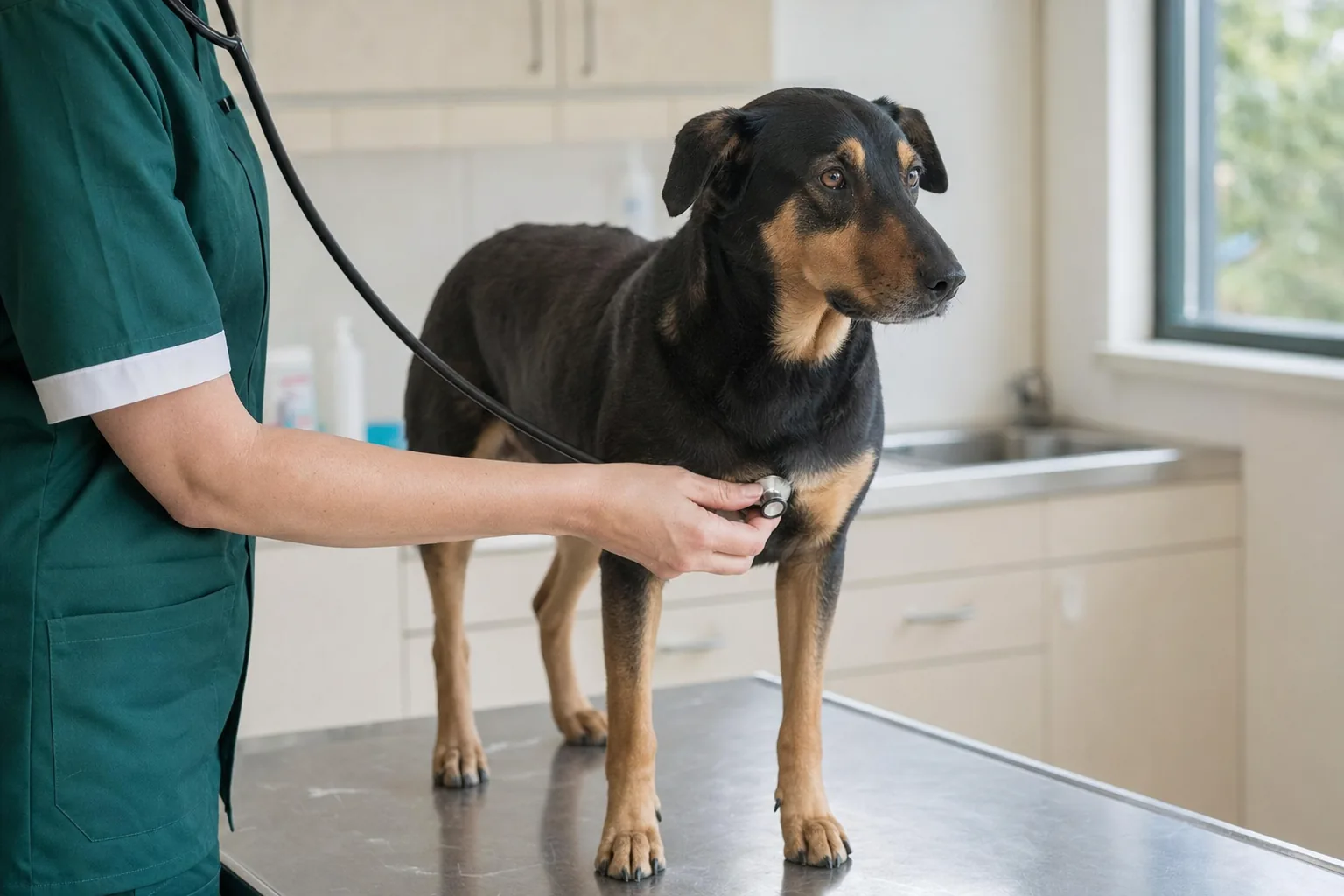
Caution. Repeated vomiting with refusing food, a dog who passes no urine, sudden lethargy, or any suspicion that he ate grapes, licked antifreeze or took human medicines: call your own vet today.
Noticed something different about your dog? Go straight to their vet.
Do not look for the answer in a Facebook group, on TikTok or on a forum. Look for someone trained for this: your dog's own veterinarian, the only person who can examine, investigate and treat them.
- The same sign, dozens of causes. A dog that vomits may have eaten grass or may have an object stuck in the gut. From two lines you typed, nobody can tell which. The vet feels the abdomen, takes the temperature, runs tests.
- Nobody on the internet sees your dog. They see a photo and a story. A diagnosis comes from an examination and investigations, not from a resemblance to someone else's dog.
- In groups you hear from the people whose dog "got better on its own". Those for whom it ended badly rarely post again. What you read there is a selection, not a statistic.
- Doses are calculated by weight and species. Human medicines that look harmless, paracetamol or ibuprofen, are toxic to dogs. "I gave mine half a tablet" is the most dangerous advice you can get.
- Hours matter. With a twisted stomach, a poisoning or a urinary blockage, the time spent asking online is exactly the time that decides the outcome.
- The vet is accountable for what they say. They have your dog's record, history, vaccinations, past treatments. An anonymous account has none of that and answers for nothing.
Use this page to know what to observe, what to note and what to ask at the appointment, not to treat at home. If you still have doubts after a consultation, ask another vet or a specialist (dermatologist, internist) for a second opinion, not a group. And if you do not have a regular vet yet, find one now, while your dog is healthy: how to choose a veterinary clinic.
Your dog is eleven and for the past month or so you have been filling his water bowl three times a day. He wakes you at night to go out. He has lost a bit of weight even though he is eating, sometimes leaves half his dinner, and his breath has an odd, ammonia-like smell. Or the results from his annual check have come back with two values in bold and "renal" scribbled in the margin. Kidney disease in dogs comes in two forms that have little in common. One appears suddenly, over a few days, usually after a poison or an infection, and it is an emergency. The other creeps in over months and years, mainly in older dogs. That one cannot be cured, but caught early it can be held back for years.
When to call the vet today about his kidneys
Chronic disease gives you time. Acute failure does not. Call today, not next week, if you see any of these:
- repeated vomiting, especially if he is also off his food, in a dog who is drinking a lot or, the opposite, has stopped drinking altogether;
- he is passing no urine, or very little, even though he is drinking;
- he has gone suddenly flat, weak or wobbly;
- his breath smells strongly of ammonia and he has sores or patches in his mouth;
- you know or suspect he has eaten grapes or raisins, licked car coolant (antifreeze), got hold of human painkillers, or drunk from puddles and stagnant water (leptospira, a bacterium spread in rodent urine, attacks the kidneys);
- he has already been diagnosed with kidney disease and has not eaten for a day, is vomiting or seems much more subdued.
Acute kidney failure can be stopped if it is caught in the first hours or days. Once the kidneys have shut down, the odds drop sharply. On the phone, say what he ate or what you suspect, when, and how much he is weeing.
What to watch and note at home
Chronic kidney disease hides well. The kidneys have a big reserve, so signs only show once a good part of the tissue has stopped working. The first sign is almost always the same: he drinks more and wees more, because the kidney can no longer concentrate the urine.
Measure the water, at least once
In the morning, put a measured amount in the bowl. Top it up during the day from the same measuring jug, and the next morning see how much is left. Keep just one bowl in the house that day and note whether he drank from puddles on the walk. A healthy dog drinks about 50–60 ml per kilo per day, more in summer or after exercise. Over 100 ml per kilo per day is too much and your vet needs to know. For a 20 kg dog, that means more than 2 litres.
One day gives you a hint; three days in a row give you a pattern. If you have two dogs, measure them separately, even if it means keeping them in different rooms for a day: one figure for both tells the vet nothing. And do not take his water away "to see what happens". You measure what he drinks with free access.
What else to write down
- Urine. How often he goes, whether he wakes you at night, whether a dog who never had accidents now has them indoors, and the colour. Very pale urine, almost like water, is a typical sign.
- Weight, once a week on the same scales. Muscle wastes slowly, especially along the back and thighs, and that shows early.
- Appetite. Eats more slowly, picks, leaves food, will only eat from your hand. That is what nausea from kidney disease looks like.
- Vomiting, even occasionally, especially in the morning.
- The mouth. Breath smell, pale gums and, in advanced stages, sores on the tongue or inside the cheeks.
- General condition. Sleeping more, slower to get going on walks, coat has lost its shine.
What the signs might mean
| What you see |
Could be the kidneys |
But could also be |
| Drinking and weeing a lot |
Yes, the typical first sign |
Diabetes, Cushing's disease, womb infection in bitches, urinary infection, some medicines |
| Losing weight despite eating |
Sometimes |
Diabetes, parasites, thyroid, tumours |
| Occasional vomiting, poor appetite |
Yes, in more advanced stages |
Gastritis, pancreatitis and plenty else |
| Breath smelling of ammonia |
Yes, advanced stages |
Dental disease (a different, rotten smell) |
| Not weeing at all |
Acute failure, emergency |
Urinary blockage, emergency |
No single sign makes the diagnosis. Blood and urine tests do.
What tests the vet will run
- History. How much he drinks (your measured figure), how much he wees and for how long, weight, diet, any medicines or supplements, possible access to toxins, whether he is vaccinated against leptospirosis.
- Clinical examination. Hydration, weight and muscle, gums and mouth, blood pressure. The vet also feels the kidneys: in chronic disease they can be small and irregular, in acute failure large and painful.
- Blood tests. Creatinine and urea show how well the kidneys are filtering, but they only rise once much of the function has gone. SDMA is a newer marker that rises earlier. Phosphorus, potassium and the red cell count fill in the picture (chronic disease often causes anaemia).
- Urine test, just as important as the bloods. Specific gravity shows whether the kidney still concentrates. The urine protein to creatinine ratio shows whether he is losing protein in his urine, which changes both treatment and outlook. Sometimes a urine culture is done as well, to rule out infection.
- Blood pressure. High blood pressure is common with kidney disease. It can damage the eyes and it speeds up the kidney disease itself.
- Ultrasound, for the shape of the kidneys and what is inside: stones, cysts, blockages.
- Staging. Vets use an international four-stage system (IRIS), based on creatinine and SDMA and then refined by urine protein and blood pressure. The stage decides how often tests are repeated and which diet and treatment changes make sense.
- The plan. For chronic disease, usually a kidney diet introduced gradually, free access to water and check-ups every few months. For acute failure, hospital, a drip and treatment of the cause.
Ask for a copy of the results at every check and keep them in a folder. How the numbers move from one visit to the next tells you more than any single value.
What not to do at home
- Do not cut back his water to make him wee less. He drinks a lot because he is losing water through his urine. Without it he dehydrates and the kidneys suffer even more. Water stays freely available, always.
- Do not give human painkillers or anti-inflammatories for an old dog's stiff joints. Some of them damage the kidneys directly, even in small amounts.
- Do not switch him to a home-made "low-protein" diet on your own. Kidney diets are balanced for phosphorus, protein and other nutrients, and an improvised recipe can do more harm than good. If you want to cook for him, get a recipe from a veterinary nutritionist.
- Do not add supplements from a shop or the internet without asking your vet. Some contain exactly the phosphorus or potassium he should not have.
- Do not change his food abruptly if his appetite is poor. Switch gradually over one to two weeks. A nauseous dog who links the new food with feeling ill may refuse it for good.
- Do not skip check-ups because "he seems fine". The disease keeps progressing between the signs you can see.
- Do not leave grapes, raisins, antifreeze or medicines within his reach. A poisoning another dog would shrug off can be serious for one whose kidneys are already weak.
What you can prevent
Chronic kidney disease cannot be prevented entirely, especially the kind that comes with age. What is in your hands: blood and urine tests once a year from seven or eight years old (earlier in large breeds), a leptospirosis vaccine if your vet recommends it for your area, fresh water always available, and nothing toxic within reach. Dogs diagnosed at stage 1 or 2 can live for years, almost normally. Dogs diagnosed at stage 4 usually cannot. More often than not, the difference was a water bowl measured in time.
Frequently asked questions
What dog owners search for most often on the internet about this problem, with the short answer. The answers are a guide only: the decision belongs to your dog's own vet, after an examination.
What are the first signs of kidney failure in dogs?
Almost always he drinks more water and wees more, sometimes at night too, and the urine is very pale. Then comes slow weight loss, especially along the back and thighs, fussy eating, the odd vomit and, in advanced stages, breath that smells of ammonia. The signs only show once a good part of the kidneys has stopped working.
How long can a dog live with chronic kidney disease?
It depends a great deal on the stage when it is caught. Dogs diagnosed early, at IRIS stage 1 or 2, can live for years with a special diet, free access to water and regular check-ups. At stage 4 we are usually talking months. Your own vet can give you an estimate for your dog, based on the tests and on how he responds to treatment.
How much water is too much for a dog?
A healthy dog drinks about 50–60 ml per kilo per day, more in summer or after exercise. Over 100 ml per kilo per day is too much and worth telling your vet. Measuring is simple: one bowl, topped up from the same measuring jug, over 24 hours. For a 20 kg dog, the threshold is 2 litres.
Which tests check a dog's kidneys?
Blood: creatinine and urea, SDMA (a marker that rises earlier), phosphorus, potassium and a full blood count. Urine: specific gravity, which shows whether the kidney still concentrates, and the protein to creatinine ratio. Blood pressure is measured and an ultrasound is usually done. From these, the vet stages the disease using the IRIS system.
Can kidney failure in dogs be cured?
Acute failure sometimes can, if treated quickly: once the cause is removed, the kidneys can recover partly or fully. Chronic disease cannot be cured, because lost tissue does not grow back. It can, however, be slowed a great deal with a kidney diet, water, and control of blood pressure and urine protein, following your vet's plan.
The information on this page is educational and does not replace an examination. For full details and a diagnosis, consult your dog's own veterinarian.