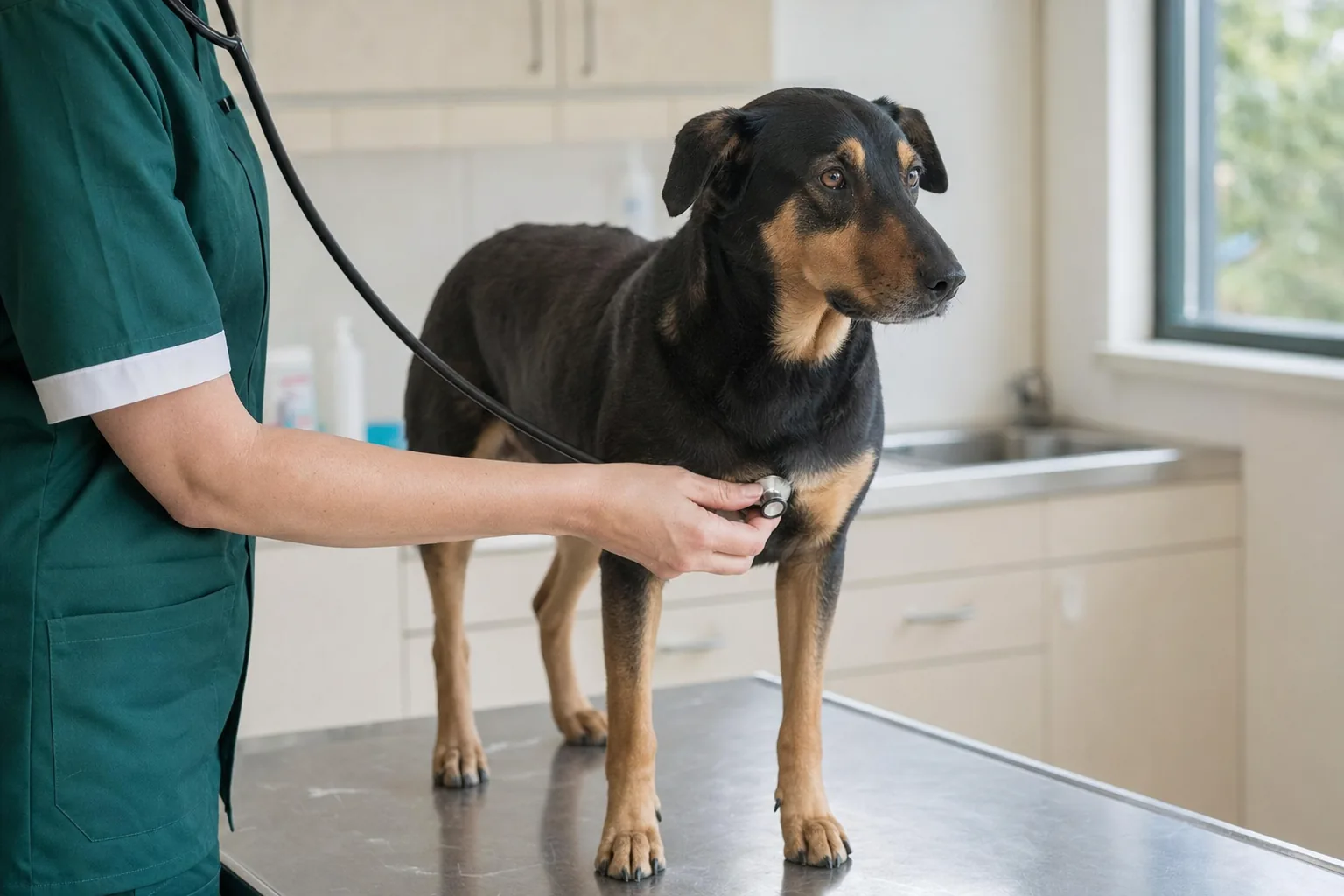
Caution. An old dog who has not eaten for a day, vomits repeatedly, breathes hard at rest, collapses, has pale gums, cannot get up or suddenly loses his balance or sight: ring your own vet today. Sudden changes are not old age.
Noticed something different about your dog? Go straight to their vet.
Do not look for the answer in a Facebook group, on TikTok or on a forum. Look for someone trained for this: your dog's own veterinarian, the only person who can examine, investigate and treat them.
- The same sign, dozens of causes. A dog that vomits may have eaten grass or may have an object stuck in the gut. From two lines you typed, nobody can tell which. The vet feels the abdomen, takes the temperature, runs tests.
- Nobody on the internet sees your dog. They see a photo and a story. A diagnosis comes from an examination and investigations, not from a resemblance to someone else's dog.
- In groups you hear from the people whose dog "got better on its own". Those for whom it ended badly rarely post again. What you read there is a selection, not a statistic.
- Doses are calculated by weight and species. Human medicines that look harmless, paracetamol or ibuprofen, are toxic to dogs. "I gave mine half a tablet" is the most dangerous advice you can get.
- Hours matter. With a twisted stomach, a poisoning or a urinary blockage, the time spent asking online is exactly the time that decides the outcome.
- The vet is accountable for what they say. They have your dog's record, history, vaccinations, past treatments. An anonymous account has none of that and answers for nothing.
Use this page to know what to observe, what to note and what to ask at the appointment, not to treat at home. If you still have doubts after a consultation, ask another vet or a specialist (dermatologist, internist) for a second opinion, not a group. And if you do not have a regular vet yet, find one now, while your dog is healthy: how to choose a veterinary clinic.
Your dog is nine. His muzzle has gone grey, he sleeps in till ten, he is slower getting off his bed in the morning, and when you throw the ball he watches it go instead of tearing after it. He eats the same, maybe a bit less. You wonder what is normal at this age. Then, what you can change at home so the years ahead are good ones. An old dog does not need wrapping in cotton wool. He needs closer, more frequent attention, and a house and walks that fit the body he has now. Below are the signs that mean ringing the vet today, what to check at home each month, what happens at a senior check-up and what not to do. Confusion, restless nights and "forgetting" have their own guide, on dementia in dogs.
Which signs in an old dog mean ringing the vet today?
In an old dog, changes that creep in slowly are usually age. Sudden ones almost never are. Ring the same day if he:
- has eaten nothing for a day, or is not drinking;
- vomits several times or has diarrhoea with blood in it;
- breathes hard or fast while lying down, coughs at night or has a swollen belly;
- faints, collapses, suddenly wobbles or has a fit;
- has pale, white or yellowish gums;
- cannot get up, or will not put a leg down;
- suddenly loses his sight, bumps into furniture, holds his head tilted and falls to one side;
- has blood in his urine, or strains to wee and nothing comes;
- has a lump that has grown visibly in a few days, or is bleeding.
Book an appointment within the week if he is drinking noticeably more, losing weight while eating the same, has bad breath and drops his food, or has started weeing indoors.
What should you check at home each month?
Old dogs hide pain well and changes come slowly. You see him every day, which makes you the person least likely to notice. A short check once a month, on the same date, gets round that.
Ten minutes, once a month
- Weight. Step on the scales holding him, then without him, and take one from the other. Write it down. A 5–10% drop for no reason needs a vet visit.
- Ribs. You should feel them easily under your fingers without seeing them. If you cannot feel them he is too heavy; if you can see them, too thin.
- Lumps. Run your hands over his whole body, including under the belly, in the armpits and between the toes. Mark each lump and its size on a simple sketch.
- Mouth. Lift his lips and look for tartar, red gums, loose teeth, a strong smell.
- Eyes and ears. Cloudy eyes, weeping, red or smelly ears. Does he still respond to his name?
- Movement. How he gets up in the morning, how he manages the stairs, how far he goes before slowing down.
- Water and wee. Is he drinking more? Asking to go out at night? Leaking in his sleep?
- Sleep and behaviour. Sleeping more by day and wandering at night? Seeming lost in the house? Growling when touched in one particular place?
- Nails. A dog who walks less wears them down less, and long nails spoil the way he walks.
Is it age, or something to check?
| What you see |
Usually age if… |
Worth a vet visit if… |
| Sleeps more |
he wakes up happy, eats, enjoys his walk |
he sleeps all day and nothing interests him any more |
| Slow to get up |
it wears off after a few steps |
he limps, whimpers, avoids the stairs |
| Hearing worse |
gradually, over years |
suddenly, or with a red, smelly ear |
| Bluish eyes |
a bluish haze, and he can still see |
eyes milky white, red, sore, or he bumps into things |
| Eats less |
a little less, steadily, and he is not losing weight |
he refuses food, chews on one side, drops food |
| Putting on weight |
he moves less and eats the same |
the belly swells, the coat thins, he drinks a lot |
What to change around the house
- Floors. Rugs or non-slip runners along his routes, especially by his bed and his bowl.
- His bed. Soft, thick, warm, out of draughts and easy to get into. For big dogs, an orthopaedic one.
- Ramps or a step for the sofa and the car. Lift a big dog with one arm under his chest and one under his bottom.
- Bowls raised a little if bending down is hard for him.
- Walks. Shorter and more frequent, at his pace, with plenty of time to sniff. Twenty minutes of sniffing whatever he likes tires an old dog out more pleasantly than an hour of brisk walking.
- His mind. Food-searching games round the house and a few old tricks relearned, with tasty treats. In our sessions we see dogs well past ten following a short trail with the same delight they had when young. The nose ages far more slowly than the legs.
- Winter. A coat for short-coated or thin dogs, and walks moved to the warmer part of the day.
What does the vet check at a senior check-up?
Most guidelines recommend two check-ups a year for a senior dog instead of one. Six months is a long time in an old dog's life.
- The conversation. What you noted in your monthly checks: weight, water, wee, movement, sleep, behaviour. Your list makes the appointment twice as useful.
- A full examination. Weight and body condition, heart and lungs, abdomen, lymph nodes, skin, lumps, eyes, ears, mouth, joints.
- Pain. The vet feels the joints and spine and watches him walk, then asks how he gets up and manages stairs. Chronic pain in dogs is often underestimated, and it treats well.
- Blood and urine tests, usually once a year in a senior, more often if something needs watching: kidneys, liver, blood sugar, thyroid, blood count, urine concentration.
- Blood pressure, especially in dogs with kidney or heart disease.
- Teeth. If he needs a scale and polish or extractions, talk through the anaesthetic. In an old dog, pre-anaesthetic bloods plus monitoring make it far safer than people think, and a sore mouth spoils every single day.
- The plan. Food suited to his age and weight, exercise, treatment for pain or for anything found, vaccinations and parasite control, the date of the next check-up.
- Quality of life. With a very old or ill dog, the vet may go through a simple questionnaire with you on pain, appetite, mobility, hygiene and happiness. It shows the vet the trend, and it stops you deciding anything on the strength of one bad day.
What should you not do at home?
- Do not put everything down to age. "He's old" explains the grey muzzle. Limping, great thirst or weight loss have other causes, and many can be treated.
- Do not give him human painkillers. Many are toxic to dogs, and in an old dog with weaker kidneys they are even more dangerous.
- Do not let him get fat. Extra weight loads the joints and shortens his life. Do not put him on a sudden diet by yourself either: an old dog loses weight with the vet involved.
- Do not change his food suddenly. Move to a new one gradually over 7–10 days, after talking to the vet.
- Do not stop him exercising. Complete rest wastes his muscles, and without muscle the joints hurt more. Short, frequent walks on soft ground.
- Do not tell him off for weeing indoors. In an old dog it is nearly always a medical or age-related sign, never stubbornness.
- Do not put off dental work for fear of the anaesthetic without talking to the vet. Ask what tests are done beforehand and how he will be monitored.
- Do not give supplements for joints, brain or "vitality" in place of a vet visit. Some help alongside treatment, but none of them stands in for a diagnosis.
An old dog looked after carefully can have good, peaceful years. The walks get shorter; the nose stays as curious as ever. Your part is to spot changes early and make his house easy to live in.
Frequently asked questions
What dog owners search for most often on the internet about this problem, with the short answer. The answers are a guide only: the decision belongs to your dog's own vet, after an examination.
At what age is a dog considered old?
It depends on size. Small breeds usually count as senior at around 10–11, medium breeds at 8–9, and large and giant breeds from as early as 6–7. Veterinary guidelines call a dog senior once he is in the last quarter of the life expected for his size and breed. From then on, check-ups are twice a year.
How do I look after an old dog at home?
Weigh and check him once a month (lumps, teeth, water, movement, sleep), put non-slip rugs along his routes, give him a soft, warm bed and ramps where he has to climb. Walks get shorter and more frequent, with lots of sniffing time, and games where he searches for his food keep his mind busy.
My old dog sleeps all day. Is that normal?
Old dogs sleep more and that is normal, as long as they wake up bright, eat and enjoy their walk. It is not normal if he sleeps all day and nothing interests him, paces restlessly at night or seems lost in the house. Then it may be pain, illness or canine dementia, and it is worth a vet visit.
What tests should a senior dog have?
Usually once a year: a blood count and biochemistry (kidneys, liver, blood sugar), sometimes thyroid, a urine test and blood pressure. The vet repeats them more often if something needs watching. The tests catch common conditions at this age, such as kidney disease or diabetes, early, when they are easier to control.
What food is right for an older dog?
No single food suits every senior. Some need fewer calories so they do not put on weight, others more because they are losing it, and dogs with kidney or heart disease need special diets. Choose with your vet, based on weight and blood results, and change food gradually over 7–10 days.
The information on this page is educational and does not replace an examination. For full details and a diagnosis, consult your dog's own veterinarian.