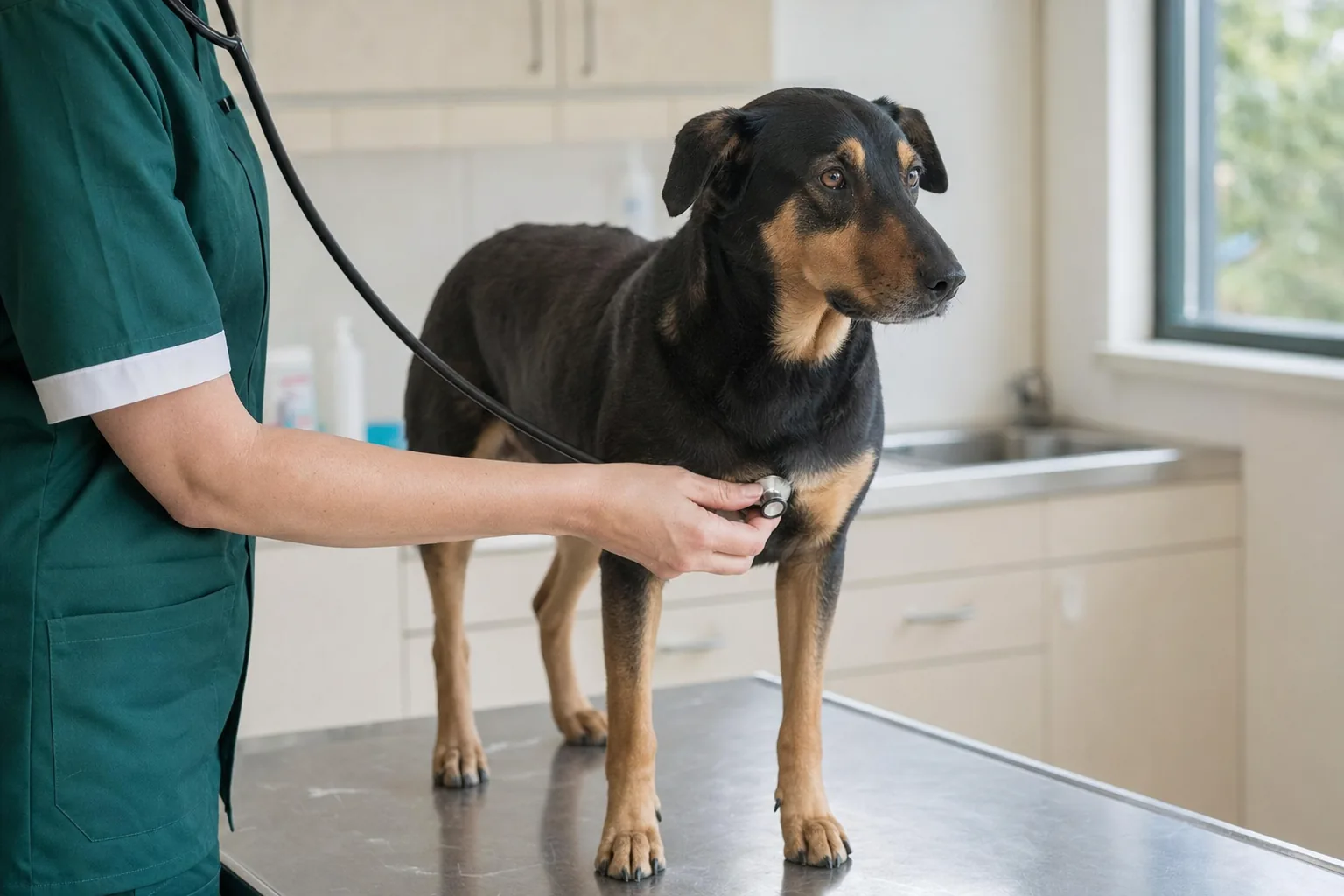
Your dog is ten, spends all day on the sofa and drinks as if he has just run a marathon. He empties the bowl twice before evening. He wakes you at night to go out, and in the last month he has had a few accidents indoors, something that has not happened since he was a puppy. His belly has dropped, his coat has thinned on his flanks, he pants in a cool room and he eats as though you never feed him. Someone told you it is old age. It might be. But that combination has a name vets look for quickly: Cushing's disease. Here is what you can watch for, which tests come next and what not to do at home. The treatment itself is for your vet to decide.
When should you ring the vet today?
Cushing's disease (vets also call it hyperadrenocorticism) means the body makes too much cortisol, the stress hormone, for months and years on end. It comes on slowly, so it is rarely an emergency in itself. A few situations will not wait for next week's appointment, though:
- after a spell of drinking a great deal, he stops drinking altogether or vomits everything he drinks;
- sudden weakness, staggering, unable to get up;
- fast, laboured breathing with visible effort from the belly, especially if it came on suddenly (high cortisol raises the risk of clots in the lungs);
- a belly that swells within hours, with restlessness and retching that brings nothing up;
- he is already on treatment for Cushing's and suddenly goes flat, stops eating, vomits or has diarrhoea. Sometimes treatment pushes cortisol too low, and that is a genuine emergency.
Whatever the situation, ring, say what you are seeing and, if he is on treatment, what he gets and since when.
What to watch and write down at home
The vet makes the diagnosis with tests. With Cushing's, though, tests run on a dog without the right signs can mislead. So what you notice matters more than usual: it tells the vet whether testing is worth doing.
Water
This is the most useful thing you can do. For three days, use a measuring jug to note how much water goes into the bowl in the morning and how much is left in the evening, plus everything you top up during the day. A healthy dog drinks around 50 ml per kilo per day. That shifts with the weather, exercise and diet (a dog on tinned food drinks less). Over 100 ml per kilo per day is clearly too much and worth discussing, whatever the cause.
Urine
How often he goes, whether he wakes you at night, whether accidents have started indoors. The urine is very pale, almost like water.
Food
He begs at the table and steals whatever he can. Many owners take it as a sign of good health: "at least he's eating well".
His body
A dropped, pear-shaped belly with wasted muscle along the back and thighs. Hair thinning evenly on both flanks and not growing back after clipping. Thin skin through which you can see blood vessels, bruises that appear easily, small hard white crusts in the skin. Skin or urinary infections that keep coming back.
Panting
At rest, in a cool room, for no reason. Note when it happens and how long it lasts.
Energy
He tires quickly on walks, no longer jumps into the car or onto the bed. Easily mistaken for arthritis.
Past treatments
If he has had steroid anti-inflammatories for a long time, like the ones given for allergies and itching (tablets, injections, even some creams or drops), tell the vet. There is a form of Cushing's caused by the treatment itself.
What else it can look like
| What you see |
Cushing's |
Other common causes |
| Drinking and weeing a lot |
Yes, almost always |
Diabetes, kidney disease, urinary infection, womb infection in unspayed bitches, high blood calcium |
| Eating a lot |
Yes |
Diabetes, some medications |
| Pot belly |
Yes |
Extra weight, fluid in the abdomen, enlarged liver |
| Symmetrical hair loss |
Yes |
Underactive thyroid, breed-specific hair loss |
| Panting at rest |
Yes |
Pain, heart or lung disease, heat |
Diabetes or a womb infection are often more urgent than Cushing's. That is exactly why a dog who is drinking a lot does not get put off until next week.
Take a morning urine sample to the appointment, the first of the day, in a clean container. And your water diary.
What will the vet check?
Diagnosing Cushing's happens in stages, and it often takes a few visits.
- A physical exam and your account. Skin, coat, belly, muscles, weight, and blood pressure, which high cortisol pushes up.
- Routine tests: a full blood count, blood biochemistry and a urine test. In Cushing's, some liver values are often raised, cholesterol is high and the urine is very dilute and sometimes infected. These tests do not make the diagnosis. They show whether it is worth going further and rule out diabetes and kidney disease.
- Hormone tests, which measure cortisol under controlled conditions. In one, blood is taken before and after an injection that stimulates the adrenal glands. In another, samples taken over several hours show whether cortisol falls as it should after an injection. There is also a urine cortisol to creatinine ratio: a normal result makes Cushing's unlikely, but a raised one does not confirm it. These tests are only done on dogs with the right signs, because stress and other illnesses can produce false positives.
- An abdominal ultrasound, which shows the adrenal glands. Most cases, around 80 to 85%, start with a small, usually benign tumour in the pituitary, the gland at the base of the brain, which drives both adrenals. The rest start with a tumour in one adrenal gland. The difference matters for treatment.
- Treatment. For the pituitary form, usually lifelong medication that reduces cortisol production, with frequent check-up tests at first and then every few months. For an adrenal tumour, sometimes surgery. For the form caused by steroid treatment, the old treatment is tapered off gradually to the vet's plan. Which product and how much is the vet's decision alone.
- Follow-up. Thirst and appetite settle first, often within a few weeks. Coat and muscle come back over months.
Before you leave, ask which signs mean the dose is too high (stick them on the fridge), when the first check-up test is and what to do if he vomits.
What not to do at home
- Do not cut back his water to stop the accidents. He drinks a lot because he is losing a lot of water in his urine. Without water he dehydrates within hours. Take him out more often, put puppy pads by the door, and keep the bowl full.
- Do not stop a long-term steroid on your own because you read that it causes Cushing's. Stopping suddenly can be dangerous. Talk to the vet who prescribed it.
- Do not buy "adrenal support" supplements or teas that promise to balance hormones. There is no evidence behind them, and some interfere with test results.
- Do not keep him hungry because he begs all the time. Hunger is a sign of the disease and eases with treatment. What you can do is split his ration into more meals and feed it from toys he has to work at.
- Do not tell him off for accidents. He cannot control them. An extra short walk late in the evening and one early in the morning help more than any telling-off.
- Do not repeat tests at another practice without saying what has already been done. And do not put such a typical cluster of signs down to age. The diagnosis needs patience and one vet who sees the whole picture.
- Do not push him hard in the heat. Dogs with Cushing's pant more and have weaker muscles.
After the diagnosis
A dog with Cushing's who is treated and monitored can live comfortably for years. Walks carry on, matched to his muscles. Nose games suit him precisely because they need no strength: food hidden around the house or in the grass keeps him busy without wearing him out. Keep the diary going, with water drunk, trips outside and appetite. When the numbers come down, the treatment is working, and you will see it before the blood tests do.
The information on this page is educational and does not replace an examination. For full details and a diagnosis, consult your dog's own veterinarian.