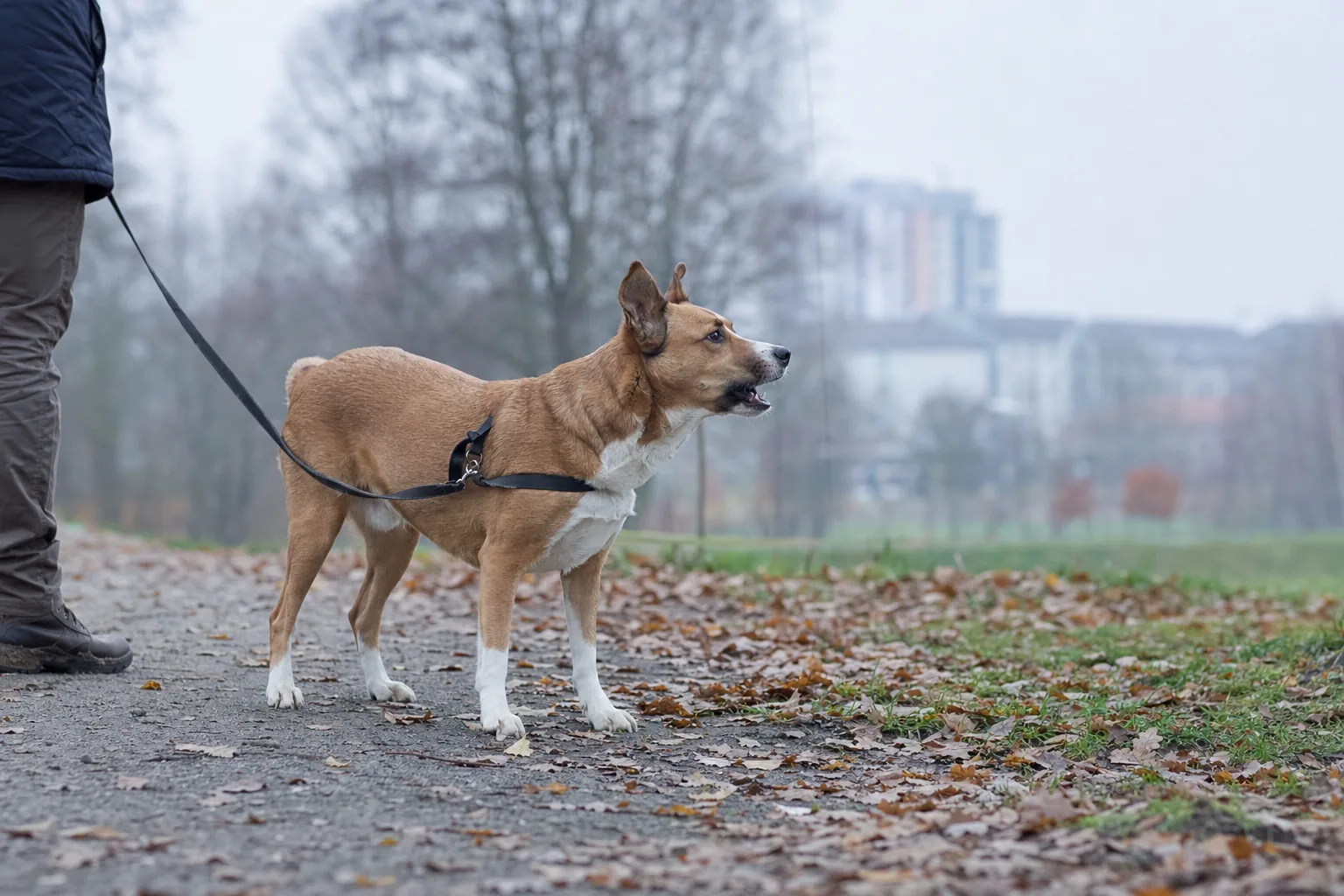
You left for work at a quarter to eight. At ten past, the neighbour downstairs messaged to say he was howling. When you got home the door frame was chewed at muzzle height, there was a puddle of drool on the floor and the dog was shaking, even though you had walked him for a full hour before you left. You have already tried "leaving him to get used to it" and it did not work, which is why you are reading this. Below is how to tell separation anxiety from everything that looks like it, what keeps it going without you noticing, and the plan that does work. It is slow. At the start you count in seconds.
Why can't he cope with being left?
Dogs are built to live in a group, and for some of them a door closing behind you is plain fear. Separation anxiety is panic at the absence of one particular person, or of anyone at all. Revenge does not come into it: the damage at the door gets him nothing, it happens because he cannot stop himself.
To find out whether this is what you have, you need one piece of kit: a camera. An old phone on a shelf with a video call open to your own phone, or a cheap home camera. Leave as you normally would and watch the first 20 to 30 minutes. You are looking for:
- whining, barking or howling that starts within minutes and only breaks for short pauses;
- pacing from the door to the window and back, never settling;
- scratching and chewing at the door, the frame, the window, in other words the place you left through, rather than the shoe lying in the middle of the room;
- heavy drooling and open-mouthed panting in a room at 20 degrees;
- wee or poo from a dog who has been clean for years;
- food left untouched until you get back, including the stuffed toy he empties in ten minutes when you are home.
Two or three of those, starting almost as soon as the door shuts, and you have your answer. If instead he sleeps for 40 minutes and only then starts on the table legs, you have a different answer: boredom. There is a separate page for that.
Where it starts, from what we see in the dogs who come to training and from the literature:
A change of routine. You worked from home for months and now you are gone nine hours. Or you moved house, someone left the family, the dog changed homes. Shelter dogs and dogs adopted as adults often arrive with this already in place.
A puppy who was never alone. Nobody left him for five minutes in his first months, because somebody was always in. Your first day back at the office was his first day alone. Eight hours of it.
A fright while you were out. Fireworks, a car alarm under the window, a neighbour hammering on the door. He tied the terror to your absence, and from then on your leaving means danger is on its way.
Age. Old dogs find being alone harder as hearing and sight fade, and sometimes as cognitive decline sets in. A dog who stayed home calmly for ten years and starts howling at eleven needs the vet before he needs a plan.
Some things look the same and are not. The dog who cannot bear the crate or the room you shut him in, but is fine loose in the house: fear of confinement, not of your absence. The dog who barks at footsteps on the stairs: alarm barking, fixed by moving his bed away from the front door. The four-month-old who cannot hold his bladder for five hours: house training. The footage separates them all.
What doesn't work (and why it looks like it does)
Telling him off when you get in. You walk in, see the chewed frame and a dog "looking guilty": ears flat, eyes to the side, tail down. Guilt it is not. It is appeasement: he has learnt that your return plus a wrecked object means trouble. Studies set up around exactly this scene found the same face on dogs who had wrecked nothing, as long as the owner walked in angry. The telling-off adds one more reason to dread the door.
The crate as the answer. For a dog in a panic, a small space makes everything worse: we see teeth broken on bars, bleeding gums, nails torn out. A crate helps dogs who already love it and walk in by themselves. For the rest, take it out of the plan.
"Let him cry it out." Trainers call it flooding: you leave him facing the fear until he wears out. It does not do to a frightened dog what it does to a spoilt child. He does not get used to it, he gets exhausted, and the next day he starts from the same level of fear or a higher one. Every absence longer than he can bear is one more rehearsal of panic.
A second dog. If the fear is about you being gone, another dog does not stand in for you. You now have two dogs, and one is learning from the other that a closed door is a crisis. It works rarely, and only when the real problem was social loneliness.
A toy at the door, and nothing else. A stuffed toy left as you go helps in mild cases. A panicking dog will not touch food; if you see that on camera, you have been gone longer than he can take, and no toy replaces the plan.
The plan, step by step
The plan has one rule without which the rest does not exist: while you work on this, the dog is never left alone for longer than he can stay calm. Otherwise the morning's exercise is wiped out by the lunchtime absence.
1. Stop the absences that throw him into panic
For weeks, sometimes two or three months, someone is with him when you are not: a family member, a retired neighbour, a friend on the opposite shift, doggy day care, a pet sitter. Take him with you wherever you can. This is the hardest part of the plan, in time and in organisation, and it is the one everyone skips. Without it nothing that follows works.
2. Film him and find out how long he lasts
You are after the length of time for which he is still calm: lying down, watching the door, sighing, maybe one whine and then quiet. For some dogs that is ten minutes. For others it is three seconds with the door shut. Three seconds is as good a starting point as any; write it down.
3. Short departures, while he is still calm
Five or six repetitions per session, one or two sessions a day, a few minutes' break between them. Step out, shut the door, count (in the first days perhaps only to three), come back in without a word and get on with something. Nothing is handed over when you return; his reward is that you came back and nothing happened. The duration grows unevenly: 3, 5, 4, 8, 3, 10 seconds. If on one repetition he gets up and comes to the door agitated, the next two are shorter. You work like this for a few weeks, then you reach minutes. The half-hour mark is the hard part. After it the time usually stretches faster.
4. Independence while you are home
A dog who follows you to the bathroom has to learn to be on his own while you are in the house too. A bed or a mat of his own, in the spot where he will be staying; a tasty bit dropped onto it when he lies there by himself; you getting up, going into another room, coming back. The bathroom door shut for two minutes. No drama, dozens of times a day, in between chores.
5. The leaving cues, emptied of meaning
Keys, coat, shoes, bag, rucksack. He knows them all and shakes at the sight of them. You take the sting out by making them ordinary: pick up the keys and sit down in front of the telly; put your shoes on and do the washing-up; put your coat on and take the bins out, back within 30 seconds. Two or three cues a day, day after day, until he no longer lifts his head.
6. Body, mind and the vet
Before departures, a 30 to 40 minute sniffing walk on a long line, where he chooses where his nose goes. Food from toys and from searches around the house, not from a bowl. And if on camera he panics within seconds or hurts himself, talk to your vet about medication. Medication does not stand in for the plan; it brings the fear down far enough for him to learn. Of the severe cases we have seen come right, most did the plan with medical support, decided by the vet.
What the first week looks like
| Day |
What you do |
| 1 |
Camera up, one normal departure filmed. Watch the first 30 minutes and note when he breaks. |
| 2 |
Sort out who stays with him. Until then, he comes with you. Start the mat work indoors. |
| 3–4 |
First door sessions: 5 to 6 repetitions of a few seconds, while he is still calm. Leaving cues twice a day, without leaving. |
| 5–6 |
Same sessions, mixed durations. Sniffing walk in the morning. Food from toys. |
| 7 |
Film one longer repetition and compare with day 1. Decide whether you need a professional or a vet visit. |
When it's a medical problem
Panic at being left does not usually have a medical cause, but a few things are ruled out before the plan, because the plan will not work over the top of them:
- pain (joints, teeth, ears): a dog who hurts copes worse with any stress, being alone included;
- failing hearing or sight in older dogs, who no longer understand where you went;
- cognitive decline: disorientation, aimless pacing, crying at night, getting stuck in corners;
- urinary or digestive trouble, when "he wees while I'm out" is in fact an infection or diarrhoea;
- a recently started treatment with restlessness as a side effect.
Take the footage and the diary to your vet. With them the consultation is far shorter than with "he cries when I leave".
How scent work helps
Scent work does not cure separation anxiety. It does two useful things alongside the plan. A dog who has hunted for food around the house for a quarter of an hour, or walked a trail for 40 minutes, is calmer for the hours that follow, and departures practised after a session like that start from a dog with a low pulse. In the longer run, dogs who work with their nose gain confidence: on the trail the dog decides and the person follows, and insecure dogs change visibly within months. At our training sessions we see dogs who arrived with all sorts of fears and who, a season later, wait alone in the car while their person lays a trail. At the start that would have been unthinkable. There is more in our article on anxious and reactive dogs.
When to call a professional
- he injures himself: broken teeth, bleeding nails, wounds on the muzzle from the door or the bars;
- the panic starts within seconds and you cannot find any length of time, however short, for which he stays calm;
- a month of consistent work has gone by and the duration has not grown at all;
- you cannot stop the absences and need a plan built around your hours;
- other fears appear too (noises, strangers), or he growls as you leave.
A behaviour professional works with you on your footage and adjusts the durations week by week. This is one of the few problems where an online session is as good as a home visit: nobody unfamiliar should be in the house when you walk out anyway.
A behaviour that appears suddenly or changes for no apparent reason can have a medical cause. For full details, consult your dog's own veterinarian.