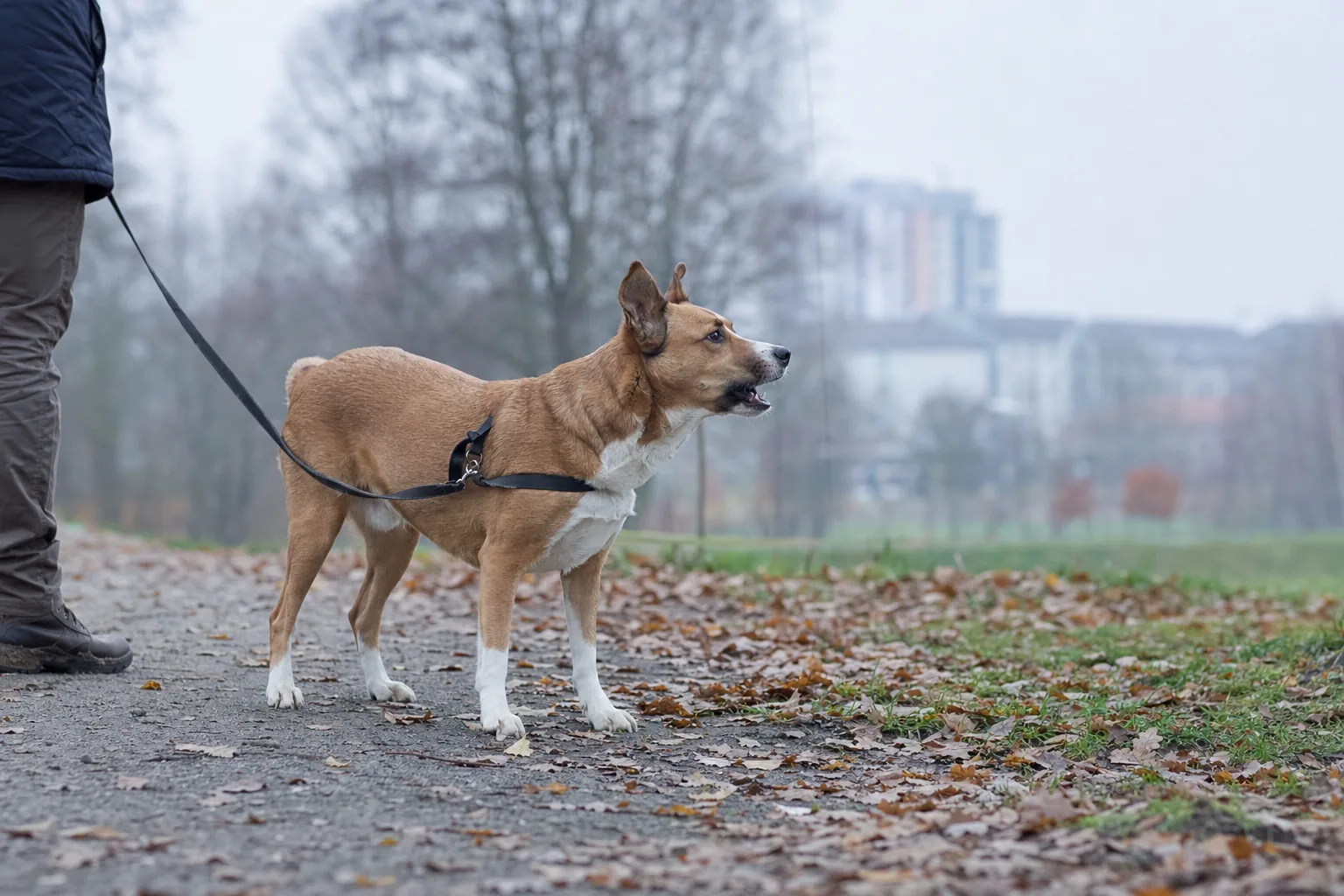
One dog is perched on the sofa with his nose against a second-floor window, barking at everyone who walks past on the pavement. Another starts barking two minutes after you shut the front door, and the neighbours can still hear him two hours later. A third, an eight-month-old puppy, plants himself in front of you and barks until you throw the ball. Same noise, three different problems. Below you'll work out which one you've got and what to do about it, starting tomorrow.
Why does my dog bark so much?
For a dog, barking is the easiest way to say something. It costs him no effort, and nearly every time, something happens afterwards. To bring it down you need to know what follows the barking in your house. For three days, write down every episode, on paper or on your phone: the time, where the dog was, what he was looking at, what you did and how long it went on. By day three the pattern shows, and it will almost certainly fit one of the situations below.
Alarm and territory. He barks at the window, the fence, the doorbell, footsteps on the stairs. He leans forward, tail up, with short, repeated barks. Here's the part that fools you: the passer-by was leaving anyway, but the dog learns that they left because he barked. Every person who walks past proves him right again.
Demand. He barks at you, for food, play, the door or attention. He stares you straight in the eye and keeps going, with pauses to see what you'll do. You taught him this, without meaning to, on the day you gave in at the thirteenth bark. Once in thirteen is enough. When barking only works now and then, the dog learns never to give up, and that's where the stubbornness comes from.
Boredom and spare energy. Take a young, medium-sized dog who spends nine hours alone in a flat and gets two fifteen-minute walks a day on tarmac. He's going to bark. At what? At anything. It's a monotonous bark with whining in between, and it comes mostly in the long hours when nothing happens. At our training sessions we often meet dogs brought along "because they bark" who, after a proper trail, don't make another sound all evening.
Fear. He barks at things that scare him: people in hats, big dogs, the hoover, thunder. His body pulls back, tail low or tucked, ears flat, and the bark is higher and mixed with growling. This bark means "go away". When the scary thing does go away, the dog learns once more that this is how it works.
Being left alone. It starts a few minutes after you leave and can go on for hours, with howling, whining, sometimes chewing and wees in the house. It's panic, and ordinary training won't fix it; it's not spite either. If you suspect this, leave your phone filming when you go out and watch the first 20 minutes.
Lead frustration. He sees a dog or a person, wants to get to them, the lead holds him back and all that tension comes out of his mouth. Off lead in the park, you'd never hear him.
Play and excitement. He barks when you run, when you pick up the lead, when visitors arrive. Short barks, loose and bouncy body. This one is the easiest to bring down, because it settles by itself as the excitement around him settles.
Pain, age, hearing. A dog who never barked at night and starts at ten, one who barks while staring blankly at the wall, one who barks at sounds he used to ignore: all of them need the vet before the trainer. In older dogs, an ageing brain (vets call it cognitive decline) and fading hearing often show up as barking at nothing in particular.
Most of the time you'll find a mix: boredom on top of alarm, lead frustration on top of fear. Deal with the biggest piece first.
What doesn't work, even when it looks like it does
Shouting. When you raise your voice while he's barking, from where he's standing you're barking too. It tells him there really was something worth barking at. In the moment he stops, because you startled him. Over time he barks just as much, only now he keeps an eye on you as well.
Anti-bark collars. Citronella spray, vibration or electric shock, they all stop the sound through discomfort and leave the reason untouched. For a dog who barks out of fear, they add one more fright exactly when he's looking at the thing he's afraid of. Some dogs learn to bark until the spray runs out. Shock collars are banned in Germany, Austria, the Netherlands, Scotland and Wales. We don't use them and we don't recommend them.
"Leave him, he'll get used to it." A dog who barks at the window eight hours a day doesn't get used to passers-by. He gets practice. Every day adds more repetitions.
Telling him off later. You come home, the neighbour complains, you scold the dog. He links the scolding to you walking through the door; the barking three hours ago has nothing to do with it as far as he's concerned. You end up with a dog who hides when you come in and barks just as much when you leave.
Running, and only running. Exercise helps a lot with boredom barking. A dog who only ever gets running, though, turns into a bored athlete. The nose tires faster than the legs.
Stroking him when he barks out of fear. Fear doesn't grow because you comfort him; an emotion isn't fed by a stroke. It doesn't help either, because the hat that frightens him is still there. Moving further away helps far more.
The plan, step by step
There are four parts to the plan, all done alongside each other. If you only do one, you usually won't see much.
1. Hide what sets him off
This is the step most people skip because it looks too simple. It's also the one that works from day one.
- At the window: frosted film on the bottom half of the glass, blinds down when you're out, or the furniture moved so he can't get onto the sill. If he can't see the passer-by, he has nothing to bark at.
- For noises: a radio or a fan on when you go out, to cover footsteps on the stairs and the neighbours' doors.
- For the doorbell: until you've worked on it, ask people to ring your phone instead.
- Out on the street: a different route and a different time of day while you work on how he reacts to dogs and people. Fewer encounters, fewer barking sessions.
None of this solves the problem. It stops the daily practice and gives you some peace to work on the rest.
2. Give him a job, mostly for his nose
Boredom barking drops when the boredom does. A healthy, medium-sized adult dog needs at least an hour a day when he's using his head as well as his legs.
- Meals stop coming in a bowl. Scatter them round the house, stuff them into toys, roll them in a towel, hide them in cardboard boxes. Ten minutes of hunting for his food tires him more than ten minutes of walking.
- The morning walk becomes a sniffing walk: a 5-metre long line, and the dog chooses where he goes and how long he keeps his nose in the grass. You keep quiet and follow.
- A search game indoors: hold him by the harness, toss a few bits of food into a room and let him go with "find it". Make it a bit harder every week.
- If it appeals, a nose sport done properly. In mantrailing the dog follows the trail of a person, and dogs who bark at home all day go home from training calm for the rest of it. What tires them is 40 minutes of working with their head without a break, more than any amount of running.
3. Quiet earns good things, barking earns nothing
Dogs pick up the new rule quickly, as long as you stick to it.
Demand barking. It no longer gets him anything: no food, no open door, no look, no "no!". You turn your back. The moment he goes quiet, even for a second, you turn round and give him what he wanted, if it's reasonable. The first few days are noisier, because he tries harder with what used to work. After a week in which you haven't given in once, the pauses get longer. Give in once and you're back to the start.
Alarm barking. When he barks at the window, don't tell him off. Say "thank you" or "I've seen it" calmly, go to the window, have a look yourself for two seconds, then call him over. When he comes, praise him and give him something tasty. He raised the alarm, you checked it, done, he can come away. After two or three weeks he'll bark once and look at you.
"Quiet" as an exercise. Wait for a pause when he's stopped on his own, say "quiet", count to two, then give him a treat and a warm word. Stretch the pause by a second a day. The word only starts meaning something after you've said it a few dozen times over a silence that was already there. Shouted in the middle of the barking, it's just more noise to him.
4. Work on the emotion, if that's where it comes from
With fear and lead frustration, the first three steps aren't enough. Here you work with distance. Find the distance at which the dog can see what worries him and can still eat and look at you. From there, every time that thing appears, something really good appears from you. Over a few weeks the distance shrinks. If you've taken him too close and he barks, you got the distance wrong, not him; back off and start again from further away. We have separate guides on reactivity and on fear in general.
Barking when left alone needs a different plan, and a long one: absences of a few seconds, stretched out bit by bit, no departure rituals, the camera running so you can see where he cracks. If he panics within the first few minutes, get help from a behaviour specialist and talk to your vet as well; in some cases medication is what makes the plan possible.
The first week
| Day |
What you do |
| 1–3 |
The barking diary. Film on the window. Meals from toys, not the bowl. |
| 2 |
First sniffing walk, 30 minutes, on the long line, no commands. |
| 3 |
Start the "demand barking gets nothing" rule, the same for everyone in the house. |
| 4–7 |
"Thank you, I've seen it" at the window. The "quiet" exercise 10 times a day, in the pauses when he's stopped on his own. |
| 7 |
Read the diary back: what's dropped, what's left. Decide from there whether you move on to step 4 or call in a specialist. |
When there's a medical problem behind it
Barking on its own doesn't mean a dog is ill. In a few situations, though, you see the vet before any plan:
- an adult dog who never used to bark suddenly starts;
- a dog over 8 or 9 barks at night, especially if he stares into space, wanders aimlessly or gets "stuck" in corners;
- he barks at sounds he used to ignore or, the other way round, no longer reacts when you call his name (hearing);
- the barking comes with panting, restlessness and a dog who can't get comfortable lying down (pain);
- it started after a change of medication.
Show your own vet exactly what's in the diary: the time, the context, how long it lasted. A written-down pattern helps them far more than "he barks a lot".
How nose work helps
We see it again and again at training: dogs who arrive at mantrailing with a reputation for barking at everything work the trail without a sound. On a trail the dog is completely taken up with a job that uses his strongest sense, and after 30–40 minutes with his nose to the ground, all he wants at home is to sleep. Search games indoors do the same on a smaller scale. If you have a young, healthy dog who barks out of boredom, put his nose to work before you go looking for other answers. We've also written about this in our article on anxious and reactive dogs.
When to call in a specialist
- the dog has bitten or tried to bite, whatever the situation;
- fear barking hasn't dropped after four weeks of distance work;
- you suspect panic when he's left alone (chewed door, drooling, wees, howling in the first few minutes);
- he barks at family members while growling, with a stiff body;
- you've done steps 1–3 without slipping for three weeks and the diary shows no drop at all.
At an assessment session we start from your dog and your diary, not from a recipe. Afterwards you'll know whether you need a behaviour programme or just a few changes at home.
A behaviour that appears suddenly or changes for no apparent reason can have a medical cause. For full details, consult your dog's own veterinarian.