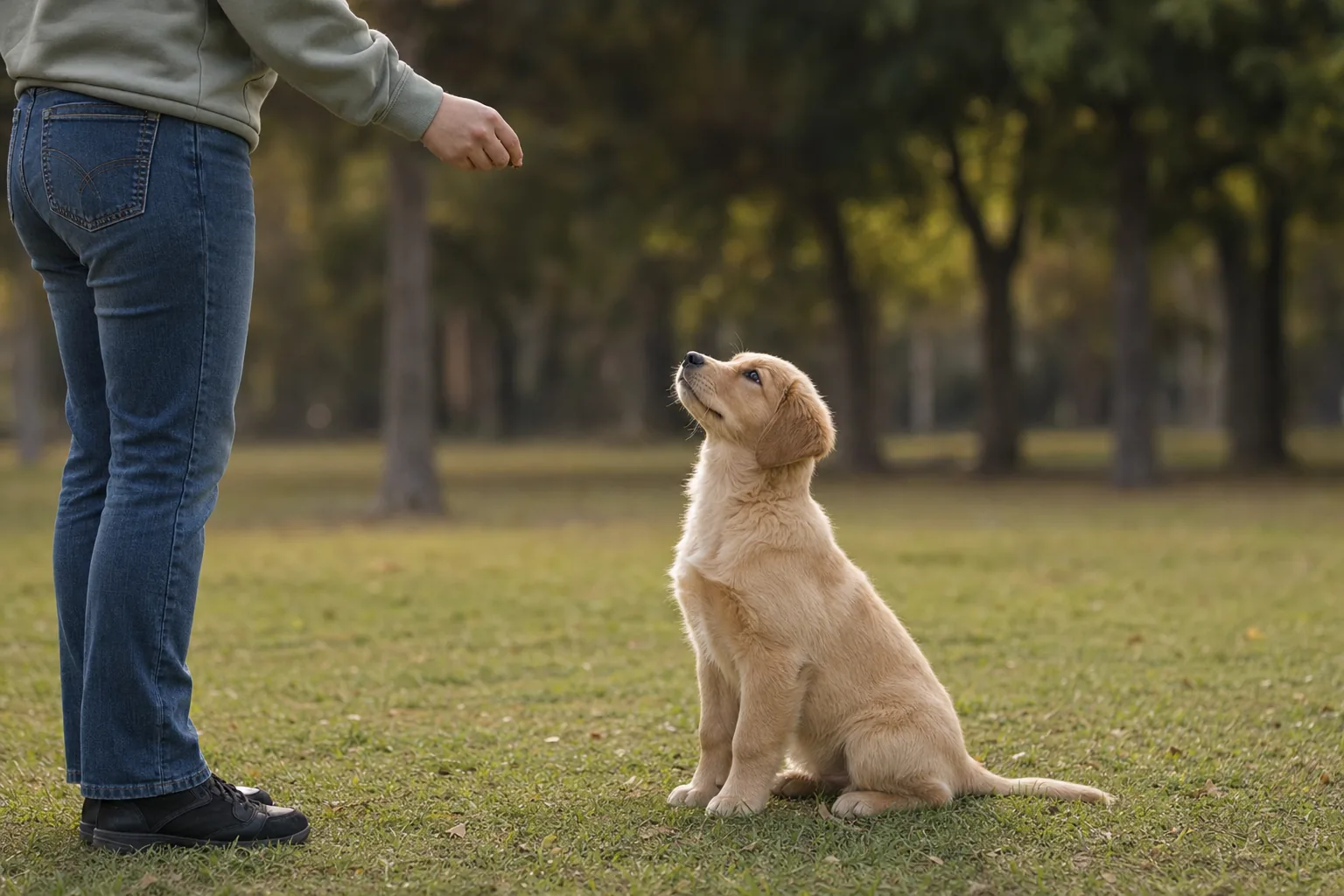
Over dinner, your child asks how old your six-year-old dog is "in people years", and you say 42, because that is what you were taught. Or you have adopted a rescue described as "about 3 to 5" and you wonder how much that range is worth. Or you have a nine-year-old Labrador and, without saying it out loud, you are counting how many years you have left together. They are all fair questions. The answers have changed a good deal in recent years, since studies covering hundreds of thousands of dogs came out. Below is how to work out his age, how long dogs of different sizes usually live, and what to change at each stage of his life.
Working out your dog's age, step by step
1. Forget "one dog year equals seven human years"
It is easy to remember and wrong at both ends. At one year old a dog is sexually mature, can have puppies and already has his adult teeth, so he is closer to a person of 15–20 than to a child of 7. At the other end, the rule ignores size. A nine-year-old Great Dane is very old, while a nine-year-old Chihuahua is an adult in his prime.
2. Go by size
Vets usually use a rough calculation. The dog's first year counts as about 15 human years, the second as another 9 or so (so at two he is about 24), and after that each year adds between 4 and 7 human years, depending on size. Small dogs age more slowly, large and giant dogs faster.
| Dog's age |
Small (under 10 kg) |
Medium (10–25 kg) |
Large (25–45 kg) |
Giant (over 45 kg) |
| 1 year |
15 |
15 |
15 |
12–15 |
| 2 years |
24 |
24 |
24 |
22–24 |
| 5 years |
36 |
36 |
36 |
45 |
| 8 years |
48 |
51 |
55 |
64 |
| 10 years |
56 |
60 |
66 |
79 |
| 12 years |
64 |
69 |
77 |
93 |
| 15 years |
76 |
83 |
93 |
Rarely get there |
The figures are approximate. They are good enough to explain to a child why the eight-year-old dog "has gone grey", and to remind you that a large eight-year-old dog already needs senior check-ups.
3. The clock in the DNA
In 2020, American researchers compared how DNA changes with age in Labradors and in people. Their formula says a one-year-old Labrador matches a person of about 30, a four-year-old a person of 53, and a ten-year-old a person of 68. The interesting part is the pace: puppies age very fast in their first year, then everything slows right down. The formula was built on Labradors only, so do not apply it to other breeds.
4. How old is a rescue dog when nobody knows?
In puppies, the teeth give the age almost exactly. Milk teeth come through at around 3–4 weeks, and the adult teeth replace them between 3 and 7 months: first the front incisors, then the canines, then the back teeth. A dog with a full set of adult teeth, white and showing no wear, is probably under two.
In adults, the estimate is broader. The vet looks at tartar, how worn the tips of the incisors are, the eyes (the lens takes on a bluish haze, usually after 6–8 years), the muscles and the white hair on the muzzle. The grey muzzle fools people most often, because some dogs go grey at three, from stress or genetics. The vet will give you a range, and for an adult dog a range of 3–4 years is an honest answer. If you need more precision, X-rays help in young dogs, where you can see the zones in which the bones are still growing.
Life stages and what changes at each
American veterinary guidelines split a dog's life into stages, with boundaries that depend on size.
Puppy (birth to 6–9 months). He grows fast and learns faster than at any other stage. This is also the socialisation period, up to around 12–14 weeks, when he gets used to the world easily. What matters now: vaccinations and worming on time, a puppy food that suits his size (large-breed puppies need food made for their growth, so the bones do not grow too fast), short play sessions, lots of new things met calmly and plenty of sleep, 18–20 hours a day.
Adolescent (6 months to 18–24 months). His body looks grown up; his brain is not there yet. He seems to have forgotten everything he knew, pushes at limits and goes through another phase of startling more easily. In large breeds the growth plates only close at around 12–18 months, so long runs beside a bike and repeated jumping can wait. It is also the time to talk to your vet about neutering and the right age for it.
Young and mature adult (from 2 years to around 7–10). The longest and quietest stage. A yearly check-up, vaccinations, worming, his weight kept in check, his teeth. This is when the big things get built: sports, long walks, nose work. An adult dog who uses his brain every day is usually a calm dog.
Senior (the last quarter of his expected life). In small dogs it starts at around 10–11, in medium dogs around 9, in large dogs around 7–8, and in giants as early as 6. Check-ups go up to twice a year, with blood and urine tests, because many diseases (kidney, liver, thyroid, heart) show up in the results before you can see them in the dog. Walks get shorter and more frequent, with more sniffing and less running. His food is adjusted to his weight and his test results. The "senior" label on the bag is not a reason on its own.
End of life. There is no fixed age. What counts is what his days are like: whether he still eats with interest, still enjoys something, can still move without much pain. Your vet can help with scales that track these things from one week to the next.
The mistakes we see most
"He's just old." The most dangerous sentence in a senior dog's life. Limping, heavy thirst, barking at night, weight loss and laboured breathing usually have a cause that can be treated or at least eased. Age is not a diagnosis.
One calculation for every size. An eight-year-old German Shepherd and an eight-year-old Bichon are at different stages of life. In large dogs, senior check-ups start earlier.
Adult exercise for a big puppy. Long runs on tarmac, lots of stairs, jumping out of the boot for a six-month-old large-breed puppy. His joints are still growing.
The extra kilos. A well-known study on Labradors followed pairs of littermates for their whole lives. The ones fed a quarter less and kept lean lived on average almost two years longer and developed arthritis later. It is the simplest thing you can do for how long your dog lives.
Forgotten teeth. Dental and gum disease is among the commonest problems in adult dogs. In old dogs it leads to poor eating and to pain they put up with in silence.
Stopping training in old age. "You can't teach an old dog new tricks" is false. He learns more slowly, but he learns, and short nose-work sessions keep his mind sharp. In our tracking sessions we have dogs of 10 or 11 on short trails, and they are among the happiest dogs out there.
How long do dogs live?
The largest study so far, published in the UK in 2024, followed more than half a million dogs and found an average life expectancy of about 12.5 years. The average hides big differences:
| Type of dog |
Typical lifespan |
| Small, long-nosed breeds (small terriers, Tibetan Spaniels, Bichons) |
13–15 years, sometimes more |
| Medium (Beagle, Border Collie, medium-sized crossbreeds) |
12–14 years |
| Large (Labrador, German Shepherd, Golden Retriever) |
10–13 years |
| Giant breeds (Great Dane, Mastiff, St Bernard) |
7–10 years |
| Very flat-faced breeds (French Bulldog, English Bulldog, Pug) |
Often around 10 years, even when small |
Females live slightly longer than males on average. Crossbreeds do not automatically outlive purebreds. Size, face shape and the parents' health count for more.
What is down to you: his weight (most of all), his teeth, vaccinations and worming, senior check-ups, daily exercise that suits his age, a home where poisons are out of reach, and a lead near roads. You cannot choose a rescue dog's genes. Everything else you can.
When to ask the vet about age
- he has reached the senior stage for his size and has not yet had a check-up with blood and urine tests;
- you have adopted a dog of unknown age and want an estimate, plus a plan for vaccinations and check-ups;
- an old dog has changed within a week: drinking a lot, losing weight, wandering round the house, no longer managing the stairs;
- you want to know the right time to neuter, especially in large breeds;
- you want to start a sport with a young large-breed dog and are not sure his joints are ready.
A trainer can help with the exercise and play side: what he can do at his age, how to adapt walks and games, and how to keep his mind busy as his body starts to slow down.